Here Comes the Bride
In time, overcoming our vanities brings real, hard-won happiness, even if it’s bittersweet.
19 After this I heard what sounded like the roar of a great multitude in heaven shouting: “Hallelujah! Salvation and glory and power belong to our God, 2 for true and just are his judgments. He has condemned the great prostitute who corrupted the earth by her adulteries. He has avenged on her the blood of his servants.” 3 And again they shouted: “Hallelujah! The smoke from her goes up for ever and ever.”
The multitude in heaven represent our possibilities, or the people we could be, now that we have the reins firmly in our hands. We have suffered, but now God has shown us the purpose behind that suffering. We have been led to a brighter future, by the rough road we have traveled down. This perspective is only achievable by climbing mountains. Those who have looked on the world from a summit, will gladly tell you it was worth all the hardships.
4 The twenty-four elders and the four living creatures fell down and worshiped God, who was seated on the throne. And they cried: “Amen, Hallelujah!”
Remember that it’s us who is on the throne, and that worship is simply an application of admiration. In this case, those who have traveled this road before us, are confirming that we have done well. The four living creatures, who represent the nations of Monarchy, Theocracy, Democracy and Anarchy, fall down, but not because they are tripping over our wings. The symbolism of us being above them, on a throne, means that we are controlling them, not the other way around. The same goes for the elders. We are applying the lessons that others have learned, to our life, and it’s paying off.
5 Then a voice came from the throne, saying: “Praise our God, all you his servants, you who fear him, both great and small!” 6 Then I heard what sounded like a great multitude, like the roar of rushing waters and like loud peals of thunder, shouting: “Hallelujah! For our Lord God Almighty reigns. 7 Let us rejoice and be glad and give him glory! For the wedding of the Lamb has come, and his bride has made herself ready. 8 Fine linen, bright and clean, was given her to wear.”
(Fine linen stands for the righteous acts of God’s holy people.)
The doom of Babylon is akin to putting away childish things. In order to be wed, the children of God need to grow up. Marriage is not something to be taken lightly. It’s a big responsibility. Our groom has tried and tested us, to ensure our commitment is strong. He has walked and talked with us, to see if we are capable of the elegance and eloquence that is required of a visitor in the House of the Lord. The rushing water and peals of thunder are the philosophies and epiphanies that have led us to this moment. They signal that we are ready.
Linen is durable, and breathable. It is perfect for summer, and warm weather. It is not as fine as silk, but we are not a princess. We are a working woman. Linen is made from flax, which grows in temperate climates. There is a distinction between it, and cotton, and wool and fur, which eludes me, at the moment. Each has a symbolic meaning that I cannot get my head around, just yet. The point, I think, is that for a simple woman, with simple tastes, who lives in a moderate climate, linen is the most preferable of materials. After all, a Son of Man must know how to dress on her wedding day.
9 Then the angel said to me, “Write this: Blessed are those who are invited to the wedding supper of the Lamb!” And he added, “These are the true words of God.”
Blessed is defined as being divinely favored, holy, or profoundly happy. It often signifies spiritual prosperity or fortunate circumstances. After everything we’ve been through, it’s difficult to feel fortunate or favored. It’s easy to wonder why God would put us through so much, if He truly loves us. Even knowing that hardship builds character, and that two gifts are better than one, gives us little consolation when our feet are being held to the fire. But it’s true that time heals all wounds, and God is the Master of Time.
Painful moments become medals on our chest, over time. We look back fondly on our struggles, and brag about them to our friends. So will it be in Heaven, when all of the pain of this world is safely behind us. I know that it’s hard to believe, but even the suffering we inflict on each other will serve to bind us closer together. We are one. We are the offspring of Adam. All of our wounds are self-inflicted, because we are destined to join with the angels, and become one with God, again. I say again, even though we have always been a part of Him. His distance from us is an illusion. He is omnipresent. He has never left us, and even when we turn our backs on Him, He is still there, in front of us.
The guest list for our wedding supper is all-inclusive. It is dinner for two. It is a meal made of memories, and memories are a dish best served cold.
10 At this I fell at his feet to worship him. But he said to me, “Don’t do that! I am a fellow servant with you and with your brothers and sisters who hold to the testimony of Jesus. Worship God! For it is the Spirit of prophecy who bears testimony to Jesus.”
In 1 Corinthians 6:3 Paul asks, “Do you not know that we will judge angels?” To see them clearly, we must take them down from their pedestal, and look on them as equals. Sure, they are different than us, but in the end, we all do God’s will. They are the family of the Groom – the Children of Light. They were divided from Lucifer, just as we were divided from Adam. They are destined to join with us, and become us, even as we become them.
Contrast requires both light and shadow. Three dimensional images require contrast and matter. Without either, the picture is incomplete. Jesus is an angel who was born into the world of matter. He has lived both sides. That is his testimony, that two shall become one, and become complete in each other. He provides us with a proof of concept. He is a promise of our future. That is why it is the Spirit of prophecy that bears testimony to him. Prophecy is a foretelling of future events.
The Heavenly Warrior Defeats the Beast
11 I saw heaven standing open and there before me was a white horse, whose rider is called Faithful and True. With justice he judges and wages war.
We are back on our high horse, or at least we will be, only this time we have earned our lofty seat, and will not let our raised perspective go to our heads. Notice that John is still outside of heaven. He is only the prophet, seeing what could be. Like Moses, who saw the promised land, John sees heaven, but cannot get in. The world is not ready, and neither is he.
Before the Israelites could enter the promised land, the generation of Moses had to pass away. They were carrying too much baggage. They were still spiritually blind. That generation was made up of former slaves, and former slave masters. They could not see eye to eye, even if they wanted to. They were essentially cripples, and there are no cripples in heaven. Their children, on the other hand, were raised as neighbors, wandering the same desert.
I do not know how many generations will have to pass, before heaven becomes a place on earth, but it will happen. That’s a promise. We will master this world, and ourselves, because that is the point of all of this.
Prophets and angels and apostles are not worthy of worship. They are just doing their jobs, like the rest of us. It takes all sorts to build a city. Someone has to dream it, while others have to take that dream and make it a reality. There has to be communication between the dreamers and the builders, or the whole project gets out of whack. Sometimes, an intermediary is needed to translate the dreamer’s blueprint into something the builders can understand. In our case, John’s dream was allowed to be misinterpreted, so that we would know confusion, as well as understanding, because the city we are building has its foundations set in contrast.
True justice comes from fully understanding both sides. A good judge has to be a student of contrast. They cannot be afraid to look good and evil squarely in the face. Only then can they see the things they have in common, and the things that set them apart.
Those who seek peace, cannot shy away from war, because without war, there is no such thing as peace. We need the one to lend contrast to the other, and make it significant.
Don’t be fooled by the word war, either. Just because we are destined to become heavenly warriors, that doesn’t give us leeway to physically kill our neighbors, whom we should love as much as we love ourselves. It is my belief that the Israelites were converting the people around them, not committing acts of genocide on them.
12 His eyes are like blazing fire, and on his head are many crowns. He has a name written on him that no one knows but he himself.
When there is a fire in our hearts, its light shines out through our eyes, and changes the way we see the world. The Son of Man has flaming eyes, because of the fire in his heart, and the scrutiny he casts on all things.
When we overcome, we conquer. We become the ruler of the thing we overcame. In this future vision, we have conquered many things.
We cannot define God. Neither can we accurately describe our neighbors, and encompass their entire being. Likewise, no one can tell us who we are, because we have travelled our narrow path alone. Only we fully understand the events and circumstances that made us who we are. Only we are capable of naming ourselves. You might argue that God could name us, because He is omniscient, and you would be partially correct. We are one with God, made in His image, and therefore as indefinable as He is.
13 He is dressed in a robe dipped in blood, and his name is the Word of God.
Recall that the Son of Man is a scholar. That’s why he wears a robe. Being a scholar, we should understand that blood is the transportation network of our bodies. It is an agent of change, and we have definitely changed since this journey began. Blood moves oxygen and nutrients around our bodies, allowing us to live. We take in things from the world, change them, and expel different things back out. We are the living embodiment of revelation.
Blood is supposed to be on the inside of our bodies, not outside staining our robe. This, however, is not our blood. It is the blood of the Lamb, and of others. Our blood-dipped robe is a symbol of our scholarship. We have studied the lives of others, and taken note of their motivations and sacrifices.
When we study the Law, and apply it in every aspect of our lives, we essentially become the Law. The rules become a part of us. We understand them so thoroughly, that we can decide when to use them, and when to set them aside. The word of God is the Law, because His words regulate everything we do. His words are brought to us by angels, our fellow servants. Being named the Word of God, symbolizes our complete synchronization with His plan. We trust Him, because we have come to know Him. We accept that everything that happens is His will, even the things we might have once considered to be bad, or evil.
As we progress on our revelation journey, we come to realize that everything is a gift, and all of this is for our benefit. When our eyes blaze, we see God’s hand moving in the world, and we know that He is with us, and for us. We come to understand that all things are good, when all things are God.
14 The armies of heaven were following him, riding on white horses and dressed in fine linen, white and clean.
In a perfect, peaceful place like heaven, what use is an army? None, really, except as museum pieces. This is a parade, to remind us of the wars we fought to get here. It is also symbolic of our readiness to fight again, and again, to protect the peace we have won. Our army looks good, in their ceremonial finery, but looks can be deceiving. They are battle-hardened, and of the highest caliber.
15 Coming out of his mouth is a sharp sword with which to strike down the nations. “He will rule them with an iron scepter.” He treads the winepress of the fury of the wrath of God Almighty.
When you see the word ‘sword’, think tongue. Then ask yourself why we would strike down the nations? Don’t we want all of our interactions to fly? Not if we want to stay grounded, and we do. This verse represents a grounded perspective. The Heavenly Warrior does not allow himself to get carried away. He does not cling to relationships, or worry over them when they are gone.
Most importantly, he remembers what Jesus told his disciples in Luke 22:25-6:
25Jesus said to them, “The kings of the Gentiles lord it over them; and those who exercise authority over them call themselves Benefactors. 26But you are not to be like that. Instead, the greatest among you should be like the youngest, and the one who rules like the one who serves.
This is truly what it means to strike down the nations. Previously, we have looked for the proper role in our interactions. Should we be the spiritual leader, or a member of the flock, etc.. This verse calls us to put ourselves in the shoes of the other person, to aid in our understanding.
If we believe someone needs our guidance, we must first look at the vanity that is pushing us to serve it. Then, we must consider if we actually have anything useful to contribute. If we don’t, maybe it’s best that we keep our mouth shut, and refrain from muddying their waters. First, though, we must take our desire to God, and let Him sort through it with us. We must acknowledge that He is the Master, and we are just an apprentice.
Iron is a very heavy metal. A scepter is the tool of a king. It signifies leadership. We control our role. Our experience allows us to correctly decide who we should be, in all of our interactions, without interference from our vanities. The weight of our iron scepter aids in keeping us grounded.
Remember that wine is a lubricant for the body. It loosens tongues, and lowers inhibitions. It’s good for the stomach, because it kills the butterflies that live there. It gives us the courage that we need to make the necessary leaps of faith. However, in this verse we are not drinking the wine; we are helping to make it. This is symbolic of our acceptance of our role in God’s plan. We are producing the lubricant, with our words and deeds, that helps others make their own leaps of faith.
Fury suggests chaotic speed. Wrath is intense, stern, or fierce anger. Our sharp, double-edged tongue is not afraid to speak the truth. It has tasted the dark and the light. Our assertions lead others to spiritual death. That is how we assist God with His plan. We make the wine that makes others think, just like Jesus did.
Remember that he was no respecter of persons, and that he was a hater who called people names. He did not mince words, and neither should we. The Heavenly Warrior is not afraid to tell it like it is. We do, however, need to check our own eye, before we point out the sty in our neighbor’s eye. Our goal is justice, and a grounded perspective. Not blatant hatred and vile rhetoric.
We should also keep in mind that Jesus hated actions, not people.
16 On his robe and on his thigh he has this name written: king of kings and lord of lords.
But wait, king of kings and lord of lords is a title we reserve for Jesus, not ourselves! And yet, we are the Bride of Christ, destined to be one with him. That is the difference between the Son of Man and the Heavenly Warrior. One is becoming the other. The Son of Man is the transitional stage we move through on our way to becoming the Heavenly Warrior.
Why, though, does the Heavenly Warrior have the name king of kings and lord of lords written on his robe, and on his thigh? Well, it’s simple. Writing on the robe is obvious and outward. It would remind him that he has a standard to live up to, that everyone can see.
The thigh, on the other hand, is a private place that is normally hidden by a robe. Having this name written there would remind him, when he is alone, of the standard he has set for himself, and his obligations and responsibilities.
You see, kings and lords, regardless of what we peasants think, cannot do whatever they please. They are beholden to the people that they take into their care.
Biblical scholars typically regard the thigh as the place where future generations are conceived. For men, the most treasured parts of our anatomy lie between our thighs. It is a place of strength, but also of vulnerability, because of the femoral artery and the genitals.
When Abraham required his servant to place a hand under his thigh, he was committing a supreme act of trust. Abraham allowed his servant to touch a part of him that was not visible or accessible to the public. He was telling him, “I trust you this much.” More than anything, it was a show of confidence in his servants abilities. Abraham was telling Eliezer that he was confident he would make a good decision, and bring back an acceptable wife for Isaac.
An injury to the thigh makes you walk abnormally. Jacob wrestled with a divine being, and suffered an injury to his sciatic nerve. Think of what we mean when we say, “struck a nerve,” and you’ll gain a new understanding of just what happened to Jacob. After that incident, he never walked the same, meaning the way that he approached the trials in his life was different than it was before his injury. He was more guarded, and cautious. He could not run, so he faced things head on, though with forethought and planning.
He was the first to see a way into heaven, even if he believed it was only accessible to angels. We know this because on his deathbed he believed his destination was Sheol, which is the space just below the ground. He saw only a grave and an eternal sleep beside his ancestors in his future. It would take quite some time before people would realize that there is a place in heaven for us, as well as for the children of light.
17 And I saw an angel standing in the sun, who cried in a loud voice to all the birds flying in midair, “Come, gather together for the great supper of God, 18 so that you may eat the flesh of kings, generals, and the mighty, of horses and their riders, and the flesh of all people, free and slave, great and small.”
The sun is the brightest light we can see, here on earth. In this verse, it represents the life that Jesus lived, which should be our shining example. Angels are messengers. This angel’s message is coming from inside that brightest of worldly lights.
Birds are animals that rise above the mud, and soar through the air. They represent us, when we overcome, and aim for the heights that the sun has reached.
The great supper of God represents the lessons we gain from our experiences. He made this world for us, and collectively, we eat up all that it has to offer.
Flesh is the sum of our ingestion. Our bodies are built with the things that we devour. We are what we eat. In the same vein, others are what they eat. The Heavenly Warrior strives to fully understand the events and circumstances that have made people who they are. In this sense, we eat their flesh.
19 Then I saw the beast and the kings of the earth and their armies gathered together to wage war against the rider on the horse and his army.
Recall that the beast is an untrue image. He is a man with a special code that allows him to take advantage of others. The dragon, on the other hand, is a mythical being that has supernatural power. That is the difference between the beast and the dragon. One is empowered by the world, the other from beyond it. They both represent perceptions that we must avoid. Jesus was a man who had to figure things out as he went along, just like us. God spoke to him, but God speaks to us, too, even if we don’t recognize the voice as His.
The kings of the earth represent systems that we think govern the world. The beast in us wants to find the key that will unlock the treasure boxes of life. He seeks it in the world. He imagines patterns that may or may not exist, and tries to extract formulas from them. He is not wrong to do this, except that he does it without communicating with the omniscient God, who knows all the world’s secrets.
The beast and the kings of the earth wage war with the Heavenly Warrior, only in the sense that their methods conflict with his. The beast is the witch that we must not suffer to live. To do this, we must scrutinize it to the point of spiritual death.
20 But the beast was captured, and with it the false prophet who had performed the signs on its behalf. With these signs he had deluded those who had received the mark of the beast and worshiped its image. The two of them were thrown alive into the fiery lake of burning sulfur.
Depending on which version of the Bible we read, this is a lake of fire and burning brimstone, or of burning sulfur. It doesn’t matter, since they represent the same thing. A lake of fire replaces water with something that burns. This is symbolic in that water represents philosophies or beliefs, and fire is intense scrutiny. A lake full of lava would be filled with stones that have melted from the heat. Stones represent hard truths. Do you see where I’m going with this?
Sulfur is a pale yellow, nonmetallic element that smells like rotten eggs. Anyone getting a whiff of a burning lake of sulfur would know, beyond a shadow of a doubt, that something in it stinks. Now, think of what we mean when we say something smells funny, in relation to an investigation we are conducting.
On a side note, sulfur is an essential nutrient for our bodies. However, ingesting too much of it can cause digestive issues. Exposure to sulfur dioxide causes eye and throat irritation. Think of what this means, symbolically.
Too much sulfur makes us sick to our stomachs and causes us to see and speak funny. This implies that we should not spend too much time and attention on the beast and the false prophet. In other words, we should not scrutinize them by trying to be them, or by getting too close to them. We should recognize them just enough to avoid becoming them.
If you are unsure and concerned that you might accidentally become them, just remember this simple phrase. When in doubt, talk it out. Hold up your concerns, and let God shine a light on them.
The Heavenly Warrior knows that something is off with the beast and the false prophet because they held them up, and let God illuminate their flaws. The number of the beast does not allow for leaps of faith. The false prophet is one who predicts things that will not come true. He is the paranoid sort, who imagines scenarios that could never be. Still, he is convincing, because all the arrows seem to point in the direction he is indicating.
The false prophet is us, when we try to figure out which way the world will go, using only what we can see, smell, taste, feel, and hear. Both he and the beast are limited to their five senses, though they can tap into the sixth, which is what police officers call their gut instinct. They do not access the seventh sense, which is a direct path of communication with God.
21 The rest were killed with the sword coming out of the mouth of the rider on the horse, and all the birds gorged themselves on their flesh.
Like us, God loves a good barbecue. We should all look forward to the day that sinners burn. But to see that day clearly, we need to know the difference between the wheat and the chaff. The truth is, one is a protective coating for the other.
Chaff keeps the wheat kernel safe until it is ready to grow. What this means for us is that our bodies are the chaff, while our souls are the kernel.
Some rabbis believe that our soul is a silver cord that connects our bodies to heaven. Our souls remain pure, even as our bodies drag themselves through the mud. The soul is a spiritual construction, while the body is a physical one. Since sin is built into the flesh, our souls are free of it. When the bible talks about the wheat being separated from the chaff, it is not speaking about two different people, one being pure and the other a sinner. We are all sinners, because sin was woven into our flesh. What those verses mean is that our bodies will be separated from our souls and burnt up like chaff.
Fighter pilots use metallic confetti to distract incoming missiles. They call this confetti chaff. The chaff confuses the missile, causing it to explode safely away from the airplane. The chaff takes the heat, in other words. Our bodies do the same for us. They allow us to experience sin, without getting our souls dirty. This means that we will all be thrown into the lake of fire, which is God’s scrutiny of our hard truths. The lake of fire is where we are purified. Some of you might be in it right now.
I went off on this little tangent because I felt it was necessary to clear up that misunderstanding. The wheat and the chaff are two parts of the same whole, just as Jesus and Satan are. Satan abdicated his throne to his better self, but only after a period of intense self-examination. We should all follow his example.
Now, about the verse above. It’s pretty straightforward, given what we already know about biblical symbolism. We destroy the kings of the earth by questioning them with the double-edged swords in our mouths. We ask them who they think they are, that they should rule over us. We only have one ruler, and that is God Himself.
You might think that Jesus is our king, but he is destined to be one with us, and for that relationship to work, we need to be equals. In a way, we need to kill god, to become god, because god is a statement of stature. It is an admission that our spouse is better than us, which might be true for some things, but not for all.
The children of light cannot die. In this respect, we are better than them, because we have both mortality and immortality. Jesus became a man to better understand us, and to show us the way. In time, we will do the same. We will become children of light. When that happens, we will truly be equal. We will eat of his flesh, as he has eaten of ours.
20 And I saw an angel coming down out of heaven, having the key to the Abyss and holding in his hand a great chain.
In this verse, a messenger descends from a perfect, peaceful place, bringing a caveat – a restriction (A chain). This represents the act of bringing Jesus down to earth and seeing him for who he truly was, and is. We do this by examining his life and his words.
Remember that the Abyss is where we keep our matters and concerns. One of our biggest concerns should be who our Groom really is. To see him clearly, we must humanize him. We do this by putting ourselves in his shoes and walking through the moments of his life, asking ourselves why he did the things he did, and if we would do them any differently.
2 He seized the dragon, that ancient serpent, who is the devil, or Satan, and bound him for a thousand years.
I truly do not know what the thousand years represents. It may simply be a period of time that seems to never end. It’s likely that John didn’t know, either. This is, after all, a prophetic dream. Think about what those two words mean.
One, it’s something that will happen, but hasn’t yet. John didn’t live these events; he saw them coming in the future.
Two, it’s an idyll. That means it’s something that John, and we, would see as a good thing. When it’s all said and done, the path of revelation, no matter how rough it gets, is for our benefit.
What I do know about this verse is that Jesus’s own life shows him to be a normal man, like the rest of us, not a supernatural, mythical creature. If we humanize his story, it is easy to see that he was just like us. That is encouraging, because it means that we can be just like him, and that it’s okay to be us, in the interim.
This verse tells us that a message from God will lock up this image that we have of Jesus as a supernatural, mythical creature. It will be thrown into the Abyss, which is the place where our matters and concerns originate. That means it won’t escape to bother us for a long time. We will be comfortable in our assertions about who Jesus was, and is.
3 He threw him into the Abyss, and locked and sealed it over him, to keep him from deceiving the nations anymore until the thousand years were ended. After that, he must be set free for a short time.
I wonder if John is predicting a time when we will all see Jesus as a man who walked and talked with God, instead of some magician working miracles. He was a normal guy, with normal problems, trying to make sense of things, like the rest of us. He went too far at times, and at others, not far enough. He kicked up a fuss, then left us with more questions than answers.
Perhaps in this future time, there will come a moment when people become confused again, and begin to see Jesus as a supernatural being? In that moment, the dragon will be loosed from its chains. Fortunately for those people, he will not be loosed for long.
4 I saw thrones on which were seated those who had been given authority to judge. And I saw the souls of those who had been beheaded because of their testimony about Jesus and because of the word of God. They had not worshiped the beast or its image and had not received its mark on their foreheads or their hands. They came to life and reigned with Christ a thousand years.
The early bird gets the worm. The prize for seeing what others don’t is the short time that we get to keep the secret all to ourselves. It is like finding a treasure in a field. Once the cat is out of the bag, there is no putting it back in. We can never recover that quiet moment when we felt blessed with confidential information.
The problem with seeing what others don’t is that oftentimes we get our heads bitten off for pointing it out. People like their comfort zones. They don’t want to be woken from their dreams. Those who hold a fanciful view of Jesus do not take it well when others try to bring him down to earth.
Likewise, some will not go happily into a time when Revelation is no longer scary. They like the monsters, and the superiority complex they get by believing that others will burn, but not them.
Some will go to great lengths to usher in the apocalypse they believe the scriptures require. They will be the last to come around to the truth.
Perhaps New Jerusalem will not truly come until all of those generations are dead, either spiritually or physically?
5 (The rest of the dead did not come to life until the thousand years were ended.) This is the first resurrection. 6 Blessed and holy are those who share in the first resurrection. The second death has no power over them, but they will be priests of God and of Christ and will reign with him for a thousand years.
Sometimes blessings can feel like curses. Those who see what others do not know what I mean. Yes, we are privy to secrets, but with those secrets come ridicule and torture. Most of that torture is at our own hands. When we see such things, it is akin to seeing a UFO. We almost always ask ourselves, first, if we’re going crazy. We are the first to try and kill the prophet in us.
Killing prophets is an enjoyable sport, one which the people of this world have never lost their taste for. To be honest, some prophets probably deserve it. We don’t always help our own cause. Jesus certainly didn’t help his. He was a hater who called people names. He hated the actions of the Nicolaitans, and hypocrite was one of his favorite words. And no matter how much offense he gave, or damage he did, he never once said he was sorry.
Too often prophets are like those kids who are ready at the drop of a hat to tattle on everyone else. They see how things should be, and are quick to point out that everyone else is doing it wrong. Never mind that they are no more perfect in their actions than the rest of us. Jesus told us to check our own eye before pointing out the speck in our neighbor’s eye. This was a lesson that he had to learn for himself, first.
Still, there is a benefit to being the first person on the bandwagon. Older children learn to walk sooner, because they have adults as their example, whereas younger children have their siblings to look up to. Those who see what others do not are the true believers in their cause, because they were convinced by God, not by some other mortal. They are not afraid to die on their hill. When the rest of the world is dying a spiritual death and becoming newborns, they will already be walking and talking. The reward for carrying the standard is a head start.
The Judgment of Satan
7 When the thousand years are over, Satan will be released from his prison 8 and will go out to deceive the nations in the four corners of the earth—Gog and Magog—and to gather them for battle. In number they are like the sand on the seashore.
Even Jesus had his moments of doubt. Where mortal vision is, so is there doubt. Even the most ardent supporters of a cause wonder if they are doing the right thing at times.
The declaration that the earth has four corners makes some of us doubt that we live on a sphere, only because we forget that the nations are representative of our actions, and within their boundaries the whole world sits.
When we stand agog, we are like a deer in the headlights. Gog and Magog mean time and time again, because doubt always returns. They may have had a different meaning in John’s day, but John’s gift was confusion, not understanding. He brought the puzzle, not the solution. He set a finger trap for wannabe wise men.
In the search for God, there are far more reasons not to believe than there are to believe. It takes a leap of faith to be in the know. We have not yet devised a way to count all the grains of sand in the world. That secret is still held by God.
9 They marched across the breadth of the earth and surrounded the camp of God’s people, the city he loves. But fire came down from heaven and devoured them.
When we doubt, we feel as if we are surrounded, and there is nowhere to turn. The shining city that fills our dreams comes under assault. What were we thinking? The world could never fit into the image we have been shown. It’s just not possible. We forget that God loves that city, and wants it built, and that He always gets what He wants.
We know what fire represents, and where heaven is, but still we think that Elijah the prophet physically killed people with flames that fell from the sky. We want the miraculous, because miracles would prove that God exists, beyond a shadow of a doubt. We want this, because we forget that God loves doubt as much as He loves all of His other creations, and that He reveals Himself to whom He wants, when He wants. Also, He has no reason to circumvent the scientific systems He has put in place, except maybe to give us the occasional miracle as a gift.
The truth is, Elijah allowed God’s scrutiny to fall on the servants of the king, who had come to arrest him. In other words, he used the knowledge God gave him to make them doubt themselves and their purpose, until they succumbed to a spiritual death. None of those men left that place, because they were all reborn into new men. It was those new men who walked away from there knowing their lives would never be the same.
Likewise, God rained fire on Sodom and Gomorrah. When the angels that came to see Lot shined a light in the faces of the men of Sodom, it awakened them to a new understanding. They loved to play their tricks on strangers, but never on their neighbors. The angels showed them that the whole world was their neighborhood. It was this revelation that ignited the heavenly fires. The men of Sodom began to rethink their lives. After that, they could not live on that plain any longer. God leavened them throughout the world. No one died a physical death, not even Lot’s salty wife.
Many of us were raised with miracles on our minds. We cut our teeth on them. That’s why it is so hard to let them go. They are the mother’s milk that calms us and puts us to sleep. There is not a kid alive who enjoys being boiled in their mother’s milk. Except we are not kids any longer. We are aspiring Heavenly Warriors, and spiritual warfare is no game for children.
The Bible does not contain fairy tales. To fully understand it, we must humanize its characters and bring them down to earth. We must walk a mile in their shoes, and live their lives as mortals who do not possess superpowers. If we let Him, God will illuminate the things that are important to understanding their stories.
10 And the devil, who deceived them, was thrown into the lake of burning sulfur, where the beast and the false prophet had been thrown. They will be tormented day and night for ever and ever.
The people in the Bible are not the only ones who need our understanding. The angels and even the Devil himself want it. In the Old Testament, a devil is just an accuser, or prosecutor, not a specific being. For instance, a devil challenged God to test Job, which God did, only He walked that devil an extra mile. Devils tell us that we are not good enough. They are the voices that plant the seeds of our doubts. When we throw them into the lake of burning sulfur, we remind ourselves that something about them stinks to high heaven. When we torment them, we give them no rest, which implies that we do not rest, either. You cannot sleep, and torment someone at the same time.
Don’t worry about tormenting devils. They love it. They love being tried and tested. That’s why the try and test us. They do unto others as they would have done unto them. For them, the Lake of Fire is a bubbling hot tub, where everyone gets to sit and talk about the hard day they had.
In that relaxing bath, devils show us where we could have done things differently. They tell us that we are good enough, but that doesn’t mean we can’t be better.
God loves us just the way we are. If we change, He will continue to love us. The thing is, He won’t love us more. We shouldn’t change because God wants us to. We should change because we want to. Like Jesus, we should put our devil behind us, where it belongs. When we face the light, our shadow is always at our back. If we use our doubts correctly, they can push us around. They can be the wind in our sails. If we let them use us, they will only push us down.
The true judgment of Satan comes when we realize that he is, and has always been, on our side. He is a messenger from God, urging us to go a little bit further. He is our spotter, pushing us to knock out one more rep. Without him, we will never know just how far we can go. By talking to God, we can find out when we have gone far enough. Life is about experience, but there are some doors that we only need to look through. Crossing their threshold is going too far.
The Judgment of the Dead
11 Then I saw a great white throne and him who was seated on it. The earth and the heavens fled from his presence, and there was no place for them.
Our throne has changed with our maturity. It is no longer green, because we are no longer new. A heaven is a peaceful place, where everything goes our way. When we accept God’s plan, we take what He gives us, even if it hurts, even if it’s war.
When we put our own comfort away, and accept that without pain, there is no gain, then heaven flees from us. Note that we do not pursue it.
The earth flees from us, too, because we know it is not the end of us. Its apples no longer catch our eye. We are destined for the house of our Lord.
12 And I saw the dead, great and small, standing before the throne, and books were opened. Another book was opened, which is the book of life. The dead were judged according to what they had done as recorded in the books.
The books that are opened are our histories, not just the Old and New Testaments. We all write the book of our life, as we live it. Sometimes those books are left behind for others to read. Sometimes they are written by people who didn’t even know us.
The book of life is our experience, that we apply to the lives of those who have come before us. This allows us to keep the dead in their rightful spots. We don’t look up to them, or down on them. They were human, just like us. They followed the path that was set out for them, just as we are. We not only examine what was written about them, but also who wrote it, and what biases they may have had at the time of the writing.
We remember that it is so easy to let our biases slip into the stories we hear and tell, and other people are just as prone to bias as we are.
The best reason for us to keep our prayers to ourselves, is so that we don’t have to bear the scrutiny of others. They might talk us out of something, that would be incredibly beneficial to us, because of some bias that they have. For instance, Jonah listened to the tales of people, about Nineveh, instead of trusting God. Their horror stories made him want to run away.
For this reason, it is best to show, not tell. Go and do the thing. Regardless of what happens, it was part of God’s plan.
13 The sea gave up the dead that were in it, and death and Hades gave up the dead that were in them, and each person was judged according to what they had done.
Notice that the land doesn’t give up its dead. It isn’t even mentioned. Can you imagine why? The land represents obvious truth. The fact that its obvious, means we don’t need to pay much attention to it. The dead that we need to judge are the ones that we can’t see clearly. They are submerged in beliefs, not truths. Their lives require a heavy application of our own experience, in order for us to understand them.
The sea is salty, but it’s still just belief, not actual, verifiable truth. We don’t have to swim in it to understand the people that died in it. As Heavenly Warriors, we can draw out the dead from its depths, without having to go for a swim, ourselves. For example, we can listen to the stories of former drug addicts, and learn from them, without having to indulge in the habits they indulged in.
Death is where we used to be. It is the old us. Likewise, it is the old person that our neighbor used to be. The Heavenly Warrior doesn’t have to die every death, to find the value in them. With God’s help, we can see them clearly in our mind’s eye, while our feet stay safely on the ground.
Hades represents actual death. The Heavenly Warrior is able to see into the lives of those who have passed away, with help from God and the stories that are told about them by the people who knew them.
Oftentimes Hades and Hell are used synonymously. It needs to be noted that there is no Hell in the Old Testament. The idea of eternal torment is a New Testament one. Jesus used the word Hades, because he was speaking to people who lived under Roman rule. Hades is a Roman idea, so the imagery that it conjured in their minds, got his point across.
As Heavenly Warriors, we must ask ourselves if eternal torment of the damned is justice, or overkill. If our neighbor lives for seventy years, and commits some sins, should that earn him an eternity in Hell?
Because of questions like this, we can force Hades to give up its dead, again. We can look at our own lives, and compare them to our neighbor’s life, and then consider why we deserve mercy, but they don’t.
Personally, I only want sinners to burn in the sense that we scrutinize our actions, and make the appropriate changes. In this vein, burning for eternity would mean never stopping that intense scrutiny. Forever, like eternity, is a construct of Time. When we die, Time ends for us. Therefore, we can calculate forever as the rest of our life.
14 Then death and Hades were thrown into the lake of fire. The lake of fire is the second death. 15 Anyone whose name was not found written in the book of life was thrown into the lake of fire.
The book of life is the life that we know, because we are living it. Just as John ate his little book, and it was like honey in his mouth, but soured his stomach, so we devour our own lives, one moment at a time. We know the events and circumstances that made us who we are. We can lie to others, but not to ourselves.
The purpose of the lake of fire is understanding, which we already have, where our own life is concerned. We may not fully understand why we did the things that we did, but we can’t escape the knowledge that we did them. To understand others, and see the truth behind the lies, we need to follow our nose and find out what stinks.
21 Then I saw “a new heaven and a new earth,” for the first heaven and the first earth had passed away, and there was no longer any sea.
Goodbye salty philosophies. With God’s help, the deep waters dry up. Our image of a perfect life changes. We latch onto a new heaven, and set our feet on a foundation of new truths.
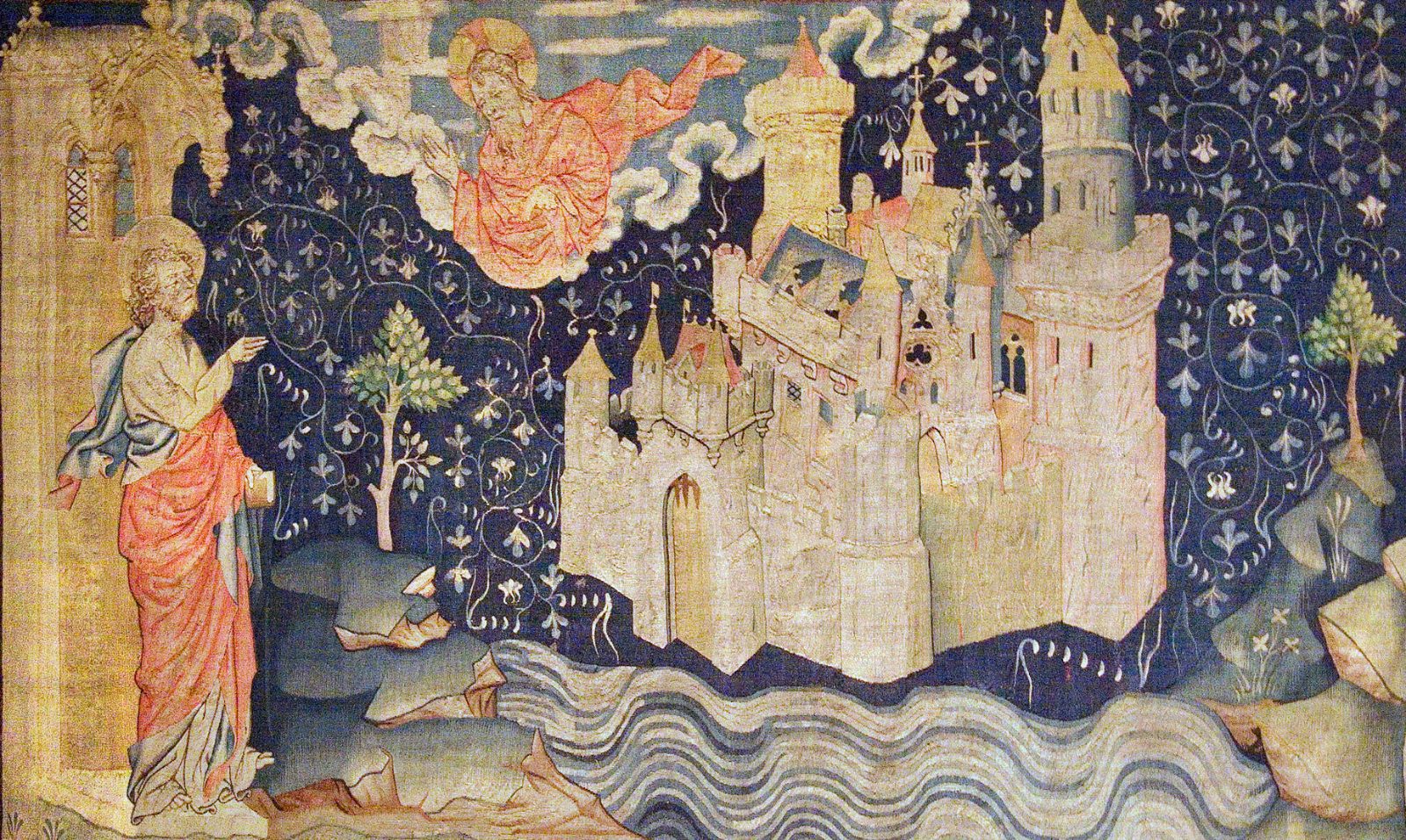
2 I saw the Holy City, the new Jerusalem, coming down out of heaven from God, prepared as a bride beautifully dressed for her husband.
One of the most important decisions a newlywed couple can make is where to live. Our home is the outward embodiment of the things that are important to us. To build the perfect home, we first have to envision it. That is why the shining city comes down from heaven. It comes from God, because with His help, we can see our true purpose and feel the true desire of our heart. Most of the time, like a typical husband, if we ask Him what He wants, He will ask us what we want. He already knows our deepest desires, because He built them into us. We’re the ones who can’t always see the writing on the wall.
3 And I heard a loud voice from the throne saying, “Look! God’s dwelling place is now among the people, and he will dwell with them. They will be his people, and God himself will be with them and be their God.
While we are alive and walking this earth, we need someone to look up to. We need a guide. This verse affirms God’s role in our lives. When heaven is all around us, then God is dwelling with us. When we accept that the world is already saved and in good hands, then we can become careless. We can place our trust in Him, knowing that no matter what happens, it is His will, and it’s for our best, in the long run. This is a very difficult place to reach, but an even more difficult place to leave, once you get there.
Notice that the voice comes from the throne, which we are sitting on. It’s our voice, reminding ourselves that we are not in this alone. Recall, also, that Jesus promised to share his throne with us. He is also on the throne. We are speaking with one voice, now.
4 ‘He will wipe every tear from their eyes. There will be no more death, or mourning or crying or pain, for the old order of things has passed away.”
When my father passed away, I was not sad. There was no longer any sadness in me. I had become careless. I knew that his death was in God’s plan, and that he was in God’s hands. I wasn’t worried, or even mildly concerned about what the future would look like without him in it.
All too often we burden other people with our expectations. We build a plan for their lives in our minds, then become upset when they die or go off track, without fulfilling our vision. This habit is built from selfishness. We feel sorry that they did not get to experience the things we think they should have experienced. We grow angry when we have to live without them.
When I heard the news, I felt none of that. Instead, I felt blessed that I had been gifted fifty-three years with him as my father. I did not see what I was missing, only what I had. I did not get to that place alone. It was only by walking and talking with God that I found myself in it.
5 He who was seated on the throne said, “I am making everything new!” Then he said, “Write this down, for these words are trustworthy and true.”
6 He said to me: “It is done. I am the Alpha and the Omega, the Beginning and the End. To the thirsty I will give water without cost from the spring of the water of life. 7 Those who are victorious will inherit all this, and I will be their God, and they will be my children.
The purpose of life is simple. To understand it, we must first ask ourselves why Adam needed a helper. The answer is to make more little Adams and Eves. That answer leads us to a new question. Why did he need more copies of himself? (Eve, in essence, was part of Adam, taken from his body.) The answer to that second question is that Adam could not have lived all of the lives that needed to be lived, and experienced all the things that needed to be experienced, in a singular form. Most of the lessons that were laid out for him involved group exercises.
Revelation starts with us figuring out where we are. Then it gives us a vehicle to travel down the road in. We walk as Sons of Man. It warns us about the changes that might happen to us (the seven seals), and lays out the pitfalls we might encounter (the plagues). Once we understand its symbolism, we can read it like a road map, or more precisely, detailed directions from one location to another.
We, the travelers, follow this road from Alpha, which is the first letter of the Greek alphabet, to Omega, which is the last. By experiencing this journey for ourselves, we carry its memories with us, and thus become the Alpha and Omega. We were there at the start, and now we are coming to the finish.
The Heavenly Warrior finds pleasure in their life, along with all of the other things that it contains. The spring of the water of life is a bubbling source of philosophical refreshment that pops up wherever we look, whenever we need it. It is not rain. It does not fall from heaven, because heaven is no longer above us, out of our reach. It is not tainted with salt, because there is no longer a sea.
I know that I said we were grown up, but in truth, when God is dwelling with us, we approach the world with a childlike curiosity. We find endless wonder in this amazing gift He has given us. Many of the things He does equate perfectly to children’s games, like Hide-and-Seek or Peek-a-Boo. It is for this reason that Jesus told us, “Truly I tell you, unless you turn and become like little children, you will never enter the kingdom of heaven.”
We must remember that God’s love is parental in nature. We might not understand the things He does, but we should never doubt that He is for us and has our best interests at heart.
8 But the cowardly, the unbelieving, the vile, the murderers, the sexually immoral, those who practice magic arts, the idolaters and all liars—they will be consigned to the fiery lake of burning sulfur. This is the second death.”
Oh no, scary words. Let’s recite that adage that our mothers used to tell us. Sticks and stones may break my bones, but words will never hurt me. We have all been all of the things that are listed in this verse, at some point in our lives, even if we didn’t recognize it. It’s okay. We don’t have to remain as we were. That old life was just practice. When we fail, we get back up. Then, if we’re smart, we analyze what went wrong, and we try to correct our mistakes. That is what it means to die a second time. We kill the person in us that failed, so that the winner can take his place. The second death holds no more danger for us than those scary words do. We are Heavenly Warriors. We know how to walk it off, and who to go to when we need a band-aid.
The New Jerusalem, the Bride of the Lamb
9 One of the seven angels who had the seven bowls full of the seven last plagues came and said to me, “Come, I will show you the bride, the wife of the Lamb.”
This angel’s name is Greed, because Greed makes us want, and in our hearts this is what we all want. We just want to be loved.
10 And he carried me away in the Spirit to a mountain great and high, and showed me the Holy City, Jerusalem, coming down out of heaven from God.
When we are in the Spirit, we are in sync with God and his plan, and everything is right with the world. Mountains symbolize a raised perspective. John is not yet a Heavenly Warrior, because heaven and God are still above him, even as he stands on this high mountain.
Mountains also indicate extreme contrast and a three-dimensional view. We need that third dimension to give our vision depth.
11 It shone with the glory of God, and its brilliance was like that of a very precious jewel, like a jasper, clear as crystal.
The most common jaspers are mottled with different colors. Recall that each vanity is connected with a color. Now the things that once ruled us have become a jewel in our crown. It is clear as crystal, because it no longer hides any secrets from us.
12 It had a great, high wall with twelve gates, and with twelve angels at the gates. On the gates were written the names of the twelve tribes of Israel. 13 There were three gates on the east, three on the north, three on the south and three on the west.
I think that sometimes we forget that the Jews are only one of the tribes of Israel. Our new city has twelve gates, one for each of the tribes, because the lost tribes were leavened throughout the whole world. This means that the path of revelation is open to any who wish to travel down it. In fact, we are all traveling on its roads, whether we know it or not. We come to the shining city from all directions, and all are welcome inside its walls.
14 The wall of the city had twelve foundations, and on them were the names of the twelve apostles of the Lamb.
The apostles came from all walks of life. One, in fact, was a devil. That speaks volumes about who can enter this city. When Jesus died, they all gave up and went home, except for Judas, who was already dead, and on to his next assignment.
They lost faith. Jesus wasn’t the man they hoped he would be. Most of them wanted a mighty king, who would raise an army and overthrow the Romans. Instead, the man they placed all of their trust in was overthrown by the people they hated the most.
The disciples were let down and dejected. When Simon proclaimed that Jesus was the Son of the living God, Jesus renamed him Peter and said that on that rock he would build his church. However, when Peter refused to accept God’s plan, Jesus had to take a minute and orient himself to keep from biting his disciples' heads off.
The shining city is built on the memory of the lives of men who wanted to believe, but didn’t always see. The name Simon is a classic Hebrew name, meaning “to hear” or “listening.” Simon didn’t always see, but that doesn’t mean he wasn’t listening. When he spoke the truth that he heard in his heart, Jesus named him “Rock”, which we know is synonymous with “truth.”
15 The angel who talked with me had a measuring rod of gold to measure the city, its gates and its walls.
We’re measuring again, only this time the rod is gold, not a reed. In order to be made into a rod, gold ore has to be refined in fire. This implies that our measurements are more thought out.
16 The city was laid out like a square, as long as it was wide. He measured the city with the rod and found it to be 12,000 stadia in length, and as wide and high as it is long.
In stadia measuring, the rod has to be held perfectly vertical, or it will throw off the measurements. This tells us that our perspective has to be just right, or our vision of the city will be skewed. One stadion is the length of a typical stadium. It’s roughly 192 meters. That would make this city 2,304,000 meters long and equally as wide. I have no idea what the significance of that measurement is, other than to say that it’s divisible by twelve, and there are twelve tribes of Israel.
17 The angel measured the wall using human measurement, and it was 144 cubits thick.
144 cubits is approximately 216 feet, or 66 meters. 144 is also divisible by twelve. Maybe someone who is good with numbers can figure out what it means.
18 The wall was made of jasper, and the city of pure gold, as pure as glass.
Again, jasper stones are typically mottled with different colors. The wall being made of jasper suggests that now our vanities have become our protection, instead of the things that cause us injury. If you think about it, if we are controlled by them, against our will, then anything we do while under their influence isn’t our fault.
Inside the protective wall of our vanities lies a heart of pure gold. In other words, we mean well; we just don’t always do well. We need to remember that if our heart is gold, then so is our neighbors'. All of our souls are pure. It is only our bodies that get muddy. Keep in mind that mud is a mixture of water and dirt. Therefore, our bodies are dragging us through truths and beliefs that have become mingled.
The word “glass” implies that we can see our vanities and our pure hearts clearly.
19 The foundations of the city walls were decorated with every kind of precious stone. The first foundation was jasper, the second sapphire, the third agate, the fourth emerald,
20 the fifth onyx, the sixth ruby, the seventh chrysolite, the eighth beryl, the ninth topaz, the tenth turquoise, the eleventh jacinth, and the twelfth amethyst.
Recall that each of the foundations bears the name of one of the apostles. The fact that they are color-coded suggests that each apostle was driven by a primary vanity. I would speculate that the jasper foundation corresponds to Judas, who was a child of light. Pure light is really just an amalgam of colored rays.
Looking at the color of each gem might give us clues as to who is associated with it, but we also need to examine the actions of each apostle, in order to make the proper determinations. That sounds like a project for another book. What say we skip it, for now.
21 The twelve gates were twelve pearls, each gate made of a single pearl. The great street of the city was of gold, as pure as transparent glass.
Those are some big pearls, except they’re symbolic. Pearls are made when an irritant, such as sand, gets trapped inside a mollusk’s shell. In order to protect itself, the mollusk secrets a very tough substance called nacre. This nacre is iridescent, or rainbow-like in appearance. Rainbows are signs of a covenant. In this case, we’re back to the multi-colored one that Noah saw, only this time it doesn’t appear after a rain, it is embedded in a stone that comes from the sea. Think about the symbolism in that. Most stones that go into the sea, are covered up by sand and silt. In this case, the sand or silt is covered up by tough, rainbow-colored nacre, so that it can’t harm the mollusk.
So many things in the scriptures are tied to color. The deeper I dig, the more astounded I am. And on top of it all, visible light is composed of colors. We are tied to the children of light. Without them, we couldn’t see at all. Without our matter, they would have no shadows, and therefore no contrast.
The streets of this shining city are gold, because everywhere we walk we find value. It’s clear as glass, because there is nothing blocking our view, anymore. The value of life is obvious.
22 I did not see a temple in the city, because the Lord God Almighty and the Lamb are its temple.
A temple is where we go to worship. God’s temple is where He goes to worship. Temples represent the place where we face our desires, or put a face to our desires, if you like. In this new city, there is no need for a temple, because we are in sync with God’s plan. This doesn’t mean we don’t have desires, it just means we aren’t hung up on them, the way we were before. We want what God wants for us, because we trust him. Likewise, we desire our spouse, because we want to be like him, and near him.
In Matthew 7:21-23 Jesus says that on judgment day he will look at some of us and tell us that he never knew us. What he meant was, if he looks at us, and does not see himself in us, then he will know we are not ready to be his bride. We are not hot enough for him, and we already know what he does with things that are too cold, or lukewarm. He tosses one into the fire, and spits out the other. Either way, his actions cause us to change. Something that’s cold, tossed in the fire, will heat up. If we have cold feet, they will melt. If we’re indifferent, or lukewarm, we’ll lay on the sidewalk until all of the water evaporates out of us, leaving only our impurities, on full display – at least until the next time it rains.
We do not have to be exactly like Jesus, to be accepted. What he wants to see is that we share a common dream, and that our desires align with his. If two people aren’t on the same page, chasing the same things, then they will eventually drift apart. Patty Loveless expressed this idea perfectly, when she sang her song, You Don’t Even Know Who I Am.
Jesus wants to see, in us, a shared commitment to this relationship. He wants us to want to be his Bride, as badly as he wants to be our Groom.
23 The city does not need the sun or the moon to shine on it, for the glory of God gives it light, and the Lamb is its lamp.
In New Jerusalem, we are all fireflies. When Jesus is in our hearts, there is a flame in us that shines out on the whole world. We no longer need external lights to show us what we need to see. We carry our light with us wherever we go. In those days, there will be no more darkness. Note that the sun and moon in this verse refer to worldly lights that we once set our course by. They can literally be anything we once desired or yearned toward.
24 The nations will walk by its light, and the kings of the earth will bring their splendor into it.
We know what the nations are, and who the kings of the earth represent. Recall that if our interactions with others are not in sync, then we trip over our wings. In the dark, it is difficult to keep from tripping. But if we’re lit from within, and following the example that our spouse set, then our eyes know exactly where to put our feet.
25 On no day will its gates ever be shut, for there will be no night there.
Not only is everyone welcome, but it also doesn’t matter when we get there. In the parable of the workers, Jesus told us that some arrive in the field early in the morning, while others show up throughout the day. It doesn’t matter. We all get paid the same. This is why we shouldn’t put apostles or prophets on pedestals. Their reward is the same as ours. You might think that this arrangement isn’t fair, but once you’ve seen the treasure, you’ll realize that it’s worth it, no matter how much work you have to put in, and the people working the hardest aren’t necessarily the ones who got to the field first.
There is comfort and serenity in knowing what others do not, but there is equal pleasure in helping to bring someone else’s dream to life. Just look at the people who build skyscrapers. The Architect might have seen it first, in his mind, but he isn’t the one who put in the windows, or set up the office spaces. The people who did those things, each got their own benefit from the work they did. It doesn’t matter that they came in later, after the plans were drawn up.
Prophets might think that they have it bad, because they walk around with a target on their backs, telling other people things they don’t want to hear, but conviction brings confidence and clarity of purpose. Those are things most of us would gladly die (spiritually) for. For those who show up late, trying to figure out what they’re supposed to be doing with their lives is the real toil.
26 The glory and honor of the nations will be brought into it. 27 Nothing impure will ever enter it, nor will anyone who does what is shameful or deceitful, but only those whose names are written in the Lamb’s book of life.
When we are all lit from within, because Jesus is residing in our hearts, then there are no more shadows. Without shadows, there is no deceit, and no shame. The Lamb’s book of life will be our book of life, too, because we have joined our life to his, and are walking in unison with him. All of the people we once were, or wanted to be, will be left outside of the city gates. Their names are not in the book, because they are who we used to be, before we were wed. We no longer walk in their shoes, or chew up the lives they enticed us to lead.