Nothing Between Us But Air and Opportunity
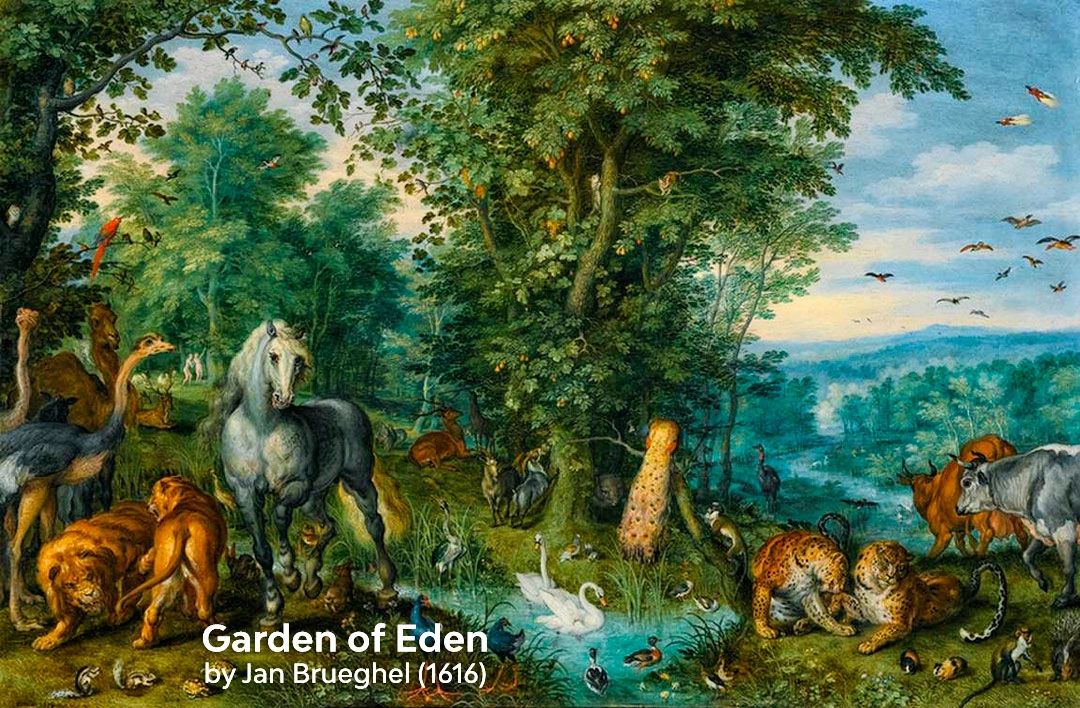
Son of Man appears hundreds of times as a title in the scriptures. It is thought to represent our mortality and frailness. Yet, Jesus referred to himself as a son of man. That's because, like us, he was traveling the road of revelation. As we will discover, he was making 'mistakes' and learning from them. Note that I only call them mistakes because they were wrong turns that he then needed to correct. In truth, nothing is really a mistake. This road was laid out long ago. In fact, even in Genesis we see its foundations being set. For six days God lays out his plans, then on the seventh day He sleeps on them. It is on the eighth day that He executes them when He places man in the Garden of Eden. On that day He establishes the system that will pull us forward into enlightenment.
Here is how it works:
Eden is a fantasy that we all chase, whether we know it by that name or not. It is the place where everything is provided for us without the need for us to perform any work, other than stretching out our hand and taking the particular fruit that we want. God placed man in Eden, knowing that we would not remain there, and that we would forever long for it. It is the perfect life we all think we want. It is our just desserts. And yet, the foods that nourish us the best are not the desserts. Heaven is the promise of ice cream, only after we’ve eaten all of our broccoli.
Note: It is more accurate to say that Eden was placed inside us.
Eden is a force that draws us forward. It is our idyll. Out of it flow 4 rivers, the Pishon, the Gihon, the Tigris, and the Euphrates. When we can identify their locations, then we can easily trace them back to the Garden itself. Genesis offers us clues to the location of this idyllic place. Let's examine them.
According to the most recent translation of the Old Testament, Eden was planted from the east. Some Older translations say that it was planted in the east, but they have since been proven inaccurate. This misunderstanding was necessary to help conceal Eden's location from previous generations. You see, the east is where spiritual enlightenment shines out from, just as the physical sun rises there. Enlightenment indeed is what we are chasing, but the planting of Eden from the east, not in the east, gives us a crucial clue to understanding the system that moves us. By placing the knowledge of Eden in our minds, God has given us an idyll to strive for, or in some cases to rail against. We love the thought of reaching it, but hate it when we realize just how out of reach it is. In those moments, as a protection for our fragile egos, we embrace the less-than-perfect lives we have. This turning away is often necessary to allow other pieces of life's puzzle to fall into place.
Since Eden was planted from the east, it is a place of light in a world that has not yet seen the sun. In fact, it is an oasis of light in a desert of darkness. But an oasis only gives us a taste of paradise. We must remember that we are still in a desert. What all of this means is that God has planted the idea of paradise in us. It is made up of our dreams of perfection. We can visit it in our minds, but we cannot remain in it. Nor can we pull it into the real world, complete. There is always a downside to everything we accomplish. Our dreams are fantasies that fall apart in reality. Therefore, Eden is just a mirage.
A mirage occurs in a place where the heat bends the waves of light. According to Google, the blazing sun heats the sand. The air next to the sand gets very hot and less dense. Light rays from the blue sky pass through the cooler air, hit the hot layer, then bend upward toward our eyes. Since our brains think that light travels in straight lines, we see the blue sky on the ground and think it is water.
A mirage is a misperception. It is an optical illusion that tricks our minds into seeing something that isn't there. If we think about it, this happens spiritually when we reach a place of hard truths. We don’t like the world around us, and instinctively look for comfort and shelter, not realizing that the places we run toward aren't real. We lie to ourselves because it's easier to live in a fantasy world than it is to face the harsh realities of life. The lesson here is that the perfection we strive for is unreachable. There will always be a downside. Still, we should strive anyway, because we can learn just as much from the darkness as we can from the light. If we are given the bad, then the good, then we have two gifts. God gives in abundance.
Two Fruits, One Tree
Adam and Eve were meant to eat from the Tree of the Knowledge of Good and Evil. The prohibition only made it that much more enticing. God knew that they would eat from it. If He didn't, then He's not omniscient. Notice that He didn't tell them not to eat from the Tree of Life. It is only the knowledge of good and evil that kills us spiritually. Eating from the Tree of Life would have given them immortality. They already had life. They knew what it was. Eve chose to eat from the tree that held mystery, and it’s a good thing for us that she did. If she hadn’t, we would be like the angels, unable to experience death and hardship for ourselves.
It was the feminine side of Adam (Eve) that reached out her hand and took the fruit. She didn't do this because she was a weak woman. She did it because women are water, and men are stone. Or should I say, the female is water, and the male is stone. We each have some female and male in us.
Water represents belief, fantasy, and philosophy. Stone represents truth, fact, and dogma. The side of us that is drawn to fantasies is the one that reaches out for what we don't have. A voice whispered in Eve's ear and told her she would not die, and she believed it. She believed it because nothing had died yet. Death was an unexplained unknown. It was an enticing mystery.
Remember that in the Old Testament, there was no promise of an eternity in heaven. There was only Sheol waiting for those who died. Sheol means the place below ground level, or a grave. Even still, no one would die until Cain slew Abel.
Remember, too, that Adam and Eve already had heaven. They lived in the Garden of Eden. We don't typically fantasize about what we already have, and we certainly don't yearn for it. We reserve our yearnings for things that are not in our hands. Even an idyllic heaven would be boring for the part of us that yearns for something, anything else.
Mystery is the force that drew Adam and Eve out of paradise, into the harsh world. It is part of the machine that keeps us spiraling toward the east, because even the bits of heaven we find here on earth aren't sufficient to fill the hole that Eden left in us. Eve's "sin" was only the first example of 'F' around and find out. It is repeated every time a child grows up, and every time one of us loses a piece of our naivety. Children are born into a perfect world. It is the only world they know. It is only with time and experience that they learn that it could be better, or that it doesn’t meet their expectations.
As parents, we tell our kids not to touch the hot stove, all the while knowing that the only way they will truly learn is by touching it. So it was with God's warning to Adam and Eve. He knew His children would not be able to resist the temptation, even when the words came directly from His own mouth. Parents know that their children will be drawn to a hot stove, because the desire to explore is built into all of us.
Life is here for the taking. It is only the understanding of life's lessons that kills us in the spirit and forces us to be reborn older and wiser. It was for this reason that Adam needed a helper. He needed help making more little Adams and Eves, so that none of life's bounty would go uneaten. He could not live all of our lives while in a singular form, because many of the lessons we need to learn come from group activities. He also needed a bold believer to blind him to the potential consequences of his actions. That was Eve. She saw the dream, not the reality.
We are just like them. We have our own internal Adam and Eve, reaching out to embrace the fantasies of life, so that we can learn their hard truths and keep the harvest moving forward.
It is important to note that God made the knower (Adam) before the believer (Eve), and that the believer was taken from the knower. This tells us that fantasy is an offshoot of reality. We cannot imagine new things unless we have some truth to base our fantasies on. It is also important to note that the believer went where the knower never dreamed of going. By asking for Eve, Adam got more than he bargained for. So it is with our fantasies.
Eden is an idyll. In this way, it is synonymous with heaven. It is a place where everything goes our way. We don't have to work, because all of the fruits are provided for us. It's the dream that we chase. It is different for each of us. It is for this reason that a global utopia is out of our reach. Earth is where the rubber meets the road. It contains harsh reality.
We need both heaven and earth, because the one (heaven) makes us reach out our hand and strive toward an idyll. Once we have that idyll, we realize it is flawed. There is always a downside (earth). Since this system of discontent is built into us, we do not stay in our imperfect heavens. We imagine a new heaven, where all of the problems in our old, broken heaven are resolved. Then we strive to make that heaven a reality. We always seem to be blind to the fact that the new heaven will be flawed too, in ways we cannot imagine. We just go after it.
Our efforts are futile, because Eden is guarded by a flaming, ever-turning sword. Can you see the symbolism there? Whenever we see the word sword in the scriptures, we should immediately replace it with the word tongue. Tongues carry questions. Is the Eden we built here on earth good enough? For us, the answer will always be no, because there will always be a downside. The best we can do is settle.
Fire is scrutiny that brings about change. When we examine the thing that we built and compare it to the image in our heads, there will always be something about it that we wish was better. Sometimes we think a thing is good enough, because seeing the flaw in it is a gift for one of our siblings. Regardless, this incongruity encourages us to take another shot at perfection.
We are truly locked out of heaven, because the Edens we imagine are only dreams, loosely based in reality. They will never exist outside of our imaginations. It is the pursuit of them that leads us along on the path of enlightenment, like Hansel and Gretel following breadcrumbs out of a dark forest. The sword that guards perfection turns in every direction. No matter how great something seems to be, someone will find fault with it. It might appear perfect from one angle, but when we turn it around, we will see the flaws. We will always be left wondering if we could have done better.
Keep in mind that it was Adam's dreamer side (Eve) that got him into trouble and started him on the path of revelation. We must dream it before we do it. This is the system God laid out in the first chapter of Genesis. It describes the mechanism that motivates us.
The Four Rivers that Eden Waters Us With
Fertility:
Pishon is tied to the nation of Democracy. We have not talked about the Nations yet, but we will in good time. For now, just keep them in the back of your mind. Pishon means increase, full-flowing, or dispersive. It circles the land of Havilah, where there is good gold, bdellium, and onyx.
Pishon is connected to the Hebrew word "puwsh", which means to spring about, jump, or spread out. It also looks a lot like the modern English word "push", which makes sense because we were pushed out of Eden. It is that same push that keeps us from swimming back upstream, into Eden again.
The Pishon river is often interpreted by scholars to represent divine abundance, fertility, and the outpouring of God's life-blessings. All of these are true, since the road to revelation is full of gifts, both good and bad. If you don't yet see bad things as gifts, you will. As I said, the foods that nourish us the best aren't the ones we call desserts. So long as there are more gifts coming, we will never find contentment. Pishon pushes those gifts out into the world, where we can find them.
Havilah means circle, circular, or sand region. This is telling, because the path of revelation is circular in that it spirals us forward. It seems as if we are covering the same ground over and over, but we're not. We are actually making headway. "Sand region" is interesting because it implies a desert. To get to an oasis, we have to cross a desert. Symbolically speaking, deserts are places of hard truth where our fantasies burn up in the sun. In real life, crossing a desert will strip you of any misconceptions that you have about yourself. You will learn precisely what you are made of, and thirst for the fantasies that once shored up your ego.
Deserts are hot and dry and make us wish we were anywhere else. All of the treasure in Havilah is hidden. The gold is buried. The bdellium has to be extracted from the bark of certain desert trees by cutting open their bark and letting the sap ooze out. This sap hardens when it comes in contact with air, and is then harvested for incense, perfumes, and medicines. Onyx stones are found in volcanic cave deposits.
All of these treasures require work to harvest. Unlike Eden, the best things in life are not free. We have to spend treasure (time and energy) to make treasure.
Pishon and Havilah work together as fantasy and truth - water and land. Notice that all of the treasure is on the land, not in the water. This is because truth, even hard truth, is far more valuable than fiction. As they say, "A bird in the hand is better than two in the bush".
For a son of man, truth is the goal. We are on a path to discover God and uncover ourselves. We cannot lie to God, and we should not lie to ourselves. Only then will there be no liars in heaven.
Even though there is treasure in Havilah, where we are, we still want more. The river Pishon tempts us with an abundance of water. It urges us out of Havilah, because gold is not good enough to quench our thirst. Reality is never good enough when there is a deluge of fantasy in our minds.
Pishon encircles Havilah. It keeps us locked in a desert, where our thirst is never fully slaked. Because of its strong current, Eden is always just out of reach.
Pishon and Havilah represent fertility. It takes a dream and an action to make a baby. Fertility implies opportunity, but it is only half of it. A second part is needed. Democracy's particular living creature has the head of an eagle. As you know, eagles have a very interesting mating ritual called a death spiral. To pull it off without injury or death, they need to work together and be aware of their surroundings at the same time. They have to multitask. What this means for us is that we have to work with each other, and with God, and we have to recognize where we are. To put it simply, we are in a dark desert chasing bits of light. Those bits of light are epiphanies, the shards of enlightenment.
There is a Jewish myth that there was a world before this one, in which God placed all of the Light. But that world couldn’t hold the Light, and it exploded. The pieces of it were scattered throughout this world. They are waiting for us to find them. That world was Lucifer. Even though he was the brightest angel, he could not hold all of the truth that God entrusted to him. He was split into light and shadow. The light part of him remained in heaven. His shadow fell to earth, because that’s what shadows do; they fall.
The war in heaven that caused Lucifer to fall was caused by us. It sprang from the same questions we ask every day. Why would God do this to us, if He loves us? Why must we suffer? Why can’t we just get it all over with? Lucifer was just as confused by our lives as we often are.
Part of Lucifer trusted that God knows what He is doing. That part remained in heaven. It is the light. The other part was sent down here to see for itself. It is the shadow. This will all become clearer as we go along.
Gold is pleasant to our eyes. Bdellium leaves a pleasant scent in our nostrils. Onyx stones entice us to go into dark, mysterious places. We are like hunting dogs, with a gleam in our eyes, a nose full of perfume, and a cave in front of us where our quarry hides. Opportunity is driven by the potential for undiscovered prosperity. If we could only beat Pishon’s strong current.
Overcoming the “current” or the now is what our dreams urge us to do. They promise us a future that is better than the present we have already been given. Isn’t this wordplay wonderful?
Ability:
One half of opportunity isn’t enough. We need the other, as well. Gihon is tied to the Nation of Monarchy. Gihon means bursting forth or gushing. It comes from the Hebrew verb giakh. It symbolizes divine breakthrough, life-giving provision, and royal appointment. The name applies to the river that comes from Eden, and also the water spring in Jerusalem, though they are not considered the same thing.
Gihon is the main water spring in Jerusalem where King Solomon was crowned. Spiritually, it represents the pure, unadulterated source of divine wisdom and life originating straight from God's presence to sustain the whole earth. Because it provided the primary water source for Jerusalem—later channeled via Hezekiah's Tunnel during times of siege—it represents quiet, constant divine protection, preservation, and living water that refreshes the soul during trials.
Gihon encompasses all the land of Cush.
Cush was the oldest son of Ham, and a grandson of Noah. The Kingdom of Kush (with a K) is also called Nubia, which is an area south of Egypt, covering parts of modern Sudan and ancient Ethiopia. The name is often linked to definitions like “black” or “burnt”. It can also refer to an adversary.
Cush was the father of Nimrod, who was a great hunter. I understand Nimrod as the first trophy hunter. A trophy hunter does not hunt to fill their belly. They hunt to fill their ego.
Recall that I said that if we could understand the ancient Hebrew names in the begats, we could gain a clearer picture of their individual contributions to society. I believe the relationship between Nimrod and Cush is not parental. The word generation implies that something was generated. The philosophy or “school” of Nimrod built on something from its predecessor, Cush. Since Cush is black or burnt, perhaps we can assume that Nimrod’s desire for trophies to show off to his friends came from a dark place within him?
The Old Testament portrays the Cushites as a strong, wealthy nation with a formidable military made up of horses and chariots. Cush is mentioned by several prophets in oracles of judgment, but prophecies also point to a time when the people of Cush will turn to God and bring Him offerings.
Cush the Benjamite was an opponent or false accuser of King David. He is only mentioned in the title inscription of Psalm 7. There’s a lot to unpack in that verse, but it’s a tangent I don’t want to veer down at the moment. Still, the Rabbis believe that the people of Cush had unusual skin, yet here is a Benjamite named Cush. The name seems to point to something else. We’ll see if it leads us anywhere.
For now, back to Eden.
Gihon and Cush also work together as fantasy and truth, but they are slightly different than Pishon and Havilah, which represent the potential for undiscovered prosperity. Gihon and Cush represent our ability to go and find that treasure.
There is no treasure in Cush; there is only the strength to pull ourselves out of the darkness. Darkness implies mystery. Since nothing can be hidden in the light, it is to the East that we are heading, where the sun comes up.
Gihon circles the land of Cush, just like the Pishon encircles Havilah. Since Gihon means “to break forth”, and rivers are made up of water, we can see that Gihon fills us with a dream of sufficiency. It tells us that we can do the thing that Pishon fills us with the desire to do. Opportunity has two parts: Fertility and ability. Without either branch, the opportunity is missed. It takes skill to execute a prison break, and that is precisely what we are trying to do.
The only way to get out of the dark is to move toward the light. We do this by educating ourselves. Gihon is tied to the living creature with the head of a lion. Its name is Monarchy. When we improve ourselves, we lift ourselves up, like a king on a throne. But first we must serve ourselves and be servants for ourselves. This might mean letting someone else take us under their wing, so that we can learn from them. By serving them, we can serve ourselves. This is why Jesus urged us to be servants first, and always.
Gihon invites us to leave the darkness and seek the light. However, since it encircles Cush, it also guarantees that we will never swim back to Eden. For the time being, until it dries up, we are stuck in the dark. This means that there are always things we don’t know. Even as we answer more and more questions, those new answers give birth to further questions.
The Cushites had a mighty army, with lots of horses and chariots. Infantry don't ride on horseback or in the back of chariots. Both of those are an improvement over walking. But we must remember that Pharaoh's army, which had many horses and chariots, was drowned in the Red Sea. When the waters fall on us, they knock us off of our high horse. In Cush we think ourselves mighty, because we don’t know ourselves, our enemy, or our God as well as we should.
Gihon shows us just how weak we are. Those who are strong often become weak through inattention. If we ask God, He might tell us that our time is better spent building a boat rather than a chariot. Gihon and Cush should remind us of where our true strength originates.
I always thought it was odd for Samson to have huge muscles. I think a better portrayal of him would be as a scrawny weakling. After all, if a muscled dude performs great feats of strength, it is easy to ascribe that strength to his body. But Samson's strength (and ours) does not come from muscles, or training, or even our diet. It comes from God. To train properly, we should first go to Him and seek His advice on where our efforts will be best spent.
Samson found wild honey in the carcass of a dead lion. Wild honey is sweet, and it gives us a rush of energy. When Samson killed the would-be king inside himself, he found spiritual nourishment. He went out and slew a thousand men with the jawbone of an ass. In other words, he used humor to bring about a thousand spiritual deaths.
I don’t know if you know this, but kings don’t make jokes. They leave that to their jesters. The original idea behind the jester was that it allowed the court to laugh at the king without actually laughing at the king. Jesters primarily made fun of their monarchs. Because they typically had some deformity of their own, it was considered okay for them to do this, because no one took them seriously.
It is my guess that most of Samson’s humor was of the self-deprecating variety.
I would have never considered that it was Samson’s jawbone that killed those men, or that he did it by making an ass of himself. That’s what comedians do. They make asses of themselves for our amusement. Most of the time they point out obvious things that we all took for granted, but they do it in a way that literally ‘kills’ us with laughter. Everyone dies in a comedy club. The people who go in don’t come out the same.
Comedians complain about dying on stage when their audience doesn’t find them funny, but I bet none of them ever realized that their audience dies during every performance. Or maybe they do, and that’s why they use phrases like “knock ‘em dead” and “you’re really killing them tonight!” I’ve got a lot more to say about Samson and his symbolism, but I’ll save it for another time. We don’t want to get too far off track. We’re still on the hunt for Eden.
Now that we have both sides of opportunity locked down, all we need is the proper spirit, or air. As the title of this chapter says, there is only air and opportunity between us and our dreams.
Direction:
The first part of our proper spirit comes from the Tigris River. Tigris is tied to the Nation of Theocracy. It was also called the Hiddekel by the Israelites. The Tigris flows to the east of Assyria. The name Tigris comes from the Old Persian word tigra meaning “fast” or “arrow”. It shares a linguistic root with the word tiger. Spiritually, it means "swift", "rapid", or "darting". It flows from eastern Turkey through Iraq to join the Euphrates before emptying into the Persian Gulf.
Daniel received his vision of a heavenly messenger while standing on the banks of the Hiddekel River. It symbolizes being at the edge of deep, overwhelming spiritual truths and heavenly realities. Daniel was a Son of Man, just like us. He spoke of a king who was attacked by a king from the North and one from the South.
Most scholars think these kings will arise during some sort of worldly apocalypse, but that’s not how Daniel and Revelation are connected. They both tell a similar tale. John talks about his dream, which lays out the path of revelation, and Daniel’s dreams tell us of his own walk and talk with God. The book of Daniel is about Daniel, not us; though it can serve as a guide for us, just like Revelation.
The king in Daniel’s dream that is assaulted by the others is Daniel himself. Or should I say, it is one particular attitude of his. A king is nothing more than something that rules over us. It can be a person or an attitude. The future that is predicted in the book of Daniel is Daniel’s future. The kings mentioned in it are attitudes that seek to rule him.
The North is cold. The South is hot. Jesus warned us that if we were not hot or cold, he would spit us out. Being spat out is not the end for us. It is a new beginning.
Imagine that we are like coffee, dumped on a sidewalk because we were lukewarm. During the day, the sun beats down on us and evaporates the water in us until nothing is left but a sticky mess. The water that is evaporated away is fantasy. What we’re left with is the cold, hard truth. We’re not lukewarm anymore. Our state has changed. Jesus doesn’t mind us if we’re cold. He would prefer us to be hot to trot, but a cold shoulder he can work with. It’s better than indifference.
Imagine how you would react if your spouse gave you the cold shoulder. The fact that they aren’t talking to you means that talking to you is something they value, and they think that you value their conversation just as much. They are withholding it to try and get a reaction out of you. They want you to change your behavior. Similarly, being hot to trot is a reward for something you did. But indifference is different. It means they don’t care about you, one way or the other. Love and hate we can work with. But a total lack of concern leaves us nowhere to turn.
Daniel was telling us that he foresaw his own growing indifference, and knew that God would not let him sit in that kingdom for long. He still had a way to go before he reached the East. The darkness of the West was at his back. He was being collected, like we all are. The only question is, are we coming in on the left (the Northern road), or the right (the Southern one)?
Interestingly enough, King Solomon’s Temple had two pillars at its entrance. The one on the right/south side was called Jachin, which translates to “He will establish.” The one on the left/north side was called Boaz, which means “In him is strength.”
These two pillars and the attacking kings in Daniel’s dream represent Jesus and Satan. One stands on the right, the other on the left. One establishes us. The other makes us believe we have the strength inside ourselves.
I’m going to say something that you probably won’t like, but it doesn’t matter if you go left or right. Both roads lead east. Some of us are sheep. The rest are goats. The whole herd is being gathered.
Daniel had another dream where he saw a ram that gores westward, northward, and southward. It does not gore to the east. A ram is a male sheep. We know that sheep have curly hair, which symbolizes spiraling thoughts.
Daniel tells us that the ram's two horns represent the kings of Media and Persia. Those kings are symbolic. They represent some stereotype the ancient Israelites understood about those two kingdoms. Because the ram’s horns represent the kings of those two countries, we can assume that Daniel was making a statement about the attitudes or motivations of the people in them. I believe he was saying that they did not seek the God of Israel (The east, the light), and so were left in darkness.
Regardless, the ram did not charge toward the light. It is my belief that this ram symbolizes fear and that its horns are superstition and magic, which ruled the world until a better, more straightforward system evolved.
That system was science. It was mostly born in Greece, where the pursuit of philosophy bloomed. We can see this because the ram is defeated by a shaggy goat. Goats have straight hair. Their thoughts do not spiral, like those of a sheep. They take a more direct approach to finding answers.
Superstition spirals. It is fed by our guts and the hair on the back of our necks. It is a system of beliefs, not facts. It drives us to hang our horseshoes with the ends pointing up, so that the luck doesn’t run out. It is grounded in hunches and the desire to not press our luck.
Throughout Daniel, there is mention of Persia and its kings. Persia represents fear and superstition. In one verse, Daniel is told by an angel (Gabriel) that he (the angel) was delayed by the prince of the kingdom of Persia for twenty-one days, and that he would return to battle with the prince of Persia, and that the prince of Greece is coming. He also mentions that Michael is one of the first princes. This is telling, because the name Michael is actually viewed as a rhetorical question: “Who is like God?” That question is the one that sends us searching for a definition of God. We want to know the length, the depth, and the breadth of Him. Michael was one of Daniel’s first princes because, as his book tells us again and again, Daniel began to contemplate and fast before his God. This means that his desire was toward understanding God, and that nothing else could satisfy his hunger.
It is also telling that the angel who is fighting against the prince of the kingdom of Persia is Gabriel. His name means “God is my strength.” In other words, Daniel was trusting that God would help him fight against his own superstitions and fears, and show him the truth behind the mystery. This is one of the many leaps of faith that we sons of man must take.
As Sons of Man, we might be tempted to follow the path of pure science. After all, we are encouraged to be studious. But remember, our Groom is a lamb, not a goat. The image he has given us as our example has curly hair. If you want to know how this applies, think about this. I am not a scholar of the Bible. I hold no degrees. I was led to these revelations because I asked a lot of questions. I wandered around from place to place, job to job, adventure to adventure, and I trusted that God would make it all make sense.
I did not sit in a class and listen to what some professor thought the scriptures meant. Now ask yourself how many of those biblical scholars can say definitively what all of the symbolism in Revelation means? How many of them can go line by line and explain it all, and have it all make perfect sense? The answer is, none of them.
Daniel also spoke of a brazen-faced king who would rise, but not by his own strength. As a son of man, we learn to trust God over people. When we do this, we become that brazen-faced king. We realize that we are surrounded by humans who are just as blind as we are. Only we are looking up and getting our answers from a higher authority.
Note: When your face is brazen, or made of brass, and people look into it, they see themselves. They see someone who is facing the same things they are. They see a kindred spirit.
The Tigris is tied to Theocracy, the living creature with the head of a calf. Like baby bulls, we must charge forward with our heads down. "Nose to the grindstone", as they say. We are still learning to be sacrificial animals.
Preparation:
We talked about the Tigris; now let’s get into its partner, the land of Assyria. Assyria is called "the Rod of God's Anger" by the Israelites. It conquered the northern kingdom of Israel in 722-721 BCE. Jonah was ordered to go to its capital city of Nineveh and preach repentance. Assyria was a place of extreme cruelty and pride. Assyria fell to the Babylonians in 612 BCE. Ancient Assyria is modern-day Iraq. Its name means “place of fish.” The ancient cuneiform symbol for Nineveh depicts a fish inside a house. None of this is a coincidence.
Fish swim in water, which represents belief. They hang in our misunderstanding, the way stars hang in the sky. They symbolize the shadowy monsters that lurk beneath the surface of our understanding. One way to think of them is as unproven conspiracies.
In Jonah's time, there were rumors about the nature of the Ninevites that were terrifying, especially for someone who had never been to Nineveh. Jonah heeded those voices and ignored God. So, God placed him inside a fish. This means he swallowed Jonah up in these conspiracies until he could see the illogical nature of them. He forced Jonah to understand the Ninevites, and where understanding goes, love follows. In this way, he prepared Jonah for his task.
Jonah was able to go to Nineveh without fear by realizing the underlying motivations of the Ninevites. He was able to find common ground with them. That's why they were willing to believe him. He did not come to them as an adversary, but as a neighbor. Knowing this should help us clarify the commandment from Jesus that we should be "fishers of men".
Tigris and Assyria are the carrot and the stick. Children are taught the rules and expected to follow them until they are old enough to understand them and see the wisdom in them. So it is with a son of man. For example, Jesus said that the Sabbath belongs to the son of man. What he meant was that it is truly up to us to decide when we need a rest.
As children, we were given a bedtime. As adults, we can set our own sleep schedule, because we better understand the consequences. As we progress along the path of revelation and grow into adult children of God, we will see that the "commandments" are really just good ideas. Most of the time they work well, but sometimes they need to be set aside.
The Tigris flows to the east of Assyria. To be on the east side of something means to be more enlightened about it. When we try to enlighten ourselves concerning God’s punishments, we often hit a barrier of water (misunderstanding), just like the escaping Hebrews did when they came upon the Red Sea. Since water is belief or fantasy, and red symbolizes anger, we can imagine that they believed they would be punished for foolishly following Moses away from Egypt. They did not know that God could divide that water and allow them to cross into the wilderness on dry ground.
The wilderness is where we go to get away from people, so that we can hear the voice of God. When we ignore the voices of others and trust in God, we are safely in the wilderness. The Hebrews had to close off their ears to the voices of fear that were trying to overcome them. They needed a reminder that what they were doing was right, and that staying in Egypt was wrong.
Egypt was wrong, because they were not servants there. They were slaves. They had lost Abraham’s wild spirit. Recall that Abraham loved roaming the wilderness, and that Lot sat in the city gate because he could not decide between his city-loving wife and his free-wheeling uncle. The gate of the city represents indecision between the voices of people and the voice of God.
Assyria was a scary place, until Jonah was "birthed" or “spat out” by that fish. The Tigris beckons us to "dart" away from the dry land we are standing on, but the sea (fantasy) is no refuge. Just ask Jonah.
The Tigris and Assyria are warnings to us not to get swallowed up by our fears, but also not to take things too lightly. The Rod of God's Anger is not oppressive, and it shouldn't be terrifying to us. It was forged with our best interests in mind, not to beat, but to guide.
Spare the rod, spoil the child.
The actual verse from Proverbs 13:24 states: He who holds back the rod hates his son, but he who loves him disciplines him early.
Many people misunderstand this proverb because they have never herded sheep. If they had, they would understand that the shepherd doesn't hit his beloved flock. He uses the rod to steer them. He walks behind them, and when he wants them to go left, he holds it up and to the right. Similarly, if he holds it up and to the left, the sheep will go right. He understands that sheep can see in nearly a complete circle around their head. So, they see the rod and instinctively move away from it. Parents know that their kids are watching them, even when they don’t want them to.
To effectively guide his flock, the shepherd has to fill himself with understanding. He has to know their limits, as well as his own, and what constitutes a danger to them. Only then can he steer them around obstacles and keep them safe from predators.
For parents, this means knowing where your children are in their development, remembering what it was like to be in their shoes, and engaging with them to steer them where they need to go.
If the shepherd were to hit his sheep, then why would they come to him if they were lost in the wilderness? His voice would hold just as much danger as the rest of the world. As adult children of God, we must come to understand God's motivations. The Holy Spirit represents His intentions toward us. He will not forgive blasphemies toward the Holy Spirit - not because they are such terrible crimes - but because forgiveness requires putting things to the back of your mind, out of sight.
Our misunderstanding of God's intentions will never be put aside, because they need to be remembered by us. When we were children, we did not understand why the rules mattered so much to our parents, or why they behaved the way they did. When we become parents ourselves, it all begins to make sense. Suddenly we recall the "blasphemies" we spoke against our parents, and that makes it easier to hear our children blaspheme against us.
Coming to understand God's motivations, and our previous blasphemies toward those motivations, will help us find common ground with those who do not yet see the goodness in all that He does for us. We should remember that we were not always adult children of God, and cut our "younger" siblings some slack when they blaspheme against Him.
Assyria represents fear. Tigris points the way out. It seems like a barrier because it lies between us and Eden, but only if we forget what it flows into.
Determination:
The Tigris flows into the Euphrates. Euphrates is tied to the Nation of Anarchy. It represents Stoicism, which is a philosophy geared toward self-sufficiency. This connection became clear to me when I came to understand the role of the Stoic philosopher Euphrates of Tyre in the book of Revelation. It is important to note that his philosophy failed him when his wife died. He was unable to find any comfort in the words that had guided his life up to that moment.
Euphrates means "rushing" or "that which breaks forth". The Israelites called it "Perath". Where the other rivers are tied to lands, Euphrates is not. This is because Euphrates stands alone. It is not near land, because land is truth. It is only water, because water is fantasy, and the belief that we can exist alone, without God, is a fantasy.
This is a partnership. We have to do our part, but only so long as we remember our place. We are the Bride, standing beside our Groom. This is a team effort. We hold the dream. He is the truth. We must reach up for him, just as he is reaching down for us.
The problem with Stoicism is that it does not allow for leaps of faith. It is all about counting pros and cons, and making plans. But the future is a mystery. Our veil clouds it. Only our Groom can lift that veil.
The son of man must know his role, whether it be monarch or subject, pastor or congregant, etc. We are more than Stoics. We are the faithful adult children of God. We do our part, and we trust Him to do His.
The four rivers come out of Eden because it is our fantasies that urge us to move and improve. The Tigris flowing into the Euphrates is an important detail. They become one. Determination is wasted without direction. Our Groom is the way, but it is we who must make the next move. He has already offered us an invitation. Moving isn’t enough. We have to move forward, toward a clear goal. That is what the joining of the Tigris and Euphrates represents. They are our willingness to put everything else behind us, in the hopes of a brighter future.
So there we have it. There is nothing between us and Eden but air (direction, preparation, and determination) and opportunity (fertility and ability). These are the tools that God gave us to help us make our dreams a reality. Fortunately for us, He also gave us a world full of imperfections, where dreams expire quickly. By doing this, He has ensured that we will never stop chasing the images of heaven that He puts in our minds.
To set the record straight, according to Google, "Ain't nothing between us but air and opportunity" is a popular Southern colloquialism and viral internet slang used right before a fight, a bold challenge, or when seizing an open chance. It means the path is completely clear, obstacles are gone, and a confrontation or moment is fully ready. This is our chance, if you’re ready to take it. To be sure, you need to know what ground you’re standing on.
Wherever you are, it’s time to start making your way home. The seven churches are simply our starting points. We are not unified, yet. We are still not on the same page. That’s okay. We have a long way to go, and a lot to see along the way. Hopefully there will be no shortage of common ground.
Now that Jesus has given us a glimpse of who he is and where he is coming from, he wants us to do the same for ourselves. He wants us to realize where we are before we begin our journey. That’s why the letters went out to all seven churches. We have to know which one we’re starting in. Collectively, we are the Bride. We will come together as one, with a unified purpose, before our wedding day. He knows that, and he knows that since we’re good girls, naturally we’re in church.
But which church? There are seven. We’ll take an in-depth look at each one and see if we can figure out which one we are in. Keep in mind that this is an exercise for us, more than for him, as he already knows us better than we know ourselves. He’s done his homework. Now it’s time for us to do ours.
What is a church, exactly, and why are letters to churches that no longer exist important to us today? Well, a church is simply defined as a place for public worship.
Taken from Google.com:
In 1978, the IRS announced a list of 14 criteria to evaluate whether a religious organization qualifies as a "church":
(1) a distinct legal existence; (2) a recognized creed and form of worship; (3) a definite and distinct ecclesiastical government; (4) a formal code of doctrine and discipline; (5) a distinct religious history; (6) a membership not associated with any other church or denomination; (7) an organization of ordained ministers; (8) ordained ministers selected after completing prescribed [courses of] stud[y]; (9) a literature of its own; (10) established places of worship; (11) regular congregations; (12) regular religious services; (13) Sunday schools for the religious instruction of the young; and (14) schools for . . . prepar[ing] ministers.
“A distinct legal existence” means a church has to be tied to a place, like a building or piece of property or a group of people, and it has to be unique from other existing churches. It’s important to note that none of the Seven Churches physically exist anymore, outside of our minds. They are spiritual places we may find ourselves in, and we can move from one to the other without taking any actual steps.
They once existed as actual, physical churches, and interestingly enough, their stereotypical congregations represent all the ways that Christians can go wrong and right in their worship.
Churches are a place to worship, but not all churches are the same. They differ, depending on who, what, how, when, and where their congregations choose to do their worshipping. The Seven Churches are no different. They draw the boundaries for us between proper and improper worship, so that we can live up to the behavioral expectations God has set for His house. If we want to walk in the house of the Father, we have to know the rules. Worship is just a way to show reverence. We don’t want to offend our future in-laws.
Recognizing which church we are in and knowing where their entrances and exits are can help us on the road to complete revelation, which is the shining city of New Jerusalem. In that city, everything is filled with light. There are no shadows, because flames don’t produce shadows. Lies, and thus liars, don’t exist there, because the truth is obvious and undeniable. There are no cripples there, because no one is blind; we can all hear clearly, and everyone knows how to walk and talk, and no one needs crutches to help them stand.
Religion is a crutch, in the same way that a couch or end table helps babies pull themselves up on their feet. When the Law is written on our hearts, we cannot put a foot wrong, and so there is no more need for the collection of rules that helped us learn to walk. The act becomes the instinct. The science becomes art.
The churches are lampstands, not lamps. They help us hold up our fire. They do not ignite it, or snuff it out. That is the job of the angels. Angels are stars. Stars burn. They give us our spark. They burn brightest in a vacuum. Their messages are more clear when our head is empty, when we clear out all our thoughts and just listen. Being a good listener is important for a healthy relationship. Let’s see if these seven stars can help us figure out where in the heck we are, shall we?