Shrouded in Mystery
Pergamum (modern-day Bergama, Turkey) was a major, wealthy city known for its massive library and intense pagan worship, including the first provincial temple for Roman Emperor worship.
Their letter starts like this:
12 “To the angel of the church in Pergamum write: These are the words of him who has the sharp, double-edged sword.
Recall that a double-edged sword has a light side and a shadowy side. With it, the Son of Man is able and willing to speak of both light and dark things.
13 I know where you live—where Satan has his throne.
When our fire is lit, and our hearts are light, then Jesus is on his throne, inside us. This is our seventh sense. Like a light switch, it is either on or off. If Jesus is not on the throne, if our hearts are dark and our fire is out, then Satan has taken up residence. The congregants of the Church of Pergamum are living in darkness, but they don’t wanna be.
Yet you remain true to my name. You did not renounce your faith in me, not even in the days of Antipas, my faithful witness, who was put to death in your city—where Satan lives.
Antipas means: for all, or against all. You are either with us, or against us. This is the motto of the perga-mummies. We fear fire, because we have not yet been properly burned. Or perhaps we burned too much, once before, and got burned for our efforts? Maybe we didn’t like sitting in jail, taking the heat for our man? We didn’t want to be dragged into this frying pan. This isn’t the life we imagined. What do you mean we have to cook?
In our ears, your dinner invitation comes with an ‘or else.’ You promise us freedom, then shackle us with your regulations. We don’t understand your rules. They wrap us up and weigh us down, so that we can’t run; we can barely stumble along. Satan lives in our city because we live in the past and embrace the old. Either we haven’t heard, or we refuse to accept the new(s) – the good news.
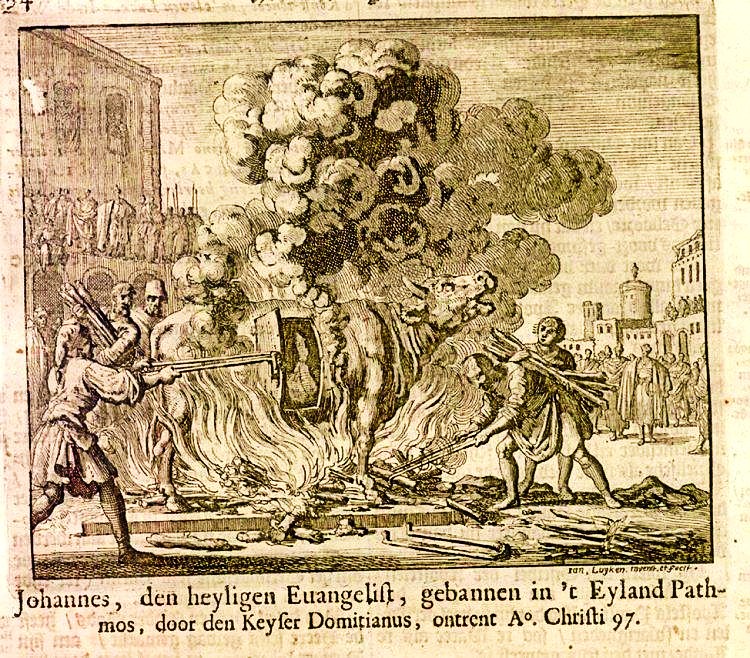
Antipas was killed in our city when he tried to introduce new ideas. He was a Bishop, ordained by John, and sent to lead the Church of Pergamos. He was burned on a brass, bull-shaped altar for the crime of casting out the local demons that the people of Pergamos worshipped. He argued against the teachings of our ancestors.
In our defense, he boiled us in our Mother’s Milk, which is the tradition handed down from one generation to the next. He angered us when he proved that our gods weren’t gods at all. He told us there was a new God that we didn’t know about, who was stronger than all the others, but we chose not to worship that God. Instead, we killed His messenger.
It’s not our fault that he is dead. He assaulted us first. No one likes to be boiled; we sure don’t, and when he said our parents were wrong, well… things boiled over. We got a little out of hand. Can you really blame us? What would you say if someone told you that your mother didn’t raise you right?
Perga-mummies don’t want to live in darkness. We want the truth. We really do; it’s just that our eyes are covered by the things we already believe to be truths. We want to know what it’s all about, as long as it fits the narrative we’ve been spoon-fed since birth. We’re not cold or callous, just because the fire within us is alien, and not the one you want to burn us with. Living in an ancient tomb doesn’t mean you’re dead… Does it?
Okay, our hearts might be empty, but only because our heads are filled with questions. We can’t see the beauty in the world, for all these bandages. We wouldn’t need to bandage ourselves if people didn’t keep pelting us with stones. We don’t want your new ideas. We’re already sheltered under a ton of bricks; we don’t need more of them falling on our heads.
Sure, we have no idea how this tomb was constructed, and we don’t know how to fix the parts that are falling, but we know its foundations are solid, because we were told by our parents that this is solid ground. Our tomb houses the truth, and if that truth was good enough for our mommies and daddies, it’s good enough for us.
For those of us who accepted this new God, even though we aren’t all in, even though we aren’t standing fully in the light, we still have a modicum of hope. We haven’t given up on Jesus, or his promises, even though those promises sound hollow and dry to us now. He hasn’t visited our city, so we wouldn’t know him on sight. We heard he visits people. We heard that he loves burning people up. We love that, too, so long as they’re the right people, the people we call sinners, the people who don’t see eye to eye with us. We love watching those people burn; just keep that fire away from us.
We’re still hoping for a visit. Our faith is our redeeming quality. We are holding on to hope, and where there is hope, there’s a way. There’s a light at the end of the tunnel. The flames are far off, like a distant star, and barely visible with the naked eye, but they are not completely out of sight.
Mostly we know about them through hearsay. Other people have been visited by this Jesus. We’ve been promised that he’ll come for us, too. We’re waiting, down here in the dark. We won’t go to him. If he wants us, he can come to us. There’s still a chance to save this relationship. To do it, we need water, not fire. Our throats are dusty, so he needs to speak up and explain himself. He needs to tell us what’s taking him so long.
14 Nevertheless, I have a few things against you:
Wait! Are you saying it’s our fault? We didn’t do this to ourselves! You think we need to come to you? Why don’t you come to us? Why do we have to move? When you have something to sell, you’re supposed to go door to door. That’s how it’s done. Just know that we don’t care for carpetbaggers around here. If you knew us, you would know that perga-mummies don’t like to move. We are wrapped up in our lives. We don’t have time for this, even though we have nothing but time. We admit, we’re not that busy, but still… Why do we have to do all the work? We’re perga-mummies, not your perga-mommy!
There are some among you who hold to the teaching of Balaam, who taught Balak to entice the Israelites to sin so that they ate food sacrificed to idols and committed sexual immorality.
We did what now? Idols? We don’t worship idols. We never made anyone eat food sacrificed to idols… unless you mean… Things sacrificed to idols are wasted things. Like, they’re vain rituals that gain nothing. I mean… we urge people to buy, and buy into the same books we buy… We expect them to follow our dress code… We tell them their salvation depends on how much money they tithe, but that’s not sacrificing to idols… is it? Those aren’t vain things… are they? I mean, we pray… We pray a lot! Out loud, and in large groups, just like our mommies and daddies did. There’s nothing vain about that, is there? I mean, isn’t that the way that Jesus prayed?
Mathew 6 “Beware of practicing your righteousness before other people in order to be seen by them, for then you will have no reward from your Father who is in heaven.
2 “Thus, when you give to the needy, sound no trumpet before you, as the hypocrites do in the synagogues and in the streets, that they may be praised by others. Truly, I say to you, they have received their reward. 3 But when you give to the needy, do not let your left hand know what your right hand is doing, 4 so that your giving may be in secret. And your Father who sees in secret will reward you.
5 “And when you pray, you must not be like the hypocrites. For they love to stand and pray in the synagogues and at the street corners, that they may be seen by others. Truly, I say to you, they have received their reward. 6 But when you pray, go into your room and shut the door and pray to your Father who is in secret. And your Father who sees in secret will reward you.
7 “And when you pray, do not heap up empty phrases as the Gentiles do, for they think that they will be heard for their many words. 8 Do not be like them, for your Father knows what you need before you ask him.
Wait… That’s what it says? I mean, we’ve read that verse a million times, but never noticed… Every church service we’ve ever been in has started and ended with a group prayer… Jesus prayed out loud, didn’t he? That one time, when he taught the Disciples how to pray the Lord’s Prayer… Though, I guess if he prayed out loud every day, they wouldn’t have had to ask him how to do it, because they would have heard it for themselves… Hold up! How else will people know we’re praying for them, if we don’t add their names to the prayer roll?
Oh…
Wait just a darn minute! How are we the criminals here? Other people don’t go to church every Sunday! We’ve never missed one! We’re supposed to be in church on Sunday! We know that, because our mommies dragged us to church by the ear every Sunday, just like our grannies did to them! Other people’s mommies didn’t do that, and you can tell! They weren’t raised as right as we are! Who cares if they had an excuse! There is no excuse for missing church!
Sure, we know Jesus missed church from time to time, and he did things on the Sabbath that he wasn’t supposed to, but that’s because he’s Jesus! He’s the Son of Man! The Sabbath belongs to the Son of Man. That’s what he told us. Never mind that we’re Sons of Man, too, and who cares that Sunday isn’t the original Sabbath.
So what if the Jews call Saturday the Sabbath? We’re not Jews. We’re Christians, and somebody in the past decided for us that the Sabbath should be on Sunday, not Saturday, and we go along, because our parents went along, and…
You know, when you put it that way, it sounds kinda silly. I mean, if you think about it, Jesus was never, ever in church on Sunday. The Sabbaths that he desecrated were all on a… Shabbat, because Saturday isn’t even a Jewish word.
These are the sorts of things that perga-mummies tell ourselves, and others, to justify our righteousness. No matter how bad we are, someone else is always worse. The passages above might sound like a Southern Christian, and you might think I’m calling them out specifically, but make no mistake. Perga-mummies are everywhere. I should know; I’m an occasional member of your congregation, and it takes one to know one.
In the past, I prayed out loud. I don’t anymore, only because this verse in Mathew struck me like a ton of bricks. I realized, quite suddenly, that if Jesus had prayed out loud, every day, the disciples would have had no reason to ask him how to pray. They would have heard it with their own ears.
I’m still inclined to see myself as better than those who haven’t had that truth dropped on them, just because I saw it, and they haven’t. You may have picked up on that in my writing. My arrogance is not completely under control, yet. I’m working on it. I’ve isolated the cause of it. It’s not pride, so much as gluttony. I hoard knowledge like a dragon hoards gold. I love it, and I love proving to others that I have more than them. It pains me that the older I get, the less reliable my memory is. I fear that, if I live long enough, there may come a day when I don’t know anything at all.
The older we get, the more childlike we become. It’s as if we revert back to a form that is ready to leave this world, that resembles the one that brought us into it. Perhaps there’s something to that? Maybe being childlike is the best way to be, in Heaven?
On that note, Matthew 21:16 tells us:
and said unto Him, “Hearest thou what these say?” And Jesus said unto them, “Yea, have ye never read, ‘Out of the mouth of babes and sucklings Thou hast perfected praise’?”
To get a better idea of what this verse means, we need to examine how children behave when they are given things. For instance, infants don’t pull away from the breast to pay their compliments to the chef. We know they are happy and content because they are quiet.
Toddlers are different. Most parents know that if their house is too quiet, the kids are up to no good. But like infants, toddlers aren’t known for saying please and thank you without some coaxing. Manners aren’t something we’re born with.
What we can glean from this is that it’s not necessary to spend our time thanking God for every little thing. If we’re truly happy, it will show on our faces and in our body language.
Perfected praise is allowing our actions to speak louder than our words. In fact, it doesn’t require words at all. If we’re not really pleased with what God has given us, no amount of words will convince him that we are. He sees right through us, and reads what is on our hearts.
It’s okay if we aren’t happy with our gifts. We’re allowed to be malcontents. Dissatisfaction is a gift, just like satisfaction is. We can lie to ourselves, and we might fool other people, but we’ll never get one over on God.
It’s not always easy to see the good in the gift, and that’s okay, because being blind is part of who we are. In fact, infants have very poor eyesight for the first few weeks of their lives. Scientists believe this helps them adjust gradually to the world, and lessens their shock.
It’s difficult to see the good in others, especially when we have been pre-loaded with negative stereotypes about them. Weaning ourselves from the Mother’s Milk that sustained us for so long is not an easy task. It feels like we’re betraying our ancestors and all their hard work. I’m sure that’s how it felt to the Jews who converted to Christianity. How do you reconcile an eye for an eye with forgiveness, if you don’t see the two Testaments as the evolution of ideas? Without that perspective, the messages in them are contradictory, not complementary.
Is it any wonder that a majority of Jews didn’t want anything to do with Christianity? They saw it as heresy. I’m sure many still do. It teaches things that fly in the face of their own beliefs. For someone who has been taught all their life that if your eye is taken, you should take an eye in return, forgiveness is a hard pill to swallow. Those two ideas set Christians and Jews apart. We can only come together if we are willing to view our neighbor through the same lens we use on ourselves. We have to love them as much as we love ourselves.
That being said, if you hate yourself and hate your neighbor, are you breaking the 2nd commandment? Perhaps that’s a question you should pray about, alone, in secret, in your closet? I’ll warn you, though: if you ask God for wisdom, don’t be surprised when He drops a ton of bricks on your head.
So what does it mean to honor the Sabbath and keep it holy? How are we even sure that the calendar the Jews so faithfully keep is correct? The Israelites spent over five hundred years in Babylon, using a different calendar. Are you gonna sit there and tell me they didn’t screw up a day here and there? Is the precise day even the point?
No. It’s not. The point is, even a Son of Man needs to take a break from time to time. God took a day off, so should you. Which day doesn’t really matter. God rested after He finished His work. We’re not omnipotent. Maybe we need a break in between?
Perga-mummies take all the rules literally. We see them as absolutes that bind us to God, but it is our perspective that ties down prospective believers and keeps them from finding Heaven. We are quick to hold everyone’s feet to the fire, but will not shine a light on ourselves. We want mercy for ourselves, while everyone else gets a heaping spoonful of brimstone.
We will not accept that the rules we cling to aren’t rules at all, but suggestions that will help us lead a better life. We wrap ourselves in them until they choke us. The problem is, we can’t die. We can only dry out. We have the Law, but without the Spirit, life is a desert, not an oasis.
There is a difference between the letter of the law and the spirit of the law. The perfect example of the two came to me through an epiphany. I was sitting at an extremely long stoplight, late at night, in a deserted business park. I touched on this in the introduction, but I feel it needs some elaboration. How I came to these truths is just as important as the truths themselves. It was around 2 am. I was driving a truck. I had just delivered my load and was heading to a truck stop to take a break. The stoplight seemed eternal. So much so that I had plenty of time to sit and puzzle out just what was taking it so long.
During the day, the business park was busy. At night, most of the businesses were closed. The lights, though, were timed for heavy traffic, regardless of the time of day. I was waiting to turn onto the major road from a minor one. During the day, the major road would have most of the traffic, so priority was given to it by the people who programmed the lights. For me, that meant a ridiculously long wait at an intersection that was completely devoid of traffic.
After a few minutes, I thought about running the light. I could have done it, since there were no cars around, but in the back of my mind I kept imagining that somewhere, out of sight, there was a police officer, just waiting for a dummy like me. So, I waited, but not silently. I cussed the light and the stupid people who programmed it. I knew they had a good reason, but still…
Then I cussed the imaginary cop who was preventing me from just running the light. I began to formulate an argument that would convince him that I was right to break the law, even though I hadn’t broken it yet.
I started to think about the reason we have stop lights, in the first place. They are a tool that helps us navigate intersections without getting into accidents. You see, we know what we’re doing, and other drivers know what they’re doing. The problem is, we don’t know what they are going to do any more than they know what we are going to do.
Rules help us communicate with other drivers. Turn signals relay our intention to turn. Brake lights let everyone know we’re stopping. Road signs tell us where we are and where other things are in relation to us, and speed limits tell us what someone else thinks a safe speed is for the road we’re on. Stop lights and stop signs help ensure everyone gets a turn, because without them, intersections can be pure chaos.
That’s the spirit of the law regarding stop lights. They help us take turns safely. The letter of the law says we must stop at them for their duration. That’s the problem. I was running out of time on my clock. If you don’t know, truck drivers have rules that set limits on how long we can drive before we have to take a break. While I was waiting to get unloaded, my clock was ticking down, even though I was napping in the sleeper berth. The law didn’t care that I was resting. It said I had X number of minutes left to drive, or I would be in violation. Thus, my anger at the stupid, ridiculously long, pointless stoplight. I needed to get to a truck stop, and fast.
Here’s the gist of it. The spirit of the law said the light was there to make sure other people got their turn. The letter of the law said I couldn’t ignore it, even though I was the only person waiting to turn. That restriction, and my adherence to it, nearly caused me to break another law. I came very close to running out of drive time before I got to the truck stop. That violation would have gotten me in trouble with my company.
Truck drivers use electronic logbooks to record our hours. Once we violate our drive time, our company, to protect their own butts and remain in compliance, has to take measures designed to keep us from doing it again. For my company, that meant a chit-chat with the Safety Department for the first violation. To do that, they would have to route me back to the home terminal, and I would be out of service for a day. That’s lost revenue for them and me. The load I was scheduled on would have to be given to someone else, and a new load would have to be found for me.
In trucking, loads are planned out in advance to ensure there is a driver to cover the load. Any juggling of those loads can potentially cause more problems down the line. Someone who was meant to be in Denver for their next load might get rerouted to Memphis. That means that a different driver would need to be planned for Denver to pick up the load that was missed. Picking up a load late costs trucking companies money, in that there are fees associated with untimely deliveries and pickups. One problem can easily cascade into a waterfall of troubles.
Perga-mummies don’t like water, any more than we like fire. We love the rules, or at least what we believe are rules. There is no leeway in our minds, but it’s not our heads that should be leading us; it’s our hearts. If you are the kind of person who lives by certain rules and never questions those rules, and if you really don’t understand them, or know where they came from, then you are in the church of Pergamum. It’s okay, though. The exit ramp is just ahead.
15 Likewise, you also have those who hold to the teaching of the Nicolaitans.
Those pesky Nicolaitans, again. How can they possibly relate to us perga-mummies? Well, telling someone that God is closer to you than to them is one way. It’s not true. God is omnipresent. I am as near to Him as you are, and vice versa. So why, then, did He choose to reveal some of this stuff to me, and not you? The short answer is, He does what He wants. The Light is His. He doles it out to whomever He wants.
You might think that makes me special. It doesn’t, except in the way that we’re all special and unique. In truth, it is a burden that, at times, I wish I didn’t have to carry. It’s not so bad; it just takes up a lot of my time, and my constant questioning and wrestling with myself makes it hard to keep up my relationships with other people. And honestly, I have no idea what I’ll do once this book is finished. This is literally my life’s work. Nothing else interests me. But enough about my problems.
Believing that God is distant from us, or that someone else is nearer, or that we need to go through someone else to get His attention, puts us in the same bed as the Nicolaitans. I know, because I’ve lain in that bed. I know these churches, and what they represent, because I’ve wandered in and out of them so many times throughout my life. It took a lot of epiphanies for me to finally realize it, though.
For the longest time, I blamed it on my manic depression. I was crazy. Everyone knew it, even me. Now, I know that craziness is a requirement. This is a foolish miracle we’re trying to make sense of. Keep that in mind. Revelation is a finger trap for wannabe wise men. There is nothing sane about it, unless you read it with love in your heart. Love, in itself, is insane. That’s why it fits the lock and opens the book.
God is near to all of us. We are all near and dear to Him. You don’t have to take my word for it. Go ask Him for yourself. Moses wanted to be an intercessor. That’s not my bag. If I had been him, and the Israelites came to me with their problems, I would have said, “Are your legs broken? He’s in the tent. Why are you coming to me with your questions?”
Perga-mummies wonder why we need an intercessor at all. Why do we need to be saved, in the first place? We ask that because our perspective is off. The truth is, none of us are lost without Jesus; we’re simply not whole. Our other half is missing. Not our better half, just our other half, the half that completes us, just like love completes the puzzles in this silly book of Revelation.
Jesus is the light to our darkness. Following in his footsteps can help us get home much faster. Without him, we’re not properly dressed.
16 Repent therefore! Otherwise, I will soon come to you and will fight against them with the sword of my mouth.
Maybe we wanna see the fight? This is an interesting line. Jesus is promising to fight against those who hold the beliefs of the Nicolaitans. That’s us! He’s threatening to show us just how distant God is. In other words, he’s threatening us with a face-to-face meeting. Isn’t he? Is he gonna kill us? Do we need to alert the police? What could they do?
He is offering us a spiritual death, of sorts. Perga-mummies, for the most part, are people who attend church, say all the prayers, follow all the rites, and hold everyone else to the high standards, but we haven’t felt the flames for ourselves. We haven’t had our moment. We hear people talk about their moment, but like Charlie Brown on Christmas morning, all we got is a rock. We like to hit people with it, so at least that’s something.
The fires raging inside us aren’t the flames of passion. Rock bottom is as far away for us as we think God is. Jesus is saying it’s not that far, after all. He’s inviting us to hit our knees, or get thrown off a cliff. The choice is ours.
If we choose the latter, his sharp words will cut us. What this means is that other people will attack us with his words that we can’t explain, because we don’t understand them. Maybe the words themselves will attack us, and we’ll begin to think this is just a bunch of hullabaloo?
We don’t understand the words, because only love can unlock them. With love in our hearts, there is no threat issuing from his mouth. There are no real commandments in either the Old or New Testaments; there are only suggestions that will make our lives richer and fuller. There are no monsters in Revelation. Its beasts are images of us, and what we could become, or what we already are. Its hidden secrets are flashlights in the dark that can show us all the ways we can go wrong. There are no stumbling blocks on our path to God. Nothing is standing in our way. There is no bouncer at the door to Heaven; there is only our man, holding that door open for us.
17 Whoever has ears, let them hear what the Spirit says to the churches. To the one who is victorious, I will give some of the hidden manna.
Manna is a substance that fell from Heaven and nourished the Israelites while they were wandering in the desert. If you think that just because you're engaged, it’s all going to be palm trees and tropical breezes, you need to snap out of it. This is reality, not fantasy. The real work begins after the honeymoon.
Balak was a king of the Moabites. He hired a Gentile prophet named Balaam to curse the Israelites, because he feared their strength. The story is actually quite interesting and contradictory. Moab sends one group of people to get Balaam, but God tells Balaam not to go, so he refuses their offer. Then Moab sends a second group, even more numerous and prestigious than the first. This time, God tells Balaam to go, but only to do what he tells him to do. So, Balaam saddles up his donkey to go. Then, we’re told that God is angry that he is going, so he sends an angel to stop him on the road, but only Balaam’s donkey can see the angel.
With stories like this, it’s no wonder atheists aren’t believers. It makes God seem like a pissed-off wife whose husband wants to go hang out with his buddies. Most husbands know that if your wife says you can go, in a certain tone, she’s really telling you that you better stay home. In this case, God is a blatant hypocrite. He says one thing, then does another. He gives Balaam permission, then actively tries to stop him from doing what He permitted him to do.
Maybe God was testing Balaam to see if he would really go or not? And what was Balaam supposed to do? God, whom he loved, told him to go. He was caught in a catch-22.
I’m going to float a theory that I will elaborate on later, that will probably make your head spin. It made mine spin when it hit me.
My belief is that the God of the Old Testament was Satan, in the same way that the God of the New Testament is Jesus. They are two halves of the same whole. Two sides of the same coin. Lucifer was called the Morning Star. We often think that Satan and Lucifer are the same being, but they aren’t. Lucifer didn’t fall to earth – not all of him, anyway. Lucifer is light. When God said, “Let there be light,” he was creating Lucifer.
When the Old Testament talks about a war in Heaven, that war was fought by angels. The losers of that war fell to earth. In truth, that war was Lucifer fighting with himself. He tore himself apart because of us. See, we aren’t like the angels. Our world is shrouded in gray areas, while they see only black and white. Lucifer didn’t understand us. Part of him felt sorry for us and loved us. That part remained in Heaven (at peace) because it trusted God and understood that there was a plan for us, and all our suffering would not be in vain.
That part of Lucifer that remained in Heaven is Jesus. The part that fell to earth was Satan. He was cast down here to see for himself what our lives were like. He was given dominion over the whole world. He was fully in control. He wanted to use his power to fix the world, to make it adhere to the black-and-white existence he was familiar with. He wanted this because, like our Father, we all want to make the world into our image. The problem is, it is already made in God’s image – meaning it conforms to the image He has in His head.
Satan is Lucifer’s doubt. The Jews don’t see him as evil. In their eyes, he is God’s prosecutor. He is the one who tests us to see if we’re ready. The Old Testament God was very judgmental. He filled the world with rules. He gave Abraham the rule of circumcision. He gave Noah the Noahide laws. He gave Moses the Ten Commandments…
It’s almost like he was adjusting the rules as he went along, to deal with new situations. In truth, he was giving us what we needed, only when we were ready for it. And he was a god for the whole world, known by different names to different groups. He treated each group according to what they needed, on a scale that we cannot fathom. When he declared to the Israelites that he was the only god, he was telling the world that the rules he established for the Israelites were suitable for everyone, because they could be applied to all situations. Those are the Ten Commandments, and many legal systems are based on them, or mimic them.
The thing is, Satan was never meant to rule forever. His twin, Jesus, was waiting for his turn at the helm. There is a verse in the New Testament where Jesus declares that all the power in heaven and earth is given to him. He says this because Satan abdicated his throne to make way for a better King, because the light will always beat out the shadow.
Devils love the law. That sounds contradictory to what we’re taught, but if you delve deeply into the scriptures, you will see that it’s true. It’s obvious in the story of Job. The devil (notice it’s not capitalized, so it’s not a specific being) tempted God because he wanted to make sure Job was actually meeting the standards that God said he was.
Devils love testing us. Jesus said Satan was a prancing lion, waiting to pounce on us. He is dancing around, daring us to put a foot wrong.
If you think of Jesus as the front of the coin, and Satan as the back, lots of verses start to make more sense. For instance, when Peter says the right thing, Jesus tells him he is the rock on which he will build his church. When he says the wrong thing, Jesus says, “Get thee behind me, Satan.” In this case, he wasn’t calling Peter Satan; he was reining in his own devil. He was orienting himself, so he wouldn’t chew Peter’s head off.
If you’re facing the light, your shadow will always be behind you, where it belongs. Jesus put his dark thoughts behind him. He knew from experience that Peter could be thick as a brick, and he chose to love him instead of hating him. That’s a good example for us to follow. Face the light first. Fix ourselves first, before we try to fix others. Jesus told us that when he said we should pull the beam from our own eye, before we pluck the splinter from someone else’s.
Perga-mummies don’t do that. I don’t always do that. We can’t see the beam in our eye, because there’s a beam in our eye… or should I say, there aren’t any beams in our eyes. There’s no fire in our hearts, and therefore no beams of light shining out on the world, highlighting the moving hand of God.
Remember that the eyes are the windows to the soul, and where our eye is, there also is our heart. The light inside us is like a fire, but the memory of our moment is an ATM that we can use to replenish our light reserves. If you haven’t had your moment, cling to the things you do have, and invest some time in collecting more. Study. Do your homework. If you hate someone, give them a good, hard once-over. Walk a mile in their shoes. You may find something about them that’s worthy of some of your love.
Perga-mummies are curious people. We are greedy for the truth. Jesus can turn our greed into an oasis, where there is plenty to drink. That’s what hidden manna is. All around us are treasure troves of truth. Some are buried and require us to dig for them. Others are lying out in the open, for all of us to see. In the proper light, all the world is a love letter, written by the hand of God.
I guess you could say that God gave me these truths, because I spent so much time wandering around in deserts, looking and begging for them. I took a lot of wrong turns. I invested a good part of my life in the search for them.
Revelation is a journey, not a moment. Balaam beat his donkey three times before the angel of God revealed himself. Both the donkey and the angel asked why Balaam beat his ass up, even though both of them knew that Balaam couldn’t see the angel standing in the road.
Balaam was blind to a truth that was obvious to them. They threw it in his face, like a handful of sand. Don’t be so hard on them. We do things like that, all the time. Perga-mummies have an abundance of sand to throw. The problem is, the coverings over our eyes make it difficult to tell when it’s us in the sandstorm.
If we want to get free of the Church of Pergamum, we need to avoid beating up others just because they see angels that we don’t, even if they’re asses about it. And if we’re the ass that sees the angel, we need to understand that God shines His light where He wants, and our silence about what we see will probably get our ass beat. Sometimes it’s our words that cause the problem. It just depends on how we say them, or if we choose to keep them to ourselves.
In other words, proper communication is key. We might not know how to explain Heaven to the Gentiles, but Jesus does, and he can show us how. Balaam was asked to curse the Israelites. Instead, he brought words of understanding back to Balak. He told the King of the Moabites how wonderful the Israelites were. In the ears of Balak, Balaam’s words sounded like a blessing, not the curses he paid for.
Notice that the third time Balaam seeks enlightenment from God, he does not resort to divination, like he did the previous two times. Instead, he faces the wilderness, and the Spirit of God comes upon him. Symbolically speaking, where the book of Revelation is concerned, the wilderness is free of people, even if it’s in the middle of the city. It’s the place we go to get away from the voices of others, so that we can hear the quiet voice inside us.
Balaam put away all the rites that he typically performed when he communed with God, and God spoke to him anyway. That’s important. It’s something worth remembering. Perga-mummies often think that to hear God, we have to obey certain rules or perform certain duties. We argue over which version of the Bible is the correct one, and forget that Abram had no bible to read. That didn’t stop God from making him into Abraham, the Patriarch of the Israelites.
Abraham wasn’t even an Israelite. He was from Ur. Israel was his descendant. It would be a long time after his death before any Israelites walked the earth. Still, he got a new name.
I will also give that person a white stone with a new name written on it, known only to the one who receives it.
We can get a new name, too. I’ll tell you mine, if you want. It’s no secret, but the story of how it came to me is mildly interesting. I was working on another book, a fictional one, that tries to incorporate all of my epiphanies into a science fiction tale about a bunch of animals living on another planet. It’s a work in progress. This book is mostly the result of me trying to pin down the puzzles I pieced together out of the book of Revelation, so that I can weave them into that story. Along the way, I decided to just say what I mean, without wrapping it in a lot of plot threads.
In that book, I used the term Tom Fool. Since I’m occasionally a congregant in the Church of Pergamum, my curiosity led me to research the history of that term, so that I could see if I was using it correctly. It means what I thought it meant. It’s a person who is prone to foolish behavior. That is occasionally me, but that’s not my new name.
If you’ll notice, the Author of this book is called Tom Long. That’s me, but that’s not what my parents named me. It’s a name I took for myself.
A Tom Long is someone who takes a very long time to tell a story. I’ve been working on mine for decades, so the name fits. I stumbled upon it while researching Tom Fool, and it just kind of stuck to me. Getting a new name can be as simple as that. In truth, it’s about realizing your purpose. Jesus can help you not only realize your full potential, but understand how your purpose meshes with the world around you.
Realizing that I was a Tom Long, but not the only Tom Long, made me feel better about the amount of time I thought I was wasting writing a book. Abram was fifty years old when he smashed his father’s idols. He was an atheist most of his life. He had to destroy that life and take a long walk away from his comfort zone before God found him and told him who he was meant to be.
The book of Jasher tells us his story. It’s very interesting. I would recommend it to all of you. Even if it’s not true, it might help clear up some things. It did for me. I’m glad I found it. If I had listened to all the perga-mummies telling me I shouldn’t read the Apocrypha, I never would have known about it.
Don’t let anyone tell you where the hidden manna lies, except God. He’ll lead you to it if you’re willing to seek Him out, and He can help you discern truth from fiction.
Saul went hunting for Jesus. He wanted to kill him, of course, but that still counts as seeking him. Doesn’t it? It seems so, since Jesus met him on the road and changed his life and his name. Jesus loved his enemy to the point of a spiritual death.
In the same vein, remember that we can lead a horse to water, but we can’t make him drink. Forcing his head under the surface will only drown him. No one likes to be drowned.
My grandmother was 12 years old when Jesus found her. I was forty-eight. Give others as much time as they need to get to their moment. We can’t rush it. It’s out of our hands. We can try to show them, but at some point they have to get in the boat and go see the new world for themselves.
Carrying it around inside of us, letting its presence shine on our faces, can help wake up the curious perga-mummy inside them. Show them your stone. Tell them the story behind it, just don’t hit them over the head with it. Let God drop a ton of bricks on them when He’s ready.
One thing I’ve noticed on my journey to becoming an author is that edits are important. The first thing I write is never the best. I am better out of the frying pan. My words need seasoning, and time to rest, and maybe some ketchup to make them more flavorful.
My manic depression causes me to rush. My ideas come in great spurts, or not at all. I am training myself to slow down and think things through. I really have to work at it. Perhaps you’re reading this book and thinking to yourself that I still have work to do? Don’t worry, I have a sneaking suspicion that I will be refining these thoughts for the rest of my life. There is no end to the hidden manna that is still lying out there, waiting to be found. I stumble across tons of it every day.
In our rush through the Church of Pergamum, we passed right over sexual immorality. You might think that’s good, that it needs to be skipped, but I don’t like blinders or hidden things. I don’t want anything standing between me and my God.
In the scriptures, adultery means surrounding yourself with fantasy. It’s not the actual act, although you should refrain from that too. To engage in an extramarital affair, you have to be caught up in a fantasy. The grass on the other side of the fence is greener. It must be. Your side doesn’t have grass at all. It’s a desert.
Balaam taught Balak how to lure the Israelites into a fantasy. That’s how he defeated them. He convinced them that the truth was a lie. The women of Moab convinced the men of Israel that their gods were better than the One God. That’s not hard to do, really, especially if the person you’re convincing has never actually seen or spoken to the One God, or if they feel He is too distant to be reached and unconcerned with their lives, in the first place.
I have heard people say, “Why should I care about Him, when He doesn’t care about me?” I hated hearing that, but like Balaam’s donkey, I didn’t know what to say to them. I didn’t have the words, because sometimes God doesn’t want the truth to come to others through us. He has other plans.
Maybe I just hadn’t been beaten up enough to speak out? I couldn’t commiserate with them. There was no common ground between us. I was in my own fantasy world, wrapped up in all the threads I was trying to untangle. I didn’t have time to open their eyes. Mine were still blindfolded.
The women of Moab were doing pretty well for themselves, while the Israelites were wandering through a desert, basically living on welfare (Manna).
For some people, having to rely on God to sustain us is insulting. It injures our pride. More than that, it plucks the strings of our greed. We want to do it ourselves. We don’t want a partnership that hamstrings us and keeps us from doing exactly what we want. The gods of Moab didn’t give us manna. Instead, they demanded something from us. They made us work for them. They made us pursue them, not follow them around a desert.
If you think those are the same thing, you have never followed your wife around a shopping mall, holding her purse and helping her decide if a pair of jeans makes her look fat.
Men like the pursuit. We’re bred to be hunters, not gatherers. That’s why the Israelite men chased the Moabite women, but the Israelite women stayed home and did not go looking for Moabite men. If you’re a woman or a man, and you’re thinking of taking offense at being placed in such a box, give me a few more paragraphs to explain, please.
In the scriptures, men and women, like Jews and Greeks, represent traits that are found in all of us. Females are water. Males are stone. Nothing corrals water as stone does, and nothing smooths stone like water does. Think about the people in your life, and I think you’ll see my point. The male in us is stubborn and hard-headed. It doesn’t like to move. It must be moved. The female in us fears stagnation. She wants nothing more than to babble along with her friends.
Genesis tells us that God made them male and female. Then, a few verses later, it tells us that male and female, He made them. The two verses seem like they’re saying the same thing, but are they? I don’t think so. In my ears, it sounds like the writer of Genesis was telling us that first people realized there was a difference between men and women, then later they understood that some men are more effeminate, while some women are more masculine. They were defining themselves and their world. They were continuing the work that Adam started when he gave names to all the animals.
Understanding that we have a masculine side and a feminine side, and seeing that in our partner, can help us choose our role in any particular moment. It’s important for a Son of Man to know his role. It’s important that we realize that Daughters of Women can be Sons of Man too. It’s vital that we don’t get hung up on the words. Together, males and females can weave a wonderful tapestry. Without both, there is only death.
We have to understand both of the people that live inside us. If we do not know ourselves, we cannot fully know God, or our intended Groom, for we are made in the image of God, and created to be a Bride for his son.