I’m Rung, and I’m Ringing Out
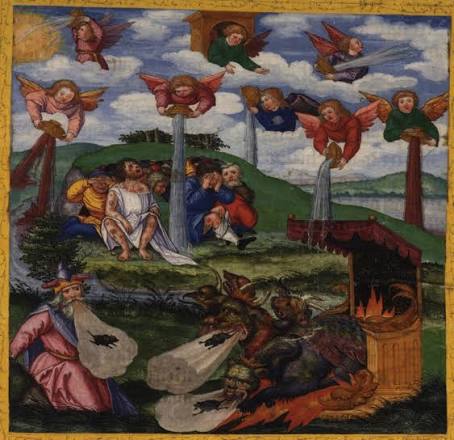
We are no longer aspiring to be a Son of Man; we are living as one. White symbolizes purity, while clouds are water-laden air that blocks the truth. The thing is, we aren’t trying to find our way through the fog anymore. We’re riding high on philosophical mysteries. We wear a crown, because we know our worth. It’s made of gold, because gold doesn’t rust or decay. It does, however, need to be refined in fire, and formed in a forge. We’ve done that, but our labors aren’t over, yet.
Harvesting the Earth and Trampling the Winepress
14 I looked, and there before me was a white cloud, and seated on the cloud was one like a son of man with a crown of gold on his head and a sharp sickle in his hand. 15 Then another angel came out of the temple and called in a loud voice to him who was sitting on the cloud, “Take your sickle and reap, because the time to reap has come, for the harvest of the earth is ripe.” 16 So he who was seated on the cloud swung his sickle over the earth, and the earth was harvested.
A sickle is a handheld tool with a short handle and a curved blade that is ideal for cutting grass. By comparison, the implement the Angel of Death carries, in movies and pictures, is a scythe. Sickles require a lot more bending at the waist than scythes do. I believe that is important to understand this verse. The Son of Man has to get close to the grass, or plant, to cut it. Recall that grass is the favored food of sheep, not goats. It is a staple and a comfort food for them. In the scriptures, grass represents the boring things that nourish us, such as the work we do that isn’t exciting.
In this verse, an angel tells this particular Son of Man to reap, because the harvest of the earth is ripe. In other words, he has reached the stage of his journey where even boring labors are comforting to him, so long as he keeps the proper perspective.
Many of you know that the hardest part of the marriage comes after the honeymoon. Good relationships are boring and require a lot of work to maintain, but in the end they pay off. Now, our hard work is paying off. The Son of Man finds spiritual nourishment in every corner of the world, because he knows where to look for it.
Perhaps you still aren’t clear on what hidden manna looks like. Well, let me give you an example. Purple is the color of a monarch. Rain is spiritual refreshment from above. When you put these two things together, you realize that standing in the purple rain would mean that you are in a place where God reminds you that you are royalty.
Most of us, when we hear Purple Rain, the song, are transported to a higher state of being. Despite its innate sadness, we know that it is a love song, and that the purple rain would be a wonderful place to be. In this way, Purple Rain is hidden manna. It refreshes our spirit.
If it’s difficult for you to imagine that Purple Rain was divinely inspired, then you are forgetting that God is the creator of all things. If you only look for hidden manna in comfortable places, then you’re missing the point. In a grassy valley, there is no need for an oasis.
Judas went to Hell to signal the coming of Jesus, because the lost sheep are never in the barn. The shepherd and his helpers must go into the wilderness to find them. Even in the darkest places, there is some light, because we do not know absolute darkness in this world.
Now, with that in mind, doesn’t that shed some light on Matthew’s statement? He said, “So if the light within you is darkness, how deep is that darkness!” He wasn’t asking a question. The truth is, even in the darkest heart, there is some light. It’s just that some wavelengths of light are not visible to the naked eye. Both angels and devils are counted among the children of light. Let God be the prism that shows you their true colors.
17 Another angel came out of the temple in heaven, and he too had a sharp sickle.
This time it’s an angel who comes out of the temple in heaven, with a sickle. This means that God is doing His part of the work, and we can see it with our own eyes. The temple in heaven is the place where God worships. It represents His intentions toward us. This angel tells us those intentions are good, and that the fruit of the earth, which is the product of every life, will not be wasted.
This part of Revelation describes the moment when we, as Sons of Man, can see the true beauty of God’s plan for all of humanity. We know where we’ve been, where we are, and where we’re going, and it’s a good place. The world is in good hands.
18 Still another angel, who had charge of the fire, came from the altar and called in a loud voice to him who had the sharp sickle, “Take your sharp sickle and gather the clusters of grapes from the earth’s vine, because its grapes are ripe.”
Fire is scrutiny. In this case, it is not ours, but God’s scrutiny that comes to us from the mouth of an angel. This messenger reassures us that God’s actions, the work He does for humanity, and His sacrifices are in our best interest. Remember that His sacrifices are the things He allows to happen, so that we can become better. Notice, also, that this is one angel speaking to another, and that angels carry messages from God. Here we see that the epiphanies we receive back each other up, building on each other to make a more complete message of love.
19 The angel swung his sickle on the earth, gathered its grapes and threw them into the great winepress of God’s wrath.
Oh no, there’s a scary word. Wrath is extreme anger. If we read this verse without love as our key, we might conclude that God is angry at the world. The truth is, these verses tell of a change in perspective, as we grow into Sons of Man. I’m sure you’ve heard it said that things have to get worse before they get better. In this case, it’s true. We have a lot of ground to cover before we reach the end of Revelation. Plagues are coming. We’re going to get sick because of the things we will come to understand. Knowing that God’s intentions are good won’t be enough to stop us from hating Him when the fever is on us.
This verse is the beginning of our illness. Just like Jesus, we will wonder why God has forsaken us and the world. The winepress of His wrath is a misperception on our part. It is where our love (Our sweet fruit) turns to bitter wine that makes our head spin, all because of a question.
We know that all the suffering the world endures is for a good cause, but we can’t help but wonder why it has to be this way, in the first place. Why do we need to learn to walk and talk, when God is all-powerful? Why doesn’t He just make us upright and good? He could do that, couldn’t He? Sure He could. So why, then, must we suffer? The answer is simple, but knowing it won’t help ease our pain. We suffer because two things are better than one.
The Beatles told us that love is all we need. I understand what they were trying to say, but I also know that if all we needed was love, then love would be all that we had. The hard truth is, evil is just as important to our growth as good is. Understanding that doesn’t make the plagues any easier to deal with.
20 They were trampled in the winepress outside the city, and blood flowed out of the press, rising as high as the horses’ bridles for a distance of 1,600 stadia.
What horses? The last horses we encountered were way back in Rev 9:17. Are these the same ones? Those horses killed a third of mankind with the three plagues that were spewed out of their mouths – fire, smoke, and sulfur. They had heads like lions, and tails like snakes. Their power was in their mouths and their tails. Those horses carried the Army of Euphrates (the Stoics). They came out of a river, back in Rev. 9, but now they tramp through a river of blood (If they are the same horses)
Notice that the grapes were trampled outside the city. When we are in New Jerusalem, and living in peace and harmony with God and His plan, there is no anger in us. Our doubts live outside the gates.
Remember that blood is life, and when it’s shed, it symbolizes sacrifice and toil. To us, at this moment, all the suffering of the world seems pointless. Even the greatest of stoic philosophers can’t help us wade through this river of blood.
A bridle is used to guide a horse. It fits over their head. It sits above the mouth. In order to keep from drowning, these horses would need to raise their heads. I think that’s important. Remember that Stoics don’t look up for guidance. They find all of their spiritual water in the world. For them, there is no rain from heaven. Their truth bubbles up from the ground.
Stoics see value in their own sacrifices, and expect the same commitment from others. They believe that if we would all do as they do, the world would be perfect. In this verse, John is continuing the war against his archenemies, the Stoics. He is telling us that, as Sons of Man, we need to recognize God’s efforts, too.
Once again, John is using a system of measurement. I have no idea what it means. A stadia was roughly 490 to 690 feet (Scholars are not in agreement on the exact distance). That means this river extends to a distance of between 784,000 and 1,104,000 feet. That’s between 148 and 209 miles. That means nothing to me.
It’s possible that this is a reference to a way of measuring distance, like stadiametric range finding, which is useful in determining the distance between a surveyor and a rod placed at a distant location. The problem with that is, stadiametric range finding is a 19th century development, so John wouldn’t have known anything about it. My gut feeling is that John was using this metric to measure the distance between Stoics and Sons of Man, but I can’t say how. Perhaps someone out there has a head for numbers and can shine some light on this?
The overall focus of this section of Revelation is our doubt in the value of our suffering. It is okay to feel this way. Jesus felt this way. Doubt is as essential to our development as belief is. For Sons of Man, it is important that we face these questions, hold them up, and keep moving. Circumcision promises that everything will be revealed, in good time.
To counter our doubts, we need only look at how far we’ve come on our path of revelation, and how far the world has come in its drawing nearer to God. From the atheist Abraham, to Moses who loved too much, and Elijah who loved too little, to Jesus loving just right, progress is being made. Stoics have a lot of great ideas, if they would only learn to look up.
Revelation is a finger-trap for wannabe wisemen. Worldly wisdom won’t solve it. Many people have played with its symbolism, without seeing the truth of it. We are told that pride goes before the fall, and Revelation has proven that rule again and again. Imagine the Stoics and philosophers of John’s day, thinking themselves smart, yet totally unable to decipher the mystery of his dream. For nearly two thousand years the wisest of the wise have read it and scratched their heads. Now here it is, handed to us on a silver platter, at a time of God’s own choosing, in simple language that we all can understand.
The concern that freezes me in place is the question of what our nightmares will look like when there is nothing more to fear from John’s dream, and the book it became. Terror is a trillion-dollar business, and much of that empire was built on misconception. How many apocalyptic movies have been made, just since 1970, and how many of them drew on the fear Revelation inspires?
How many people will cling to their misconceptions, just because they love scary movies? I suppose I shouldn’t let it bother me. They are not my problem. They are in good hands, and those hands aren’t mine. The true goal of a Son of Man is to become careless. When our trust is completely in God, then we truly have nothing to fear, even fear itself. We can lay our concerns on His shoulders, and live untroubled and free of our cares. It is a difficult peak to reach, and one that we are easily knocked off of.
Seven Angels With Seven Plagues
15 I saw in heaven another great and marvelous sign: seven angels with the seven last plagues—last, because with them God’s wrath is completed.
Only seven more hurdles until we reach that shining city. I hope that you have noticed the importance of the number seven, and what it recurringly refers to in Revelation. There are seven spirits of God, and seven vanities within us. The spirits move our vanities, like potentiometers change the volume of our radios. We slide between lust and chastity, or greed and charity, because God is our DJ. Each of the plagues that follow is tied to a specific vanity. Each has a messenger angel that rings our bell. When we vibrate, we make other things vibrate. That’s just physics. God uses the systems He created because He loves them. We are all His orchestra. His wrath only seems like wrath because it makes us move against our will.
2 And I saw what looked like a sea of glass glowing with fire and, standing beside the sea, those who had been victorious over the beast and its image and over the number of its name. They held harps given to them by God
Glass is melted sand, basically. A sea is salty water, not fresh; therefore, it represents the things we believe that have been made bitter by worldly experience. Coming face to face with the fact that God is behind not just the good, but all the bad in the world, is a bitter draught to swallow. It is made even more bitter with the knowledge that there is nothing we can do about it, and that it is probably, truly, for the best. The glass sea is solidified belief. In other words, we know it beyond a shadow of doubt, but still can’t prove it to others.
This sea is glowing with fire, which represents our scrutiny. We are playing with fire in our minds. Our anger and hate and resentment are set ablaze by our evolving understanding. We have overcome the beast, which is the idea that Jesus was just a man, not an angel living a man’s life. His image is what others tell us he was, not the picture of him that is developing in our minds, with God’s help. The number of his name is the formula we all use for making good decisions, which even he abandoned in order to become the lamb we needed. He abandoned his idea of what a messiah should be, and let God make him into what he was born to be.
We have left the formula behind because it does not allow for leaps of faith, and a leap of faith is necessary to put ourselves and the world into God’s hands. Doing that brings peace within us. The world is not ours to save. In fact, it has already been saved. As bad as we think it might be, it is perfect just the way it is.
Harps are somewhat triangular in shape. They have three basic structural parts: the soundbox at the bottom, the harmonic curve at the top, and the pillar at the side to hold it up. Their strings run between the soundbox and the harmonic curve. They represent the relationship between God and the world, with Him above and us below. The pillar is our new understanding, holding it all up. We can see the strings (our vanities) running from above to below, and hear the music they make in the world.
A harp is also representative of the Trinity, the Father, the Son, and the Holy Spirit. Typically, fathers are role models. Little boys want to be like their fathers, and little girls want to marry a man like their father, if their role model is positive. Good fathers are deserving of our respect and admiration, and worth looking up to.
In the Trinity, the Son represents our growth as children of God. Jesus had to grow into his role, and so do we. He ascended to the Father, and so will we. Our classroom is the world. It is a safe space where we can experience the totality of good and evil before we rise into the House of God. It is the place where we learn the rules, so that we will know how to walk properly in His presence, as part of the Heavenly Host.
Note that the name “Israel” represents those who seek a closer connection with God. Not all who call themselves Israelites truly deserve the name. And as Jesus himself learned, some of the dogs under the table might like to wear that title too. A dog is a beast, but even old dogs can learn new tricks.
The Holy Spirit is the pillar that keeps the other two in their proper places. A son can become a father, in his own right, but no matter how hard he tries, he will never be the man his father is (He might be better, or he might fall short). The Holy Spirit represents God’s intentions toward us, or the spirit in which He exercises His will toward us. We will never be forgiven our blasphemies against the Holy Spirit, because God does not want us to forget that, at times, we believed He was against us, or that He didn’t care about us at all.
Rev 15:3 and sang the song of God’s servant Moses and of the Lamb: “Great and marvelous are your deeds,
Lord God Almighty. Just and true are your ways, King of the nations. 4 Who will not fear you, Lord, and bring glory to your name? For you alone are holy. All nations will come and worship before you, for your righteous acts have been revealed.”
Moses loved the people dearly. He subordinated the Law to them, because of his desire to be great among them. Recall that he was raised as an Egyptian, but later found out that he was Hebrew. I think of him like one of those people who takes a DNA test and realizes they belong to some group they weren’t aware of. Then they go above and beyond trying to recapture their heritage. For instance, they discover they are part German, and the next thing you know they are wearing lederhosen and listening to polka music.
Though he was Hebrew, he had the sensibilities of an Egyptian. He wanted for the Hebrews the self-respect that the Egyptians had, not knowing that the Hebrews had their own form of self-respect. When he saw an Egyptian beating a Hebrew, he intervened because he thought the Hebrew should stand up for himself. After all, no Egyptian would allow themselves to be abused in such a manner without putting up a fight. When the Hebrew man chastised him for killing the Egyptian, he realized that the people he loved did not think the way he did. So, when he was forced to flee, he fled to a place where he could learn more about them. Then, when he met God face to face, the deepest desire of his heart became his calling.
As I have said, when we ask God what we should do, He will typically ask what we want to do. This is because He has already placed that desire inside us. We just need to admit it to ourselves.
Moses wanted to be a Hebrew, but his Egyptian sensibilities were at war with the image he had of the Hebrew people. In his eyes, they were being mistreated. They had also lived long enough under Egyptian rule and wanted someone to save them, and Moses was the perfect go-between to argue their case before Pharaoh.
Jesus and Moses both sacrificed something for the people. Moses was willing to set aside part of the Law to please the Israelites. Jesus was willing to shed his blood for all of us. That means he didn’t just die for us. He lived so that we would know how to live. He left Heaven and became human in order to deepen our understanding of God.
The nations are the ways we interact with ourselves and others. God rules them. He plays our vanities like a harp, ringing us and making us ring others. He did this to Moses and to Jesus. We all sing His song, whether we want to or not.
Holy is defined as dedicated or consecrated to God or a religious purpose; sacred. So, if God alone is holy, then He, alone, is dedicated to His own purpose. This means that no matter how much free will we think we have, it’s just an illusion. We all march to His drum. Realizing that all the steps we take are because of God’s urging can be a bitter pill, especially when we apply that to everyone else around us.
How can we hate the people who have wronged us when we discover it wasn’t their fault? How can we love a God who would let us get hurt? That is the question we must ask, because if we ask, the answer will be given to us. It may take some time, and some suffering, but understanding is on its way. It doesn’t help to know that God is also responsible for any delays in its arrival.
Rev 15:5 After this I looked, and I saw in heaven the temple—that is, the tabernacle of the covenant law—and it was opened.
A temple is a place where we go to worship. The tabernacle was a portable structure, like a tent, that the ancient Israelites used to house the Ark of the Covenant. The word tabernacle can also refer to a container for storing the Eucharist in Catholic churches, or a place of worship for some Christian groups. The important part, as it relates to this verse, is that it’s mobile. It’s inside us, but its location depends on how we see our relationship with God at any particular moment. When we begin to doubt the covenant we have with the Almighty, then the tabernacle moves into darkness, out of our hearts and into our minds.
The temple in this verse is the place where we revere or revile the Law. When it is opened, it means we can go in and out. In other words, we are debating the laws of God within ourselves. Perhaps we are asking ourselves why we should follow any of them when God doesn’t seem to care about us, or maybe we’re wondering why they need to exist if God is making us do everything, anyway? Are we really breaking any rules if we aren’t in control of our own actions? Is anyone else worthy of damnation, if they aren’t in control of theirs? And why is revelation taking so long? Surely God could speed it up, if He wanted to.
6 Out of the temple came the seven angels with the seven plagues. They were dressed in clean, shining linen and wore golden sashes around their chests.
Angels are messengers. These are telling us we’re sick. Better yet, they are making us sick with the messages they are relaying. Our new understanding of God and His handling of the world can, on one hand, reassure us, and on the other, make us queasy. There is a part of us that wants to be in control. The Stoic in us wants to be God, not the subject of one.
The angels wear clean, shining clothes to let us know that God’s intentions toward us are pure. Their gold sashes should remind us of where our true treasure lies. It’s in our hearts, when Jesus is on our throne.
7 Then one of the four living creatures gave to the seven angels seven golden bowls filled with the wrath of God, who lives for ever and ever.
Recall that the four living creatures represent the nations. They are Monarchy, Democracy, Theocracy, and Anarchy. We don’t know which one this is that is giving the bowls to the angels, but we can probably guess. It is probably Anarchy, as it represents our choice to work with others or alone. In this case, we are wondering why God needs our help, and how much He is actually helping us.
The seven bowls are filled with the seven deadly sins. If our perspective is off, we might think God hates us, and that’s why He gave them to us. They are greed, lust, pride, gluttony, sloth, envy, and wrath. They are diseases of the spirit that can be cured by turning around toward their counterparts, the seven saintly blessings.
8 And the temple was filled with smoke from the glory of God and from his power, and no one could enter the temple until the seven plagues of the seven angels were completed.
Smoke is matter-laden air. It fills the place where we worship the covenant of the law. In order to clear it out, so that we can go in and find peace between us and God, we have to suffer the seven plagues that our vanities bring. In other words, we have to learn to heal ourselves of our deadly sins.
The knowledge that God is completely in control, and yet, somehow, we can take the reins for ourselves, is a contradiction that makes my head hurt. I know that the purpose of life is for us to learn all the ways of good and evil, but I cannot fathom the inspiration for our education. What made God think all of this was a good idea, in the first place? That’s a question that has not been answered for me yet. I cannot see our final destination, or what we will look like when we arrive there.