In the Image of a Son of Man
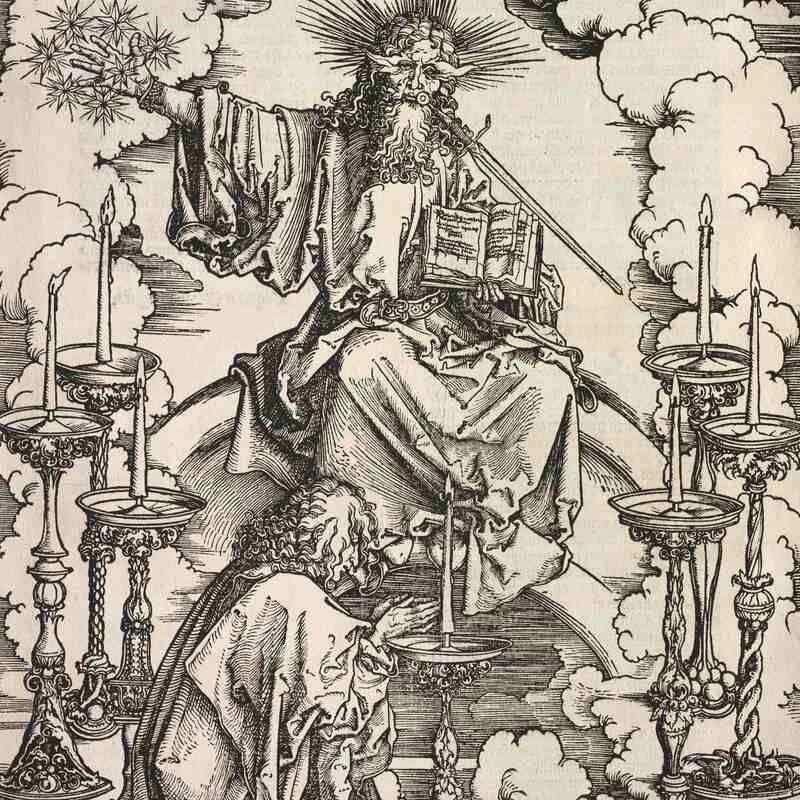
The image of the Son of Man provides us with a packing list for the road of revelation. The symbolism found in the first chapter of John's book gives us a glimpse of how we should attire ourselves, and what we should aspire to be and remain during our journey. We know that this image is not just of Jesus, but also us, because Daniel was also called "son of man" by an angel, as were others. A Son of Man is anyone who seeks a closer relationship with God. Our title represents our basic acceptance and understanding of who we are and where we are starting from. As we walk the road of revelation, our form will change until we reach the shining city where all things are lit from within. As you know, fire produces no shadow. Therefore, when we are all light, there will be no shade and no place for dark things to hide.
Location, Location, Location
Context is always important, and so is the scene that is set for us. John sees someone like a son of man, standing among seven lampstands. To understand the son of man, we must know what these lampstands are. Fortunately, John tells us. They represent the seven churches: Ephesus, Smyrna, Pergamum, Thyatira, Sardis, Philadelphia and Laodicea. None of those churches exist in a physical sense today, so why write letters to them? If they were only important in John's time, why do we still care what they say? It's because they hold a deep spiritual meaning, even for these modern times. They are places we believers can find ourselves in. They are starting points, but also waypoints on our journey. They can help us determine where we are, and if we are heading in the right direction. We will study them in depth later on. For now, just know that the Son of Man is surrounded by them, because this is the beginning of his journey on the path of revelation.
The Clothes make the Man
Bronze Feet
We wouldn't wear high heels on a twenty-mile road march. That would be insane, and insanely cruel on our feet. It would be in our best interests to choose more fitting footwear. Likewise, the road of revelation has a dress code, and we aim to dress for success. John describes the proper attire for us. All we need to do is figure out what each piece symbolizes. We'll start at the feet, since we're already on the subject. The Son of Man is not wearing shoes. Instead, he has feet that are like bronze glowing in a furnace.
Many people have tried to riddle out the meaning of this verse. So did I. Little did I know the answer was right in front of my nose. In ancient days people did not have mirrors like we have. Instead they used pieces of polished metal, like bronze. The Son of Man has mirrors for feet. There's a very good reason for this, and understanding it will bring another biblical mystery into the light of day. You see, when we travel the road of revelation we get tired. Naturally our head begins to sag, and instead of watching the road ahead, we focus on our feet. But when we do this, we see something most people don't. We see ourselves reflected in them, and we remember who we are and who we are aspiring to be. This reminder is of great importance, because it gives us the jolt of energy we need to keep going. We lift our head, and focus our eyes back on the road.
It is for just this reason that the washing of feet was so important to Jesus and his disciples. The road is dusty, and that dust clings to our feet, obscuring our reflection. In order to keep that image clear, we must frequently wash off the dirt and grime of the road. And sometimes we need to wash our neighbor's feet. In this way we can remind each other of who we are all trying to be.
This will take on yet another meaning when we get to the symbolism behind dirt.
Our feet shine like they are in a furnace, because fire represents scrutiny, and we should always scrutinize ourselves and the image we see reflected back to us. Hindsight is 20/20.
A White Robe
Onward, Christian Soldiers is a popular hymn, and we are urged to put on the full armor of God, but it is important to note that only wizards in fantasy novels fight in robes. In ancient days, Roman soldiers fought in leather armor with pleated skirts, but many other armies fought naked covered in bear grease, or in light tunics. This is because clothing hinders movement, especially when it's a full-length robe. Cloth offers no protection against bladed weapons, so our ancestors made the choice to wear as little as possible, so that they could move freely. It is better to get out of the way, than to rely on your apparel to stop an incoming blow. What we can deduce from this is, that the Son of Man is not a warrior. In fact, he is a scholar, because only scholars and courtiers wore robes. His robe is full-length, because he is modest, and because it forces him to move more slowly, pondering each step. The road of revelation is not one that should be traveled quickly. For much of it, we have to do our own homework, because this is a team effort between us and God. That is what we should remember, when we see our white robe reflected in our mirrored feet.
White clothing is the hardest to keep clean. It symbolizes our attempts at remaining pure. I say attempts, because like our feet, our clothes will need a regular washing to remain in proper order.
A Golden Sash
Sashes are typically used like belts, except in beauty pageants and as symbols of award. In this case, the golden sash that the Son of Man wears is a reminder of where his true treasure lies. It's in his heart, when a fire is lit there. That fire is not one we can light ourselves. Only Jesus is able to ignite it. What we can do is invite him in, as our guest. When he is in residence in our heart, we are lit from within. And since he is a carpenter, we shouldn't be surprised when he remodels the place, and makes it big enough for the whole world.
Our sash should also remind us that we are a contestant for the hand of the Groom. We are in a pageant, and pageant contestants are under scrutiny. In order to meet his approval, we must show him that we are of the same mind as him. We must be just as committed as he is. What he really wants from us is a desire to be better.
Blazing Eyes
Speaking of lit from within, when there is a fire in our hearts it shines out on the whole world and alters what and how we see. Through the lens of our blazing eyes, the whole world speaks of God's love. The movements of His hands are no longer hidden. But we have two eyes, and blazing eyes symbolize two things. One, that Jesus is in our hearts. And two, they are a reminder that we should scrutinize everything, just as we are scrutinized.
White, Curly Hair
White always symbolizes purity and freshness. In the case of our white hair, we earned every one of them. First they turn gray, as do our moods when we get older, then they go white as we shake off our cares. The world is in good hands. It is out of ours, for the most part. We leave our matters and concerns where they belong, with God.
Our hair curls the way our thoughts do. They spiral around, but that doesn't mean they are trapped in a circle. They move out of our heads, into the world. They are like the Old and New Testaments, who display the spiral of human evolution from one idea to another. The best example of this is the conundrum of an eye for an eye. Many people believe it to be a commandment. I am not one of them. In my eyes it is a simple observation. When we lose an eye, we gain a new way of seeing things. Our depth perception suffers. Scientists know "an eye for an eye" by a different name. To them it is "Nature abhors a vacuum". It tells us that when something is moved, something else will move in to fill the space it left, even if that something is only air. We Christians know that man does not live by bread alone, but by every breath that proceeds from the mouth of God. For us, air is a great gift.
If we assume that "an eye for an eye" is a commandment toward vengeance, and we follow it to its likely conclusion, then we are not the only person who loses an eye. We take the eye of the person who took ours. In some minds, this would make us even. But the objective is not to be even. We are trying to be better. Taking someone else's eye will not make us feel better. And, it would demand that they seek retribution from us for the eye we took. They would need to take our other eye, and so on it goes until no one has any eyes left. This is how generational feuds are started, and this is why they are so hard to stop. No one remembers who wronged who first, so no amends can truly be made.
If "eye for an eye" is a commandment toward vengeance, why did God claim vengeance for Himself and what about the other rules? What about loving our neighbor as ourself? What about doing unto others as we would have done unto us? If we place these in the order Jesus assigned to them, they outweigh our vengeful rights. If we love our neighbor as ourself, and we loved having two eyes, then why would we wish to rob our neighbor of one of theirs, regardless of what they did? If we didn't want them to take our eye in the first place, how is it wise to go and take theirs, no matter the reason? It's not wise at all. We didn't want anyone to take our eye. Therefore we should refrain from taking theirs.
This is how thoughts spiral. This is how we go from the Old Testament (an eye for an eye) to the New Testament (forgiving those who trespass against us). They are an evolution of ideas, and should only be read as such.
The Seven Stars
This is the proper uniform of a Son of Man. In these clothes we will walk the revelation path together. As for the stars, we are told that they are the angels of the seven churches. Stars represent angels, and angels are messengers. They provide us with our spark - our question. The ones that we hold are tied to our vanities, of which there are seven. We will discuss them in depth later. For now it is important to know what it means to hold things in our hand. It shows that we are controlling them, or at least trying to. When we hold something in our right hand, it means we are using it for our benefit, or for the benefit of others.
Angels are mesengers, but some messages are warnings. The seven churches warn us not to stay in them. They are only starting points on our road. We are each standing in one of them. To leave one, we may have to wander through the other six. We'll discuss them at length in a future section.
The Lampstands
A lampstand is a place to hold our fire. That's what the churches are. They are conduits of communication between us and God. As we will see, Philadelphia is the best church. It is the only one that Jesus doesn't have a problem with. It also holds a door to heaven. It's our way out, beyond religion. Why would we want to go beyond religion, you ask? Because religion is a crutch, and there are no cripples where we are going. As babies, when we were learning to walk, most of us pulled ourselves up on whatever we could find. We used furniture to help us stand, and keep us standing until our legs were strong enough to do the job alone. Likewise, religion is the furniture we pull ourselves up on. In Philadelphia we become pillars in God's church. We become like turtles, carrying our place of worship with us wherever we go. We do not simply follow the law, we become it. It is written on our hearts and it is ever on our minds.