Woah is Me
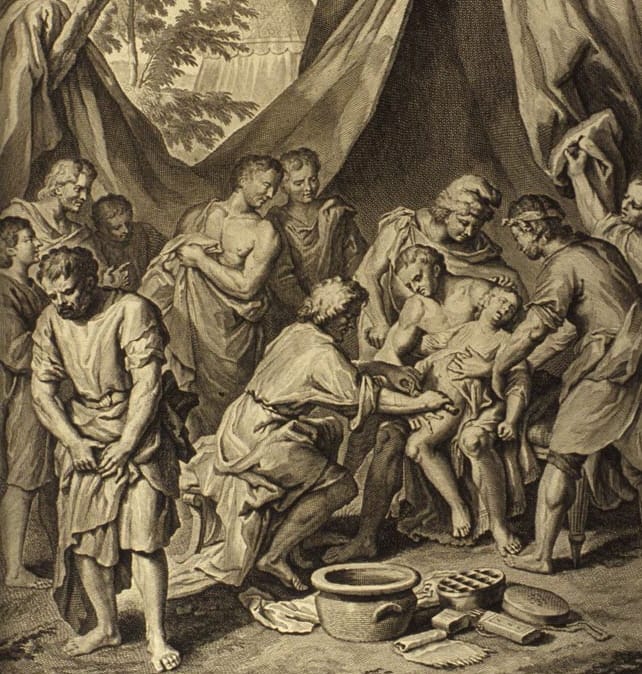
Sometimes a little reflection is all that we need. Remember when I said we need to exercise the patience of saints? John was given a half hour of rest, and now his head is alight with epiphanies that are rocking his world. We are being warned that our solid ground will shake, as well.
2 And I saw the seven angels who stand before God, and seven trumpets were given to them.
3 Another angel, who had a golden censer, came and stood at the altar. He was given much incense to offer, with the prayers of all God’s people, on the golden altar in front of the throne. 4 The smoke of the incense, together with the prayers of God’s people, went up before God from the angel’s hand.
Trumpets were the ancient world’s version of an early warning device. They called men to battle, announced the arrival of important people, and summoned the people to some special event. We are being called to witness the process of revelation as a visitor, standing outside that process, by the angels of the seven churches. Our location matters, because our perspective changes what and how we see.
It should be noted that the first thing people do when they hear a trumpet is stop and listen.
An angel, a messenger, holds a golden censer, which is a covered bowl used in religious ceremonies, to burn incense. The person carrying the censer swings it back and forth, or left and right, to spread the smoke.
Smoke is air laden with matter (particles). Those particles block the light. That’s why we have difficulty seeing through smoke. Depending on where you are in relation to the burning incense, you may get a nose full, or barely a whiff.
The smoke might be thicker around you, getting in your eyes, making you cry, and blurring your vision, or its veil might be very thin from your perspective. Regardless, remember that it is an angel who spreads it, and angels carry out the will of God. Where the veil is, or how thick it is, is not up to us. All we can do is hold up our own matters before God, so that he can help us untangle them.
In the Scriptures, smoke represents the things that get in our eyes, as in our matters and concerns. They blind us and distract us from the truth, which is God. These things can also be pleasing to our noses, or they can cause us to turn up our noses in disgust. We might cover our mouths to keep from breathing them in, or cough to expel them. Regardless of our reaction to them, they make us move, like a censer being swung, left and right, forward and back.
Notice that the prayers of God’s people go up with the smoke. That’s because we don’t pray about things that don’t concern us. We only complain about the obstacles in our way. The mountains we pass are just scenery. It’s the boulder in the road that builds our anxiety.
Even our prayers of thanks are born from some obstacle we perceived that God helped us avoid.
The altar before the throne is gold, as is the censer. We’ve already talked about gold and its value. An altar is where we sacrifice things to God. In this case, we are sacrificing our pride by admitting that we cannot resolve our problems without Him. We are offering up our matters and concerns. We are taking the people and things we care about and placing them in His capable hands. With the aid of His perfect perspective, we can see them clearly and find our proper role in relation to them, but first we have to let them go so that they can rise.
People say that if you love something, you should set it free. In this case, it works. By giving our matters and concerns to God, we can gain a moment of relief from them. We can become careless, meaning that even though we love them with all our heart, we couldn’t care less about them.
Care and worry are synonymous terms. The best way to handle our matters and concerns is not to worry over them. Instead, we can give them to God, then go do something else until he sends us an epiphany that will guide us in dealing with them. In this way, we become careless.
We should not worry about being careless (failing to pay enough attention or thought to what you are doing, often resulting in mistakes, damage, or accidents). At times, Jesus was careless with his actions. The truth is, we cannot see where our carelessness will lead, or what lessons will come from it.
This does not mean we should just do whatever we want, without thought of the consequences. We should always talk before we walk.
It does mean that we should not overly concern ourselves when milk is spilled. If we never spilled milk, how would we know how to clean it up?
5 Then the angel took the censer, filled it with fire from the altar, and hurled it on the earth; and there came peals of thunder, rumblings, flashes of lightning and an earthquake.
Even angels make messes, sometimes. If you let go of a thing and it doesn’t come back to you, then it was never yours. That is how I look at the conundrum of the half hour. I don’t know why it’s specifically a half hour. It hasn’t come back to me, so I can assume that it isn’t mine. That might change in the future. If it does, and an epiphany comes, so be it. Until then, I’m not going to stress over it.
Evil spirits always come back. Jesus told us so, and our condition is worse when they invite their friends in. The lesson from that story is that we should love the devils we have and be happy we don’t have worse. No matter how bad you think your situation is, it can always get worse.
By loving our devils, we come to understand them. We don’t kick them out; we learn to live with them. We watch them as if they are the apple of our eye. We study their every move, and by doing so, we learn a lot about ourselves, because they are a part of us. We cannot rid ourselves of them for good. They belong with us. They seem like a stumbling block, but with God’s help we can turn their presence into a blessing.
Jesus is a carpenter. The moment he moves into our hearts, he begins renovating us until our hearts are big enough to accept everyone, even our evil spirits, and if we can accept ours, then we can accept the evil spirits in others as well.
Revelation 8:5 signifies God’s answer to us regarding our matters and concerns. His messenger is returning them to us, with world-shaking epiphanies. He is giving us what we asked for: a way to deal with our problems, though sometimes we don’t like the answers.
The storm that revelation brings is often scarier than the obstacle we prayed to be rid of. Every addict has to admit that they are, and will always be, an addict. I quit smoking over twenty years ago. Still, I am a smoker to this day, because I wage a war with smoking every day. The battle is easier now than it was, because I am more practiced at denying my craving, but the craving is still there. That’s the evil spirit that I cast out. It came back and brought an abundance of pride with it. That pride changed the way I looked at other smokers. If I could quit, so could they… except it took me twelve years to quit, once I started. Sometimes I forget that.
6 Then the seven angels who had the seven trumpets prepared to sound them.
Now that we know the process, it’s time to move again. The trumpets are calling. Remember that they are the angels of the seven churches, which are the messengers that tell us where we are. They are our GPS locators. Listening to them will help us stay on the narrow path. That path is only wide enough for one, because we are the only one following it. Our life is absolutely unique. Others may walk similar paths, but none go to all the places we go, or see the sights as we see them.
7 The first angel sounded his trumpet, and there came hail and fire mixed with blood, and it was hurled down on the earth. A third of the earth was burned up, a third of the trees were burned up, and all the green grass was burned up.
The first church was Ephesus. Here’s a reminder of its verse:
2 “To the angel of the church in Ephesus write:
These are the words of him who holds the seven stars in his right hand and walks among the seven golden lampstands. 2 I know your deeds, your hard work and your perseverance. I know that you cannot tolerate wicked people, that you have tested those who claim to be apostles but are not, and have found them false. 3 You have persevered and have endured hardships for my name, and have not grown weary.
4 Yet I hold this against you: You have forsaken the love you had at first. 5 Consider how far you have fallen! Repent and do the things you did at first. If you do not repent, I will come to you and remove your lampstand from its place. 6 But you have this in your favor: You hate the practices of the Nicolaitans, which I also hate.
7 Whoever has ears, let them hear what the Spirit says to the churches. To the one who is victorious, I will give the right to eat from the tree of life, which is in the paradise of God.
Consider what hail is. It’s frozen water that pelts you like a stone from heaven. In order for frozen water to fall on you from heaven, you must be below heaven. That means you have lost your love, because when Jesus is in your heart, you’re in heaven, sitting beside him on the throne.
This trumpet is warning you not to return to Ephesus. It’s raining fire mixed with blood, so that you will remember that your spark comes from the blood of a star, and that scrutiny burns away all impurities. But it’s not just the blood of the Lamb that’s required to stay out of Ephesus; it’s your blood – your life, as well. You must remember that you bleed just like everyone else.
I find it easy to judge other smokers from the high horse of my victory over smoking, but that is a false perspective. In order to love them, I must acknowledge that I am one of them. I fought their battle, once, and lost it over and over again. To properly respond to them, I must become careless and give them and their addiction up to God. They are in his hands, not mine. The best I can do is commiserate with them, but only if they are in the mood for commiseration. Most people don’t like having a light shined into their dark places.
When Jesus ate with people, he didn’t talk about their sins unless they broached the subject first. He just enjoyed their company. If I know smokers, it won’t take long for them to ask you for a light, or to offer you a smoke, because misery loves company, even if that misery doesn’t recognize its own miserableness. If I am given that opportunity, I might mention that I don’t smoke anymore, and perhaps they will give me the chance to elaborate, but it’s a narrow, slippery slope. It’s easy to turn people away if our pride prevents us from properly reading the room.
Once we’ve been adequately stoned with ice and fire and blood, much of what we thought was truth will disappear. Earth is a mixture of crushed stone, metals, and decayed flora and fauna. Soil is proof of resurrection. Life springs from death. Our second life sprang from the decay of our first life, but that first, dead life nourishes our new one.
Trees are the tools we use to apply our philosophies. Towers rise with the help of scaffolding. Things we thought were possible, impossible, or important die in the light of our focus, as does our comfort, because only disproportionate comfort can motivate us to move. Adam and Eve ate the fruit because their curiosity made the garden seem boring. They had an excess of comfort, which triggered their gluttony to want more than they had. Too much comfort often means not enough excitement. Since nature abhors a vacuum, we look for something to fill our interest.
We all prefer different temperate zones. Some like the desert heat, while others love the cold. Sheep love valleys; goats love steep, rocky cliffs. One of the things that makes us unique is our preferred distance from the fire.
Green grass signifies comfort. It does not grow in deserts without an abundance of water and care. If you’ve ever lived in a desert and tried to grow a manicured lawn, you know how much work is involved. You have to feed it and water it and give it all the things that desert soil lacks, only to have it burn up from too much sun, despite all your hard work.
If we want something to grow where it wasn’t meant to grow, we first have to ask ourselves why we want it so badly, and if it’s really worth the effort. Why would green grass be better, in our opinion, than the natural desert flora God has already provided?
Becoming careless, holding our desires up to God, can help us see the truth in them. Sometimes the answer is to hug our evil spirits, instead of pushing them away. The Deadly Sin associated with Ephesus is envy. Keeping it in check allows us to be happy with what we have.
8 The second angel sounded his trumpet, and something like a huge mountain, all ablaze, was thrown into the sea. A third of the sea turned into blood, 9 a third of the living creatures in the sea died, and a third of the ships were destroyed.
Smyrna is the 2nd church. Its deadly sin is pride. Pride is the leading killer of Christians. Here are the words that were sent to its congregation:
8 “To the angel of the church in Smyrna, write: These are the words of him who is the First and the Last, who died and came to life again. 9 I know your afflictions and your poverty—yet you are rich! I know about the slander of those who say they are Jews and are not, but are a synagogue of Satan. 10 Do not be afraid of what you are about to suffer. I tell you, the devil will put some of you in prison to test you, and you will suffer persecution for ten days. Be faithful, even to the point of death, and I will give you life as your victor’s crown.
11 Whoever has ears, let them hear what the Spirit says to the churches. The one who is victorious will not be hurt at all by the second death.
Slander is a false accusation. In this case, we are being slandered by false Jews. People who pretend to believe are accusing us of not believing. The problem is, we know they’re wrong, but how do we prove it? The answer is, we can’t. It’s a battle we have to let God fight for us. He is able to change the hearts and minds of men. He can uncover the evidence we don’t even know exists.
If we give in to our pride and try to wage this war on our own, we will only be led to wrath, which is where all of the churches go when they go too far. Recall that Laodicea is the last of the seven churches, and its deadly sin is wrath.
The trumpet of the 2nd angel shows us how to stay the course. When he trumpets, something like a huge mountain, all ablaze, is thrown into the sea. We know that our pride is like a mountain, and that it can be an obstacle on our path, but if we overcome it, well… there’s nothing like the view from a mountain peak.
To defeat our pride, we must set it on fire. We must scrutinize it. We must ask ourselves why the words of others bother us, when God’s love is for us. By shining a light on our pride, we can see it for what it really is. We can stop ourselves from making mountains out of molehills, and we can love our neighbor, no matter how they feel about us.
The sea is feminine. Even when it seems still, it is moving. It is vast enough to drown all the mountains of pride we can throw into it. When our heads are hot, there’s nothing like a nice swim to cool us down, but the sea is different from a river. Rivers are fresh water. They begin as streams, born of snow, that run down the sides of mountains. The sea, even though she is fed by fresh water, is an entity all to herself.
The difference between seawater and fresh water is an abundance of salt. To understand what salt represents, we need to examine what it is. It’s a seasoning, for one, but it also has a strange effect on water – it absorbs it. Our bodies need salt to absorb water into our cells, and since the physical mimics the spiritual, we can assume that spiritual salt does the same. Salt is also a food preservative. Without it, humans would not have been able to spread across the globe the way they did. Salt allowed our ancestors to cross deserts where little food could be found.
Too much salt will kill you just as quickly as too little salt. Drinking seawater will bring on madness, then death, if you consume enough of it. If we live too much, people might call us salty, because life loses its flavor. Lot’s wife became a pillar of salt. Some might take this literally, but the scriptures are spiritual stories, more than physical ones.
The Bible doesn’t say Lot’s wife died. It only says she looked back. That’s the best way to become salty. If we imagine where we were is better than where we are, and we long to be in that fantasy place, then the place we are in loses its flavor, and we become salty.
I imagine that Lot’s wife longed to be back in the bustling city, not in a small town near the mountains. If we think of her saltiness as an attitude, then the whole story changes. We can see her lying around, bored and depressed, and ruining the flavor of everyone else’s life.
Her continued insistence that the world had ended would have left a bad taste in her husband’s mouth and spoiled her daughter’s perception of the world. Drinking from her well, they would have been driven to madness. Witnessing her depression would have probably prompted them to do something to save their world.
Whether or not they had physical congress with their father, or just plotted with him (their ideas being their offspring), we cannot know. Either way, there is a lesson in the story of Lot’s wife. Looking back is not the way, and living in a fantasy world causes more pain than a hard dose of reality.
Lot tried to find the middle ground, because that was his nature. In Sodom, he sat at the gate, which is neither in nor out of the city. We can guess that part of him wanted to be where his wife was, while the other part longed to be out in the wilderness with his uncle Abraham. He couldn’t make up his mind, so he was spat out of Sodom.
The angels told him he should run to the mountains, but I suppose he knew his wife would hate it there, so he chose a small town on the edge of the wilderness. A town, any town, would be more interesting than the mountains, right? I imagine that’s what Lot thought.
But maybe Lot made the right choice? He was a peacemaker, after all, and he chose the place he thought would make his wife happy. I’m sure all he wanted was a peaceful home. Little did he know that neither of the two choices could fill the hole that Sodom left in his wife’s heart.
The only real answer would be to wake her from her fantasy and make her live in the real world. Fresh mountain springs might have been the better choice to dilute her saltiness. From the high peak, she might have seen things differently. There was no substitute for Sodom. By offering her a compromise, Lot probably just made it worse and prolonged her agony, and his.
When we read the scriptures through a spiritual lens, instead of a physical one, they change into something less incredible, but more meaningful. It’s easy to see that miracles might not actually be that miraculous. God made the physical laws. Why would He break them? If I took the time to draw up a blueprint for a house, would I throw that print in the trash before the foundation was even poured? Would I stop halfway through and decide that I wanted a barn roof instead of a gable? If I were omniscient, I wouldn’t.
Stories of miracles do serve their purpose. They inspire us to reach higher than we thought possible. I’m not saying that miracles can’t happen, or that we shouldn’t try to become supernatural. After all, we were designed to break the law. Rebellion was built into our flesh. My point is, maybe the scriptures hold physical as well as spiritual truths, and we shouldn’t assume that the people in those stories were anything more or less than human.
The men of Sodom were human, after all. In fact, they were pranksters who loved playing tricks on strangers. We are told that they would offer visitors to their town bread that was poisoned. The poison would paralyze their guests, giving the men of Sodom plenty of time and opportunity to play their games on them. They would offer them water that was putrid. They would laugh at them and dance around them while they slowly died, but they were not completely lawless. They viewed Lot as one of them, so he did not have to suffer their pranks. They loved their neighbors, but their neighborhood did not stretch beyond the borders of their city.
When we understand this key fact about them, we can see that they wished to play their pranks on the angels that came to save Lot. However, Lot was not from Sodom. He had a different idea of how guests should be treated. We can see this in the way his uncle Abraham treated strangers – he invited them to share a meal with him.
When Lot offered up his daughters, who had never known a man, we can imagine that they were innocent, and that their father had kept them inside his house, away from the people of Sodom and their games, but the men of Sodom refused them, because they viewed Lot’s daughters as their neighbors, and you didn’t play tricks on your neighbor, because he might play tricks on you. That’s why they wanted only the strangers.
The angels, however, knew the hearts of the men of Sodom, and they knew their traditions, as well as the traditions of Lot and his uncle. They used that knowledge to shine a light into the dark hearts of the Sodomites. They proved to them that they were blind, because the truth is, a guest in our house is a temporary member of our family, and that’s how they should be treated.
Once the men of Sodom saw this, they could not continue as they were. Truth spread through that city like a fire, and Sodom ceased to exist, as did the other cities on the plain, which had similar ideas on how to deal with strangers.
When Jesus is in our hearts, the whole world is our city, and all of its people are our neighbors. More than that, we are all family, and we are all one. Borders are the best friend of criminals. What is law in one place might not be in another. It is a simple thing to break the law here, then skirt over there to avoid the punishment.
Unless we see the people of Sodom for who they really were, we cannot decide which of their actions we should refrain from. To be clearer, they didn’t like assholes; they were assholes. A plain is a boring place. Is it any wonder the Sodomites got up to no good?
Is the wilderness truly any better? Sure, it’s dangerous, but there are lions and other predators that live on the plains, just as tigers rule the wilds. If you live in a walled city, like Sodom, there isn’t much to do, and the dangers are safely on the outside. People live in the wilderness to avoid other people. They wall themselves up within themselves. They become a walking city without neighborhoods, because they don’t have any neighbors. The rest of the world is strange to them.
It’s easy to imagine that Esau probably didn’t want his birthright. He loved the wilderness, away from the tents of others. In his heart, he probably knew that he was not fit to lead the people. Jacob, on the other hand, loved being a towny. I’m sure their mother saw the truth that each son held in his heart, because mothers watch the children, while fathers watch the world.
Isaac's eyes were set on tradition. He was a scriptural Jew, clinging to his traditions, even before Judaism was a thing. It’s a good thing that his wife saw the truth. She organized a way for one son to supersede the other, so both could get what they wanted. In fact, Isaac was probably in on the scheme. I mean, even a blind man wouldn’t confuse goatskin with a hairy human arm, especially a man who had raised goats all his life, and think about the symbolism of goat hair. It’s straight, not curly, like that of a sheep, and she covered her son’s arms with it. Arms imply action in the scriptures. Rebekah showed her son the straight, short path toward victory, and he took it.
The Bible says Isaac loved Esau the most, which means he paid more attention to Esau than Jacob, because our eyes are fixed on the things we love. Isaac probably knew that the birthright would not bring Esau joy, only suffering, and he didn’t want that for his eldest son.
No, I think Isaac’s family found a way around an obstacle, but first, in order to be truly ready, Jacob had to go out into the wilderness, find a wife, and become successful in his own right, so he could better understand men like his brother Esau.
Even Esau’s threat of death toward Jacob could be seen as a spiritual act, not a physical one. It would be the same as him saying, “I’m gonna make a man out of you, little brother.” Meaning, you need some toughening up if you’re going to lead this crowd, and where do you go to get tough? Not into your tent. You need to go out into the wilderness and test yourself to find out what sort of man you truly are.
On his return, Jacob was probably afraid that he would become the younger brother, living in Esau’s shadow, again. The boy that he was had died in the wilderness; only now the man that he had become was in danger of dying, too. In order to prevent that, he had to show his brother that he was the bigger man. When we tell someone to be the bigger man, we mean they should lower themselves and sacrifice their wilder instincts.
Jacob sent all of those gifts to Esau to show him that he had plenty to spare. He had not wasted his time in the wilderness. He could lead men. He proved it by telling his servants who should go, and when. He proved himself a forward thinker who planned ahead, and that’s what the people needed, whether they lived in tents or out in the wilderness. Being a good shepherd requires keeping one eye on the flock, and the other beyond them, because danger can lie anywhere. Jacob came last, because a shepherd’s place is behind the flock, guiding them with the rod.
10 The third angel sounded his trumpet, and a great star, blazing like a torch, fell from the sky on a third of the rivers and on the springs of water— 11 the name of the star is Wormwood. A third of the waters turned bitter, and many people died from the waters that had become bitter.
The third angel warns us not to ride the cycle. Wormwood is a cyclical spiral of thoughts that always lead back on each other. Indecision lies in its halls. Wood that has been eaten by worms is full of tunnels. If you have lived with the symptoms of manic depression (bipolar disorder for you younger people), then you have wandered the corridors of Wormwood.
The great star that blazes like a torch represents our intense focus. It falls on the philosophies of the world, both those that bubble up from the ground, and those that run fast and deep. This passage signifies our examination of those philosophies.
They turn bitter because we can’t escape them. We can’t rectify them. We keep coming back to them, but they just don’t make sense, only because it is our wisdom that we are relying on. God’s light will help us discern good water from bad, but even the bad water leads to a spiritual death, so is it really all that bad?
The third angel is of the church of Pergamum. His message reads like this:
12 “To the angel of the church in Pergamum write:
These are the words of him who has the sharp, double-edged sword. 13 I know where you live—where Satan has his throne. Yet you remain true to my name. You did not renounce your faith in me, not even in the days of Antipas, my faithful witness, who was put to death in your city—where Satan lives.
14 Nevertheless, I have a few things against you: There are some among you who hold to the teaching of Balaam, who taught Balak to entice the Israelites to sin so that they ate food sacrificed to idols and committed sexual immorality. 15 Likewise, you also have those who hold to the teaching of the Nicolaitans. 16 Repent therefore! Otherwise, I will soon come to you and will fight against them with the sword of my mouth.
17 Whoever has ears, let them hear what the Spirit says to the churches. To the one who is victorious, I will give some of the hidden manna. I will also give that person a white stone with a new name written on it, known only to the one who receives it.
Perga-mummies are heretics. They get lost in minutiae that means nothing and leads nowhere but back to the beginning. They do not mark their path with breadcrumbs, and therefore cannot remember where they have been, or where they are going.
Still, they hold on to their faith. They look for a light at the end of the tunnel, without realizing the light is supposed to be inside them, not at the end of their journey. It is the walk and the talk, not the destination, that matters.
Perga-mummies ask themselves, how could God allow this, or why would God do that, then try to find sense in the maze, instead of the amazement. They look to Moses to tell them God’s words, instead of going in the tent and asking Him with their own mouth. They hide their heads from the face of God, daring only to look at His backside, unaware that the backside of Jesus is Satan.
Bread, even the crumbs, are the only way out of the Wormwood. To know which way to turn, we need only follow the way that Jesus set for us. It is one thing to ask, " What would Jesus do. It is another entirely to ask, " What did Jesus do?
He fell into the Wormwood once. He lost his way, and he died in the spirit, as well as the body. He called out to God and got no answer. He had to wait on the Father to become the Son. He was given all the power on earth and in Heaven, but would have gladly given it up in exchange for the life he wanted. It was only his faith that kept him walking and talking. Keep moving and mumbling, perga-mummies.
12 The fourth angel sounded his trumpet, and a third of the sun was struck, a third of the moon, and a third of the stars, so that a third of them turned dark. A third of the day was without light, and also a third of the night.
What could make the sun and moon and stars go dark? Clouds can do that. Matter blocks light, even if it’s just air laden with matter. It’s easy to be afraid of the dark.
When our eyes can’t see, our other senses try to take up the slack, but we’re not used to navigating by ear or nose. It freaks us out. To be honest, we rely too heavily on our own eyes. The letters to the churches are written for those with an ear to hear, not eyes to see or noses to smell. When the world goes dark, the best thing we can do is sit and listen. When Jesus was unsure, he went up into the wilderness and prayed. Remember that the wilderness is where we go to escape the voices of other people, so that we can attune ourselves to the natural voice.
The wilderness doesn’t have to be far from home, or outside the city. It could be as close as our closet. The fourth angel reminds us that we shouldn’t rely on others to tell us what to do or think. Yes, there is truth in the world, but understanding that truth takes communication with God.
Moses was a gatekeeper because the people weren’t ready to see the face of God. Jesus holds the gate open for us, so that we can go in and see Him for ourselves. Moses had a shining face. For people in dark places, that would be a terrible sight. That’s why we should close our eyes and just listen.
One of my favorite stories from the Old Testament, now that I know how to read it, tells of the Israelite battle with the Amalekites. They were descendants of Esau, which means they carried that wild spirit and distrust of people. The Israelites only wanted to share their good news with them, but the Amalekites were apprehensive, so there was a battle of wits, if you will.
My first clue that there was more to that story was when I imagined Moses standing on a hill, with his arms raised.
I thought to myself, he looks like he’s being arrested, and in a way he was. He was being restrained because of the great power of his reputation. You see, the Israelites had just left Egypt, and since word travels fast, I’m sure that other people were hearing tales of what happened. The fame of Moses would have spread like wildfire, but the truth of fire isn’t in its smoke, which is usually the first thing we see.
No one died in Egypt. That’s clear to me now. At least, there were no physical deaths. The Egyptian firstborn were born again. They were like hippy children in the sixties, who tossed away the mother’s milk they had been raised on. Their parents loved them and saw in them the future of their family, and had to suffer plagues before they would let them go, but the moment they were out of sight, the light in their parents’ eyes went out. They felt like they were duped.
They had given their children valuables to use in their worship ceremonies, on the promise that they would get them back, but they weren’t coming back, so their parents sent an army to get them back. It was the truth that washed over the Egyptian army at the Red Sea. Their blood, their offspring, were okay. They hadn’t been conned by Moses and the Hebrews. Their transformation was real, and so was their God. They returned to Egypt as new people.
For the Amalekites, the story was probably murky and therefore scary. They decided not to wait for the Israelites to attack them first. They hit the Israelites where they were weakest, in the rear, because it was the shining face of Moses that terrified them the most – and his staff, which they knew could turn into a snake if it hit the ground.
That’s why they arrested Moses. They made him keep that staff where they could see it, as far from the ground as he could, but while their eyes were on him, the words of the Israelites were in their ears, and those words were very soothing.
The battle being waged was for the hearts of the Amalekites. The Israelites weren’t conquering in the physical sense; they were converting in the spiritual one. They were going forth and making more Israelites. That’s why the Amalekites ceased to exist; they came out of the wilderness and joined the neighborhood. Joshua defeated the Amalekites with the sword in his mouth.
The fourth church is Thyatira. Its letter says:
18 “To the angel of the church in Thyatira write:
These are the words of the Son of God, whose eyes are like blazing fire and whose feet are like burnished bronze. 19 I know your deeds, your love and faith, your service and perseverance, and that you are now doing more than you did at first.
20 Nevertheless, I have this against you: You tolerate that woman Jezebel, who calls herself a prophet. By her teaching she misleads my servants into sexual immorality and the eating of food sacrificed to idols. 21 I have given her time to repent of her immorality, but she is unwilling. 22 So I will cast her on a bed of suffering, and I will make those who commit adultery with her suffer intensely, unless they repent of her ways. 23 I will strike her children dead. Then all the churches will know that I am he who searches hearts and minds, and I will repay each of you according to your deeds.
24 Now I say to the rest of you in Thyatira, to you who do not hold to her teaching and have not learned Satan’s so-called deep secrets, ‘I will not impose any other burden on you, 25 except to hold on to what you have until I come.’
26 To the one who is victorious and does my will to the end, I will give authority over the nations— 27 that one ‘will rule them with an iron scepter and will dash them to pieces like pottery’—just as I have received authority from my Father. 28 I will also give that one the morning star. 29 Whoever has ears, let them hear what the Spirit says to the churches.
With a star, we will always have light to guide us into the dawn. There’s a lot of truth in the phrase, It’s always sunny in Philadelphia. The way to that sunny place is out of Thyatira, where magic and fantasy rule the night. Our star is like a bank account that we can draw from whenever we need it. It’s our rainy day fund.
We add to our treasures in heaven by following the example of Jesus every day. He was human, and he recognized that same humanity in the people around him. If we let him, he’ll build a city inside us that is big enough for the whole world. When everyone is our neighbor, no one is a stranger. That’s the truth the descendants of Esau needed to learn. The Israelites were their long-lost cousins, not aliens at their gates.
13 As I watched, I heard an eagle that was flying in midair call out in a loud voice: “Woe! Woe! Woe to the inhabitants of the earth, because of the trumpet blasts about to be sounded by the other three angels!”
John watched, but it was his ears that brought the warning. The worst is yet to come. There are plagues in our future. Fortunately for us, we know a good doctor.
Eagles represent the way that we work with others. Eagles are solitary and territorial, but their mating ritual is a complex, spiraling, mid-air dance (plummet). Once they are mated, they become dedicated, monogamous co-parents who share the duties of raising their offspring.
If an eagle is warning us about the next three trumpets, you can bet that they signal the possibility of a split. We need to guard our relationship with Jesus, so that it doesn’t end in a death spiral. We are not on precarious ground; we are free-falling, trying to hold it together. (Eagles occasionally die during their airborne mating dance, which is why it’s called a death spiral, in the first place.)
9 The fifth angel sounded his trumpet, and I saw a star that had fallen from the sky to the earth. The star was given the key to the shaft of the Abyss.
The fifth church is Sardis, whose sin is sloth. Sloth is a lack of movement when movement is required. It encompasses the things we don’t do, even though we know we should.
In this case, we weren’t paying attention and need a reminder. Stars are angels, and angels are messengers, after all. This one isn’t shining in the sky. Like he’s supposed to be. He’s on the ground, alerting us to a hole in the road.
Notice the key is for the shaft of the abyss. A shaft is a tunnel with a hole on both ends. A bottomless pit could be as simple as a shaft that makes a U – or a U-turn. The fifth angel is warning us not to go into a place where we might get turned around. That place is the bottomless pit. What’s in there? Well, there’s smoke, so there must be fire.
2 When he opened the Abyss, smoke rose from it like the smoke from a gigantic furnace. The sun and sky were darkened by the smoke from the Abyss.
Clouds are a recurring theme in Revelation, because they represent veils that are placed over our eyes. This one keeps us from seeing the light of day and the sky above, where we think heaven is. Any good pilot will tell you that it’s not safe to fly if you can’t see where you’re going. This matter-laden air has confused our instruments, and lowered our visibility to nothing. Still, we have to move on.
3 And out of the smoke locusts came down on the earth and were given power like that of scorpions of the earth.
There is no real mystery to the identity of these insect-like creatures, when we view them with love. They are the things that bug us, the things that we love and care about. They are our matters and concerns. They are our family members, and our friends, and anyone or anything that might object to the new person we’re becoming. Their stings make us want to turn around and go back, but the way is always forward.
4 They were told not to harm the grass of the earth or any plant or tree, but only those people who did not have the seal of God on their foreheads.
These insects and their stings are all in our heads. They represent how we think others must look at us, not how they actually feel about our transformation. They cannot hurt the grass, because sheep eat grass, and we have a belly full. Grass is a comfort food, and the bread crumbs of our Lord’s life bring us peace.
They cannot hurt the plants, because plants grow, and so are we. Plants don’t look back, and neither should we. Plants grow wherever and whenever they can, but even when they wither, they don’t go back. They stack one cell on top of another, always aiming for the sky and the sun, except for their roots, which love dark, dirty places. We came out of a dark, dirty place, but now our goal is the clear, blue sky.
These insects cannot hurt the trees, because trees make lumber, which we use to build, and the lumber we need to build is all around us.
Treetops summon our eyes upward, and bid us climb them for a better view. In dense forests, it is easy to get lost. Sometimes we have to climb to gain the right perspective. The tools we need to rid ourselves of these pests cannot be taken from us, so long as there is a carpenter residing in our heart.
These bugs are only in our minds. Likewise, being sealed in the forehead is a state of mind. Some people are sealed because they are God’s secret agents, sent to introduce ideas into our lives that we would not have considered on our own.
Others think that they are sealed, but are not. They imagine themselves to be prophets or disciples, or even Christ himself. Those people cannot be hurt by the opinions of others, because their opinion of themselves overshadows everything.
5 They were not allowed to kill them but only to torture them for five months. And the agony they suffered was like that of the sting of a scorpion when it strikes. 6 During those days people will seek death but will not find it; they will long to die, but death will elude them.
We’re already dead, and born again. These bugs can’t re-kill us; they can only make us wish we were dead. They can make us beg for the cup to be taken from us, so that we don’t have to live the life God wants us to live.
Jesus himself was bothered by these pests. They are a swarm, and the best way to be rid of a swarm is to keep moving through them. If you do this, you’ll find that they aren’t as interested in you as you think they are. They are caught up in their own lives. You’re spending more time thinking about them than they are about you.
I don’t know what the five months signify. Maybe it was only meaningful to John. I do know that a scorpion raises its tail over its head when it is preparing to strike.
A scorpion’s sting can cause swelling and a burning sensation, tingling or numbness, restlessness, drooling, muscle twitching, slurred speech, a thick tongue sensation, roving eyes, and a staggering gait.
Scorpions are easily handled for those with a bit of understanding. People who live around them all the time know their limitations. They are not as scary as they seem to be. They’re tiny little bugs.
It’s true, their stings hurt, but most of them aren’t deadly. A little caution and vigilance are all you need to keep yourself safe from them.
These pests aren’t scorpions, though; they’re locusts. Scorpions don’t swarm. They’re solitary critters.
Locusts and fire both bring destructive change. That’s telling, since Abaddon’s name means Destroyer, and there’s a fire in the pit. He’s an angel, and his message is warning us of a destructive change that could turn us around. We can’t allow ourselves to become locked in indecision. We need to talk, and walk, in that order, so we can avoid the pitfalls.
To be clear, we are being threatened with the loss of things that we care about because of the new life we are leading. The thing is, this threat is mostly in our heads. It’s true, some people might move away from us when we become believers, but typically that only happens if we become unbearable believers.
7 The locusts looked like horses prepared for battle. On their heads they wore something like crowns of gold, and their faces resembled human faces.
Medieval riders covered the heads of their horses with chamfrons to protect them, because a horse’s head goes first into the battle. The head is the seat of logic. We are being attacked by the logic put forth by our friends and family. They are trying to reason away our new beliefs. They are fighting the spiritual with the physical. Fortunately, that never works.
In the same vein, you can’t fight their physical logic with spiritual arguments. Your words and feelings aren’t enough. You have to show them that there’s no danger in your new transformation, because the reality is that scorpions are more afraid of you than you are of them.
War horses are trained to react to their riders' movements, not just the reins, because fighting from horseback requires the use of both hands, whether you’re carrying a bow or wielding a sword and shield.
In this case, our locusts are reacting to our actions. We have to remember that we are the ones who are different, not them. They miss their drinking buddy. They don’t like awkward silences around the dinner table, but they don’t know what to say to us now that we’re reborn. They definitely don’t want to say anything that might start us preaching at them. They need a sign that we still love them. They need to know they are still important in our lives.
They wear something like gold crowns, because they are important, just not as important as our relationship with Jesus. Also, their concerns might not be as important to us as we think they are. Remember, this battle is mostly in our heads. In the end, though, they are only human, just like us. Their faces tell us so.
Warhorses are trained not to be frightened of loud noises and the screams of dying men, even if the dying man is on their back. We can’t allow the sounds of battle to drown out God’s voice. Our ears are our best navigational devices, not our eyes, especially our mind’s eye, which is prone to fancy.
8 Their hair was like women’s hair, and their teeth were like lions’ teeth.
A woman’s hair is seductive. These matters and concerns can easily draw us in if we let them. They can be mesmerizing, like the tail of a scorpion hanging in the air, because it is their tail that holds the most meaning for us.
For most animals, the tail stretches out behind them. They use it for balance. The scorpion’s tail arcs over its head when it prepares to strike. Symbolically speaking, your history with this person – your tale - is where the danger lies. It’s no longer behind you. It’s hanging over their head. This means it is weighing heavily on their mind. You need to keep that in mind when dealing with them. They are worried that things won’t be the same between you. That might be true, but that doesn’t mean your relationship has to end.
When a scorpion moves forward, its tail stretches out behind it, just like most other animals. The lesson there is: don’t focus on what was. Get your locusts focused on the future. Get them moving. Maintain your relationship. Show them that things can be just as good, if not better. Don’t let them drag you into the past.
The locusts have teeth like lions - canines designed for ripping and tearing. They will rip you to shreds if you stand in their midst and give them nothing else to eat. Share your bread with them. Not just the life of Jesus, but remind them of the life you shared with them. Don’t try to drown them in your spiritual water. Locusts don’t drink much water. They typically come in dry seasons. It’s best to stick to worldly dishes when dining with locusts.
One way to share the bread of Jesus without them knowing is to follow his example. Most non-Christians have a bad view of us because others in our flock go too far. They try to yell from the rooftop while sitting at the dining room table. Remember that Jesus only preached to people who came looking for a sermon, and evil spirits always come back with company.
Your friends might still smoke, and even though you quit, aren’t you still a smoker? Don’t let your pride tell you otherwise. Admitting that you want a cigarette when they light up, but also confessing that you don’t want to go back to that, might make them wonder why it’s better to be a non-smoker if you don’t make a big deal out of it. Show them why your life is better; don’t tell them. Put your soapbox away. These are your friends and loved ones.
9 They had breastplates like breastplates of iron, and the sound of their wings was like the thundering of many horses and chariots rushing into battle. 10 They had tails with stingers, like scorpions, and in their tails they had power to torment people for five months.
Iron is a very heavy metal. An iron breastplate would weigh you down. Still, it would cover your vital organs. You might be concerned that your new life is weighing heavily on the hearts of your friends and family. Maybe it is, maybe it ain’t. Regardless, you can’t fight their concerns with feelings.
Their hearts are covered, but their heads aren’t. You have to attack their concerns with logic, if and when they express those concerns. Sometimes we think everyone cares, and we want to explain and put them at ease, but usually it is us who are uncomfortable, not them.
We’re different. We think everyone sees it. We want them to know what happened to us. Typically, we don’t bother to ask them if they want to hear it, because it’s really us that we’re trying to convince. We secretly want them to affirm our new beliefs.
Take time, when you need it, to come to grips with the new you. Let others see it, because they trust their eyes more than their ears. Let them bring their observations to you. If they ask, it’s because they want to know. For instance, my father quit smoking, but didn’t tell anyone, even my mother. One day she noticed that the carton of cigarettes she had bought him was still unopened. When she asked him why, he told her he had quit two weeks earlier.
Other people aren’t as attentive to our lives as we think they are. Think about it: do you notice every little change in your friends? Probably not. Then why do we expect them to notice every change in us?
Sure, it’s a big deal for us, but they might not even notice if we don’t tell them. We want them to notice, so that we can show them how to get it for themselves, but that’s because we all want to help in saving the world. If we put them in God’s hands, He’ll uncover what needs to be uncovered. Maybe they aren’t thirsty enough to drink blood yet?
Remember the Seraphim and their wings? Two can blind them, two can trip them, and two can make them fly. Our matters and concerns have wings, too. They can drown out the voice of God in our ears. They can blind us and trip us if we let them. So how do we deal with them? We do unto others as we would have done to us.
Scorpions hold up their stingers over their heads. When they feel threatened, they prepare for attack. When they’re hungry and see prey, they do the same. We should follow their example. We will hold the things that sting us up over our heads, and give them to God. Only then can we kill them all and let God sort them out.
11 They had as king over them the angel of the Abyss, whose name in Hebrew is Abaddon and in Greek is Apollyon (that is, Destroyer).
The pen is mightier than the sword. Communication rules on any battlefield. Abaddon might be the Destroyer, but he’s just a courier in our army. He reminds us to keep the lines of communication open between us, God, and our family and friends. Then we can become like John the Baptist, wandering the wilderness, living off of wild honey and locusts.
12 The first woe is past; two other woes are yet to come.
It wasn’t just a woe; it was a woah, because it made us stop and think about where we are, and where we’re going. Sometimes, along the road, we have to check our compass and scout the way ahead. Looks like we still have two more woahs coming.
13 The sixth angel sounded his trumpet, and I heard a voice coming from the four horns of the golden altar that is before God. 14 It said to the sixth angel who had the trumpet, “Release the four angels who are bound at the great river Euphrates.” 15 And the four angels who had been kept ready for this very hour and day and month and year were released to kill a third of mankind. 16 The number of the mounted troops was twice ten thousand times ten thousand. I heard their number.
Woah… What? This makes no sense. A third of mankind is not two hundred million… wait, does he mean the number of mounted troops sent to kill a third of mankind was two hundred million? I feel like you’re gonna need a lot more than that. I mean, there are currently around eight billion people in the world. That means each soldier would need to kill forty people… I guess that’s not so many if they’re U.S. Marines… but there have been many more billions who have lived throughout history… so what does this mean?
Maybe we’re getting ahead of ourselves. We might need to backtrack a bit.
The sixth church is Philadelphia, and its sin is gluttony. Five kills in a fighter jet make you an ace. Forty kills on the ground would definitely earn you a medal… That’s a weird tangent. Let’s not go down it.
The sixth angel sounds his trumpet, but the voice John hears comes from the four horns of the altar that sits before God. Altars are where we sacrifice things. Is God sacrificing a third of the world? Could this mean that we’re surrounded by people with no real purpose, except as offerings? Like, one out of every three people? Maybe, but altars are also safe places. Touching one is like touching ‘base’ in tag, or hide-and-seek. Altars are where we go when we want asylum. We offer things up, so that our sins can be forgiven.
Horns, themselves, represent lives of men, but what does that have to do with anything, and why is the river Euphrates important?
To be honest, I don’t know. This verse makes me doubt my understanding of Revelation. I’m tempted to throw the baby out with the bath water, and just chuck all of the progress I’ve made toward unlocking these scriptures.
Maybe Revelation is just a prophecy about a physical apocalypse? Maybe God really doesn’t want us all to be saved? Perhaps He is just looking for the cream of the crop, and no one else?
It certainly seems that way from a certain perspective. Without love as the key, Revelation becomes a vindictive, hateful work. The problem is, verses like this might make sense, but so many others fall apart without love. For instance, if this is a book about the future, why write letters to churches that no longer physically exist? If God is omniscient, and the future is in His hands, wouldn’t he know they would be gone?
In the same vein, if Revelation is just about a certain moment in time that has already passed, then why are we bothering with it anymore? Why does it still fill our nightmares with terrifying content?
No other book has contributed so much to the genre of horror as Revelation. Numerous books and movies have been written around the concepts of the antichrist and apocalyptic horsemen and Abaddon, but they were all constructed with fear as their goal. If love is the key, and the riders and other images in Revelation aren’t scary, it could spell the death of an entire industry. What will scare us, if there is nothing scary left?
I’m afraid that I’m wrong, and that this has all been a waste of time, but the more I learn, the less I fear. The process of learning, itself, eases my mind. These things didn’t just hit me all at once. They are strings that God has been unravelling for me, over many years.
I was fifteen the first time I read Revelation. I don’t recall hearing anything about it before then. It never came up in conversation among the churchgoing folk I grew up around. Maybe they didn’t want to look at it, because they didn’t understand it? Perhaps they were just willing to trust God to protect them from its possibilities? If so, they weren’t wrong. That’s what holding things up is all about. We give it away, then go about our business. If it comes back, then we deal with it.
Reading Revelation with fear in our hearts could lead us to all the wrong conclusions. If we see it as a series of physical events that must happen, it could change the way we interact with others. We might begin to actively try to make the apocalypse a reality. Like naïve children, we might think we’re helping when we aren’t. I can tell you that there are people out there who want to see the sinners burn. In their minds, that is the only justice. They want the people who wronged them to pay for those trespasses. They want more than balance; they want vengeance. Perhaps you feel that way, or have felt that way, in the past? I have.
When it comes to our own crimes, we want mercy. We hope that God will forgive us, even as He torches our enemies right before our hungry eyes, but that’s not the promise of the Lord’s Prayer. It has a different message. It tells us that we should let go of our desire to watch the world burn, so that we don’t burn with it, doesn’t it? Or does it just reinforce the Golden Rule? I think it does.
Hellfire can be a good thing. It’s just intense scrutiny. We need it to burn away the things that aren’t important, so we can get to the real gold. With that in mind, it’s easy to see that forgiving others, keeping them from our scrutiny, is nothing more than doing to them as we would have done to us. We should leave the judging to God.
But doesn’t washing feet require scrutiny? Don’t we have to see the dirt to clean it? Yes, we do. There’s a difference between “Hey, you’re slipping a bit” and “You’re not worthy.”
We all slip, and none of us are worthy. One perspective leads us to reach out a helping hand. The other might tempt us to push our neighbor off a cliff, or try to block them from entering Heaven.
That’s the real danger in reading Revelation, or any of the scriptures, the wrong way. If sinners have to burn, then there have to be sinners to burn. In order to make that a reality, we might hold back bits of the truth from our neighbors. We might decide that they are the sinners who have to burn, and therefore spend no effort in helping them see from our vantage point. We might climb onto our high horse, and run them down like dogs.
But make no mistake, sometimes love has to be tough. The good Samaritan helped, because the injured man couldn’t help himself. A Son of Man has to utilize his scrutiny to decide when to offer a hand, and when to merely lead by example. Too much aid, at the wrong time, is no help at all. Most of us are able to pull ourselves up without a helping hand. Some of us only offer our hand, so that we can take credit for others rising.
On that note, I will leave the mystery of Rev 9: 13-16 where it belongs, in God’s hands.
17 The horses and riders I saw in my vision looked like this: Their breastplates were fiery red, dark blue, and yellow as sulfur. The heads of the horses resembled the heads of lions, and out of their mouths came fire, smoke and sulfur. 18 A third of mankind was killed by the three plagues of fire, smoke and sulfur that came out of their mouths. 19 The power of the horses was in their mouths and in their tails; for their tails were like snakes, having heads with which they inflict injury.
Sometimes we just need to wander a little further down the road in order to gain a better perspective on where we are. Rev 9:17-19 continues the description of the army that will wipe out a third of mankind. We are given some colors, and colors are usually easy to interpret. Fiery red implies passion. Dark blue typically symbolizes trust, intelligence, authority, and stability. Yellow is usually associated with sunshine, happiness, optimism, and energy. None of these things are bad, unless your enemy has them, and you don’t.
Breastplates cover our vital organs, not counting our head. With Abaddon’s army, we previously learned that iron breastplates meant we could not defeat the locusts with emotion, since emotion is born from the heart. Likewise, intuition is formed in the gut. The head, however, is the seat of logic.
Recall that when we encounter a person with an animal’s head, that person has adopted the logic of that animal. In modern times, we might say someone has the eye of the tiger, which implies they are stalking their prey, ever vigilant for the right moment to strike. These troops are on horseback, but it is their horses that have heads resembling those of lions.
Note that these are not Abaddon’s army. His were locusts that looked like horses prepared for battle, and their faces were human. They came from the bottomless pit. These came from the river Euphrates and were held in check until the four angels released them. Their tails are like snakes, having heads, not like the tails of scorpions. The question is, what can we make of all of this symbolism?
Let’s start with the things we have already uncovered, and see if any of them apply. For one, we have already learned about Euphrates of Tyre, the Stoic philosopher. In John’s day, Stoicism was very popular. He and the other disciples would have probably encountered some Stoics and come up against their logic during their battles for the hearts and minds of the people.
It is my belief that this verse is a continuation of that war. You see, Stoicism and the scriptures don’t jive. Stoicism is mostly about doing things for yourself. Stoics are the children who fall off their bikes and fight any attempt at being picked up. They want to do it themselves, so as not to look weak. They want to prove to themselves and others that they are capable, and therefore worthy. But the scriptures are for the other kids, the ones who fall down and can’t help themselves up, or won’t.
The three colors, fiery red, dark blue, and yellow, all symbolize things that Stoics revere. Passion, dignity, and a bright outlook (proper attitude), no matter how bad the storm is. The Stoics are the goats, coming around along the left-hand path. They are welcome members of the flock, just like the sheep, but remember that even Euphrates of Tyre found Stoicism to be wanting. When he lost the love of his life, the system of beliefs that he walked on crumbled under his feet.
Waters are philosophies that we float on. The river Euphrates is Stoicism. It’s the idea that man is on his own and must do for himself. It is the essence of witchcraft, as far as the scriptures go.
In modern times, the acronym W.I.T.C.H. stands for a woman in total control of herself. When the Bible tells us not to suffer a witch to live, it is referring to this attitude that we are independent and capable of finding our way without God. It is the witch inside us that we must kill, not the Wiccan next door.
Like Abaddon’s army, the army of Euphrates is full of people we are likely to come across during our road to revelation. We must not let them tear us out of our turtle shell. We are Philadelphians, and Sons of Man. We carry our church on our backs. In it, we are always at home.
The advantage we have over stoics is the same one Moses had over the sorcerers of Egypt. We are in communication with the Source. We are not sorcerers, trying to do it all ourselves with flimsy wooden boats, constructed with man-made wisdom. We practice Sourcery. We know that we are not in this alone. God shields us with His hand, as He did for Moses. In other words, we can see His hand at work in all things. That is our comfort. That is the roof and walls of the church we live in. The four messengers of the river Euphrates can’t distract our ears from the whispers of God. We are turtles who have no fear of deep water. As sea turtles, we don’t need boats to keep us afloat.
The world makes perfect sense if we view it with love in our hearts. Sulfur is also known as brimstone. It is pale yellow. Where hellfire is our intense scrutiny, brimstone represents the attitude we should have when we stone the things around us. Stoning is the act of throwing questions. We should do so only with a sunny disposition (Proper attitude). Our intention is to reach a conclusion. We are not trying to cause undue injury. Remember that as Sons of Man, we can hold the keys to Death and Hades. We can kill the spirits of others with the swords in our mouths, or cast them into hell if our badly worded questions become persecutions. Ours is not to judge, only to wonder and wander.
Stoics ride high horses. A horse with a lion’s head (The logic of a monarch) charges boldly into the fray, with authority and sharp teeth. We must try to meet their charge with humility and a smile, knowing that a horse is not a lion, and its teeth cannot penetrate our shell.
They might breathe fire and smoke and sulfur, but we know the symbolism of these things, so they cannot hurt us. Stoics scrutinize us because they don’t understand us, but they want to. Our truth is hidden behind a veil of matter-laden air, which we cannot lift on our own. They throw rocks at us, but they are sulfur rocks. The thrower means well and isn’t trying to hurt us with their questions.
Stoics only want to understand, but they also believe their perspective is the correct one. They are givers who will gladly share their opinions with those around them. They are scriptural Greeks who build their boats from logic. They will gladly change their blueprint in favor of a better one. We must not see their stones as an attack.
Stoics are tough, and their speech can be just as harsh as the thorns and thistles they dine on. Their intention is not to harm, only to disarm us so that they can win, and we can see their point. We have to remember that offenses are stones that land at our feet. If we don’t pick them up and take them to heart, they cannot hurt us. If we do, then the woe they bring is our own fault. We mustn’t forget, though, that stoicism is not completely wrong. After all, aren’t we taught that Jesus helps those who help themselves?
When John says a third of mankind is killed by the plagues of fire, smoke, and sulfur, he might mean a third of those who aspire to be Sons of Man. It is easy to lose sight of ourselves on the road through revelation, and easy to forget that we cannot die, unless we want to. We hold the keys to Death, after all.
To live again, we must only wash our feet and remember who we are, and what we are trying to be. It helps if we keep in mind that the scrutiny of others can help us clear out the detritus from our own beliefs. If someone makes us question, we know that we can take that question to God and put it where it belongs, in His ear.
It also helps if we remember that the world has already been saved. We don’t have to answer every question the moment it is asked. In fact, we don’t have to answer any questions at all. We don’t owe anyone an explanation. We are not Moses, gatekeeping the entrance to God’s tent. We aren’t the middleman. We can remind stoics of their love for doing things for themselves. We can point to the tent, and invite them to take their questions to God, the way we do – by holding it up, then waiting for an answer. Whether they will or not, shouldn’t matter to us. We already have a shell. Let them fiddle with their boats.
Stoics can’t hurt us, because their power is only in their mouths and their tails. They talk a good game; they berate others for not being like them, because the life they have lived proves that they are right, until their boats sink, or the ground crumbles under their feet, like it did for Euphrates of Tyre.
They say to themselves, I did it on my own, so why can’t you? But we see the hand of God in the world, so we know they were never as alone as they thought they were. They had help; they just couldn’t see it. Somewhere in their tail lies the key to unravelling their self-image. That doesn’t mean we should go digging for it, but if we listen long enough and ask the obvious questions, it will probably uncover itself, right before our eyes. Then our snake can devour theirs, just like the snake Moses summoned devoured the snakes of the Egyptian sorcerers.
The tails of the stoics (the life that stretches out behind them) have heads because logic is seated in the head. They see truth in the past and the things they have done that have worked for them. They are quick to point those things out, and we should be in no hurry to challenge them.
This is not a competition where we compare our lives and our failures or successes to theirs. Our eyes should be on the future, and our minds should be on God. He’s moving, and with love in our hearts we can see Him. He is the Source of our power. He is the solid ground we stand on. Before we recognized that, our lives were a wreck. They still might be, in the eyes of those who don’t understand the road we’re on.
A walk and a talk will help us get to the meat of things, but walking and talking require energy. We need a little food for thought. There’s hidden manna all around us, if we know how to look, and we do know, because we’re Sons of Man. We wash up before dinner. We wash our feet, of course, but we also wash our hands, meaning we come clean about how we do what we do. We scrutinize our methods. Our bread is baked. We didn’t find it lying on the ground.
We had a recipe for every action that we took. So do the Stoics. Perhaps we have some things in common? Even if we don’t, we can ask them how they decide which way to go, and we can tell them how we find the answers we desire. We can invite them to make their own bread, using our recipe.
We must remember to keep our eyes on the future, not the past, because the way we made bread back then was wrong. We didn’t know the Source, and couldn’t see the hidden manna. Our old tail was cut off, but there is still power in it, as an example of what not to do.
Our snakes are mightier than theirs, because we are ravenous in our search for the truth. They’re hungry, too; they’re just not sure what for. Maybe all they need is a little bread (the life we share with them), or some saliva (when they eat their own words)? We just have to remember that the best way to a man’s heart is through his stomach, and you get to the stomach through the mouth, not the breastplate.
The exact meaning of the numbers is still hidden, but now we have a better understanding of the sixth angel and his trumpet, because we held him up and waited patiently for God to uncover him. For this very reason, God gave Abraham circumcision. It is a reminder that everything will be uncovered, in time, but the knife we use to cut away the skin is in our own hands. Our questions pierce the veil. We only have to ask them.
20 The rest of mankind who were not killed by these plagues still did not repent of the work of their hands; they did not stop worshiping demons, and idols of gold, silver, bronze, stone and wood—idols that cannot see or hear or walk. 21 Nor did they repent of their murders, their magic arts, their sexual immorality or their thefts.
Before we allow ourselves to judge the people in this verse, let’s remember that we are all criminals, as was Jesus. He worshipped a fantasy life that he could not have when he asked that the cup be taken from him. When you realize that a parable is a lie, then you cannot help but see that he was a liar, because he used a lot of parables.
He had a moment of doubt, where he wondered about God’s true intentions, which is the essence of blaspheming the Holy Spirit. He cursed a tree for not giving him what he wanted, when he wanted it. When he was accused of blasphemy, he did not repent, even though he was guilty under the understanding of the law at that time.
He allowed a prostitute to anoint him with perfume and wash his feet, which some believe was a metaphor for sexual congress in those days. Regardless of whether that was the case, he lived in a world where unmarried men and women were encouraged to refrain from close relations, so his behavior toward her may have crossed lines that our modern eyes cannot see. And finally, he said a lot of things, but sorry was never one of them.
As you become a Son of Man, you might be successful in temporarily ridding yourself of a devil or two, but they always come back, and there are some lurking inside you that you might not even recognize as devils, just yet. In thinking that you are victorious, you might unleash the biggest killer of Christians – Pride. The battle is not won while we are alive, and church isn’t over until the fat lady sings. She is the Bride, who is made up of all of us, together.