The Little Book
Just to recap, we are still waiting for the seventh trumpet to sound, and we are still in the midst of the sixth seal. We still have a bit of road to eat up before we get to the end.
10 Then I saw another mighty angel coming down from heaven. He was robed in a cloud, with a rainbow above his head; his face was like the sun, and his legs were like fiery pillars. 2 He was holding a little scroll, which lay open in his hand. He planted his right foot on the sea and his left foot on the land, 3 and he gave a loud shout like the roar of a lion. When he shouted, the voices of the seven thunders spoke. 4 And when the seven thunders spoke, I was about to write; but I heard a voice from heaven say, “Seal up what the seven thunders have said and do not write it down.”
Where smoke is matter-laden air, a cloud is air that is laden with water. The body of this angel is hidden by lightweight philosophies. Its message might be vague, but it is still refreshing. It is a parable in and of itself, because through parables, which are not truths, we can still understand the spiritual things we cannot see.
The rainbow over his head implies a new covenant that rises above logic. We and God are coming to an agreement. That is what a covenant signifies: an agreement.
His face is like the sun. His disposition is bright. He is reminding us that God loves us.
He is standing on burning pillars. He is held up by hard truths that we have scrutinized, because we are starting to witness the foolish miracle for ourselves, and the proof of it is everywhere we look. We could not deny the existence of God, even if we wanted to.
His right foot stands on the sea, which is salty water, or philosophies built up by worldly experience, and his left foot is on the land, which is made up of dirt, minerals, and the remains of dead things.
He shouts like a lion, which is loud and carries for a long way, and his shout is answered by the voices of seven thunders. He is telling us, with authority, that it is our vanities that control us. Their voices, when we truly notice them for the first time, are like thunder that shakes our world.
To hear the words of the seven thunders, just imagine what your vanities might say to you.
Pride says, “I am.”
Envy says, “I want.”
Wrath says, “I will.”
Sloth says, “I won’t.”
Greed says, “I must.”
Gluttony says, “I have.”
Lust says, “I like.”
Like John, we should seal up the words that motivate us when we can. In other words, keep them in our heads and out of our mouths. Don’t say, just do. Show, don’t tell. Our battle with our vanities is between us and them, but we have God on our side. By taking our questions (which are also the questions our vanities ask) to Him, we can see them for what they truly are. We can scrutinize our motives, and ignore the ones that don’t edify us, and we can see ourselves more clearly, because they are a part of us. By understanding them, we can understand other people, because we all possess vanities and are driven by them.
5 Then the angel I had seen standing on the sea and on the land raised his right hand to heaven. 6 And he swore by him who lives for ever and ever, who created the heavens and all that is in them, the earth and all that is in it, and the sea and all that is in it, and said, “There will be no more delay! 7 But in the days when the seventh angel is about to sound his trumpet, the mystery of God will be accomplished, just as he announced to his servants the prophets.”
When we swear, we affirm the truth of something. For the Son of Man, the whole world, even the rocks that cause us to stumble, affirm the presence of God. We no longer wonder if He’s really there. The great game of hide and seek is over. Alle, alle, auch sind frei.
8 Then the voice that I had heard from heaven spoke to me once more: “Go, take the scroll that lies open in the hand of the angel who is standing on the sea and on the land.”
9 So I went to the angel and asked him to give me the little scroll. He said to me, “Take it and eat it. It will turn your stomach sour, but ‘in your mouth it will be as sweet as honey.’” 10 I took the little scroll from the angel’s hand and ate it. It tasted as sweet as honey in my mouth, but when I had eaten it, my stomach turned sour. 11 Then I was told, “You must prophesy again about many peoples, nations, languages and kings.”
Every moment that we live, we make decisions – thousands a day. In the moment that we make our choice, it is the best one that we can make, with the information we have at our disposal, even if we are merely choosing the lesser of two evils. Only hindsight makes us sick to our stomach.
The scroll John is given is the story of his life, and the plan for his legacy. He was shown what his dream would become in the minds of those who read it.
When we devour the moments we are given, the decisions we make are like honey in our mouth, because they are the best choices we can make in that moment. Once we have a chance to digest them, they make us wish we had done things differently.
Likewise, looking back on our former lives, with our new understanding of our vanities, makes us wish we had known about them sooner. It is easy to get lost in the fantasy of shoulda, coulda, and woulda.
The thing is, the moments that look like wrong turns still led us to this place, and our new state of revelation. If Paul had not pursued Jesus the Criminal, he never would have found Jesus the Savior. We should try to keep this in mind when chewing up the lives of others. They may be distasteful to us, but they are the only honey our neighbors have.
If we stop and think about it, most of the food that we eat, that nourishes us the best, is not dessert. Our mothers make us eat our vegetables, because they know our bodies need them, despite the opinion of our taste buds. Our Father wants us to eat them, too.
Accepting that God is responsible for not only the good, but also the bad, is a difficult mountain to climb, and a distasteful pill to swallow. I know Christians who avoid some parts of the Bible because they only want to read the verses that make them smile.
The thing is, if you can keep love in your heart, for yourself and for God and for your neighbor, then the bitter things go down a little easier. Sour stomachs go away, with patience and the passage of time. There are more things to see on this road of revelation. Not all of them seem pretty, at first glance.
11 I was given a reed like a measuring rod and was told, “Go and measure the temple of God and the altar, with its worshipers.
Ya got me… At first glance, I have no idea what this means. My second and third and even fourth glances can’t make sense of it, either. I’m tempted to scoot it off my plate and leave it for the dog to eat off the floor. I guess we’ll just have to try and pick it apart, one piece at a time, and see what comes of it.
A reed is a tall, slender, hollow-stemmed grass that grows in wet areas. It is used for thatching, mats, and basketry. In music, it is a thin piece of cane or metal used in wind instruments that vibrates to produce sound.
Since the primary actions that lead us through and to revelation are walking and talking, I’m inclined to lean heavily on the second definition of a reed, which describes how it is used in musical instruments.
Our voices, even those that can’t carry a tune, are musical in nature. We sing out, or cry out, or hold our tongue. That’s our song. In music, the spaces between the notes are just as important as the notes themselves.
In fact, notes are limited, while silence is unlimited, so you could say the spaces are more important. It’s the silence that defines the song and separates it from every other musical piece. What that means to us is that what we don’t say can be more important than what we do say.
We can use our sounds to gain a picture of God, His temple, His altar, and His worshippers, the way dolphins echolocate fish.
We can march to the beat of His drum, but only if we’re in sync with Him and His plan.
We uncover God by walking and talking with Him. His temple is the place where He worships, which can tell us where His heart and mind are and what He wants from us and others.
When we worship, we hold things up in reverence. Our eyes are on them. Our desire falls on them. We were made in God’s image. His desires are not that different from ours. He built inclinations into us, so that we would be pulled in certain directions. By talking to Him, we can uncover the things we worship and see them for what they are. Only then can we discern idols from idylls.
God’s altar is the place where He sacrifices for us. It’s our safe space, where we gain our immunity from prosecution or persecution. In this game of hide and seek, it is “base.” It is His forgiveness for the sins we have to commit during our learning curve.
When we were babies, our parents overlooked the messes we made, as part of our growing process. God does the same. He doesn’t blame us for our dirty diapers, because all of our righteous acts are as dirty rags before our Lord.
We can find those who believe like us by stating what we believe, and we can identify those with different beliefs by asking questions and listening to their responses. In this way, we can separate Jews from Gentiles, sheep from goats, and sorcerers from sorcerers.
Those who complain that we are objectifying should know that we were built to objectify, especially the male in us. We are leg men, or breast men, because in the male mind the whole world is made up of objects and their parts. It is this perspective that allows us to take things apart and build new things from the pieces.
The female in us finds value in emotional and spiritual things. They don’t objectify; they quantify. They add up things that have no basis in the physical world, but are more ethereal.
The interesting thing about interpreting this verse in this way is that echolocation was not discovered until 1938. That means that John was writing about something he probably had no concept of, which makes me think Revelation was as big a mystery to him as it is to us. Fortunately for all of us, that mystery is coming to an end. I wonder, what will our nightmares be made of, when all the world is filled with love?
2 But exclude the outer court; do not measure it, because it has been given to the Gentiles. They will trample on the holy city for 42 months.
Gentiles are not Jews. Some Christians think of Gentiles as non-Christians as well, but in the early days, most Christians were Gentiles, too.
If Jews are the adherents of rituals aimed at understanding God, then Gentiles are everyone else. They are witches, who want power over their world and themselves, and Greeks, who love philosophy and naval warfare (Spiritual contests), and all those who look to the world for understanding.
They are outside the temple, but that doesn’t mean they aren’t necessary or loved by God. They just haven’t heard the peal of the church bells yet. John is told not to measure their court, because it is not for us to save the world. Preaching at people who don’t want to be preached at will not make them your friend. If you use your reed to take their measure, you may find it is you who comes up short.
What all of this means is, if someone professes to know a path to God, or offers a description of Him, use your own reed to measure their assertions. Ask them questions, and listen to their responses. Use your knowledge of the vanities to try and uncover their true motivations, but don’t forget to bring all of your discoveries to God.
If your neighbor only wants to show you his new swimming pool, don’t try to drown him in the deep end. There is a time and place for preaching, and believe it or not, it’s usually best if done to a choir. Your example, not your words, will be the best invitation into God’s temple for a Gentile.
I know that 42 months is four years, but that’s all I can tell you about what it means for the Gentiles to trample the holy city. That part of the verse is still a mystery to me.
3 And I will appoint my two witnesses, and they will prophesy for 1,260 days, clothed in sackcloth.”
Welcome to the ICU. The two witnesses are Jesus and Satan. Only by seeing both of them clearly can we witness the truth of God for ourselves. I have no idea what the specific length of their prophecy means. Perhaps it will come to me, in time.
I do know that sackcloth is made of loosely woven cloth. It is light and water-permeable. You should have a good enough understanding of symbolism, by now, to get the gist of what that means. The witnesses hide the light, but not very well. They stop the rain, but not all of it. They are the pieces of Lucifer, continuing with the work he began, which was hiding the scarier faces of God, so that others might come a little closer.
4 They are “the two olive trees” and the two lampstands, and “they stand before the Lord of the earth.” 5 If anyone tries to harm them, fire comes from their mouths and devours their enemies. This is how anyone who wants to harm them must die.
I hate to burst your bubble, but the Lord of the earth is Lucifer. It was a gift for him, one that made him wonder to the point of injury. He broke over us. Part of him loved us; the other didn’t. Half of him trusted God, while the other half wondered how a loving God could subject us to such misery.
As an angel, Lucifer knew nothing of human suffering. His two sides mirror our own confusion. In one respect, we love it. In another, we hate it. Satan demands adherence to the law. I know that seems like the opposite of what we have been told, but it is only because our own image of Satan has been twisted. In Judaism, he is God’s prosecutor.
It is Jesus who seemingly broke all the rules by reminding the Jews of his time that the law was made for men, not the other way around – i.e., the Son of Man is master of the Sabbath. Together, Jesus and Satan speak of God, because to believe in either, we must accept the existence of the Almighty.
Olive trees are evergreen. They love the sun and are very drought-tolerant. They grow best in sandy or gravelly soil. Olives, themselves, are a healthy food. Eating them can improve your heart health. When squished, they make a very fine oil. All of these things have a spiritual meaning, alongside their physical one.
We already know that a lampstand is a place that holds fire. These two witnesses stand before the Lord of the earth, Lucifer. Their light shines on him, and the cut he suffered for us. If anyone tries to harm them, fire comes from their mouths and devours their enemies.
Notice the wording of that. It seems important. If we try to harm Jesus, or Satan, fire comes from their mouths that destroys their enemies. Those enemies might not be us alone. The enemies that are destroyed could be the arguments we have against them. In other words, if you delve into the Devil, you will find Jesus, and vice versa, because belief in one requires belief in the other.
In team sports, it’s best to know who is on your side. To make that easier, we wear uniforms. Likewise, Jesus and Satan are defined by certain traits. One stands to the right, the other to the left. One invites the sheep, the other prefers goats. (Goats are a popular symbol in Satanic circles.)
Satan encourages you to pick yourself up and to watch your own back. Jesus will pick you up and be your friend when you need one. Either way, you end up on your feet.
It’s important to know whose team you’re on, but you should also realize by now that they both lead to God. To love Him or hate Him, you gotta believe in Him. Before you let your pride carry you headlong into judgment against one side or the other, remember that there are more than just Jews in New Jerusalem, and there was probably a time when you were an atheist, just like Abram.
6 They have power to shut up the heavens so that it will not rain during the time they are prophesying; and they have power to turn the waters into blood and to strike the earth with every kind of plague as often as they want.
Prophesy means to reveal, foretell, or indicate beforehand through divine inspiration or mystical insight. I underlined the word reveal because of its extreme importance. We are on a path that is revealing God. That means all of us, whether we know it or not. All the children of Adam are walking the same long road, both Jews and Gentiles alike. It seems as if it is taking a long time, but in truth, Time was made for just this purpose, so we have all the time we need to reach our destination.
Both Jesus and Satan have the power to stop you from receiving water (philosophy) from heaven. This means that, while they are revealing themselves to you, it’s gonna be pretty dry. You might wonder what the point is, and that’s okay, because thirst is uncomfortable, and discomfort makes us want to move. It really doesn’t matter which way you go, because all roads lead to God, since God is everywhere.
Talking to God will help you mark out your own path. It’s a narrow path, with only room for one to walk abreast, because it is only for you. You are the only traveler on your narrow path. Yours might intersect with others, or even cover some of the same road, but it’s still yours, alone, because your perspective is unique in all the world. No one has ever been you, in your body, with your knowledge, and your way of looking at the world. You are one of a kind.
Before the birth of Jesus, it was Moses who turned water into blood and struck the earth with plagues. He was following the Old Testament God, who was the being we know as Satan. When that prancing lion fell to earth, he was given dominion over the world. The Israelites looked at His back, not His front, because it wasn’t time for them to see the face of God. They still had a lot of desert to walk across. If this idea makes you uncomfortable, then move. Walk and talk, like Moses did, and Abraham did before him. Don’t take my word for it. Go in the tent and ask God, for yourself. That’s what I did.
7 Now when they have finished their testimony, the beast that comes up from the Abyss will attack them, and overpower and kill them.
As I said, it’s a hard row to hoe, believing that Jesus and Satan are two sides of the same coin, and that one ruled over the Old Testament world until his abdication in favor of his better self. Jesus rules the world now. He said it himself, in Mathew 28:18, when he told his disciples that, “All authority in heaven and earth has been given to me.” Notice he didn’t have to wait until he was dead to get it.
The word abyss implies emptiness. We know that the bottomless pit is a U-turn. The realization that all of our joy and pain rests on the shoulders of Jesus and Satan, and therefore everything that happens is their fault, makes us want to turn away from them and bury our heads in the sand.
Personally, when I reached this moment, I would have rather known nothing at all. It is our denial that kills the two witnesses, and denial is a river in Egypt. It is also the first stage of grief.
The Abyss of disbelief only seems empty when we aren’t in it. We wonder how anyone can go through life not believing, forgetting that our own belief came like a thief in the night. The atheist in us will kill the witnesses if we let it.
8 Their bodies will lie in the public square of the great city—which is figuratively called Sodom and Egypt—where also their Lord was crucified.
One of these things is not like the other. Sodom isn’t in Egypt, is it? And Egypt is a country, not a city, and Jesus was crucified in Jerusalem, wasn’t he? If all these things are true, then this verse makes no sense, unless it’s speaking symbolically, not geographically.
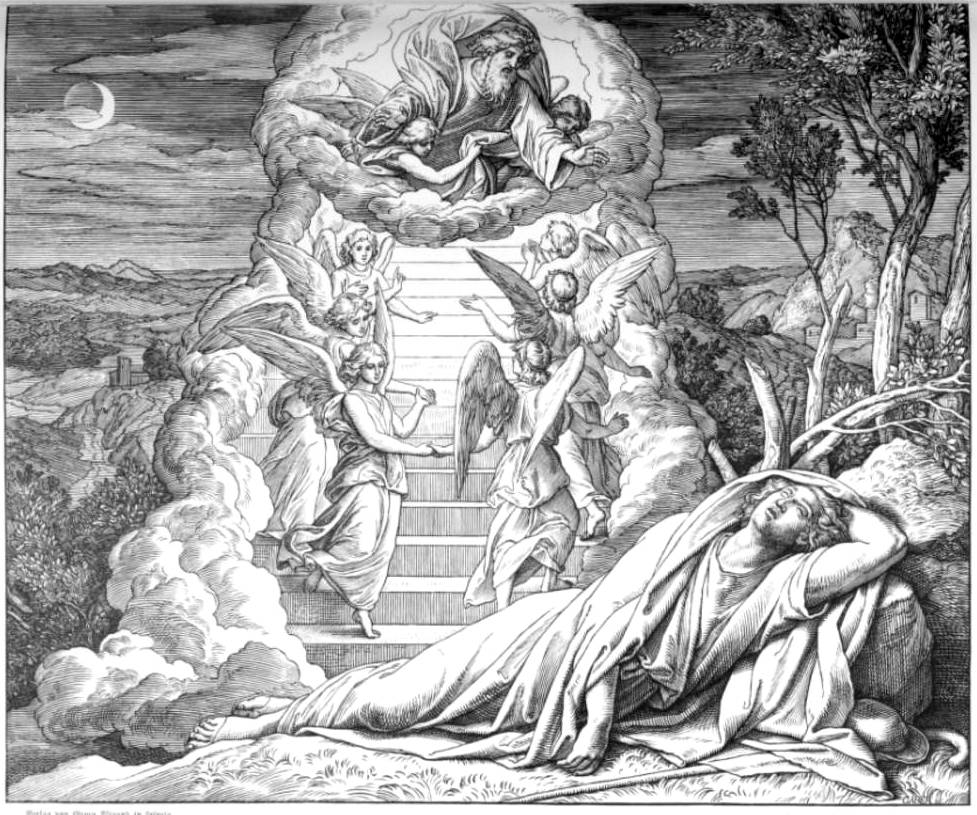
Jacob saw a stairway to heaven, with angels travelling up and down on it. He took that idea down into Egypt, and the Egyptians became obsessed with conquering the afterlife.
Egypt is where we want to live forever. It is a fantasy whose reality is always a moment away. The Egyptians wrote a book to help the newly dead navigate the afterlife. They didn’t know there was a shortcut. Neither did Jacob. The usher at the back door wouldn’t show himself until the New Testament.
Jacob built on Abraham’s discovery. Abraham knew there was a God, but that god was still distant. Heaven was not a place people could go. Our only afterlife was Sheol.
Jacob saw a way to heaven, but not for people, only for angels. On his deathbed, he only wanted to rest in Sheol, with his ancestors.
Jesus tells us that Abraham made it into heaven. He told a parable about a rich man begging the old Patriarch for water. The thing is, Abraham lived in a desert. Even in heaven, he didn’t have water to spare. If that rich man had only turned around, he would have noticed the criminal behind him, making it rain in that dry place. Or at least he would have, once Jesus was dead and in Hell with his faithful devil, Judas.
The Egyptians wanted to control the afterlife. They wanted to live amongst the gods, and they wanted to take all their stuff with them. According to Jesus, we can. He said that imagining a thing is the same as doing that thing. He was speaking about adultery, but we can apply the concept to everything; therefore, we can take our stuff to heaven, because our memories are the only things we take with us when we die. They are our treasures in heaven. If we held a gold bar in this life, the memory of that gold bar will follow us into heaven.
In that wonderful place, we will be judged, not so much by the talents we were given, but by the ways that we invested in them, and the experiences we gained from them.
Unlike Egypt, Sodom is the place where men wanted to have their way with the angels. Sodomites want heaven to be at their beck and call. It was in Sodom that we learned that everyone is our neighbor, and neighbors should share and share alike. What that means is, in heaven we will not only enjoy the fruit of our own experiences, but also those of our neighbors. We will all feast at the smorgasbord of billions of lives. That is the Jerusalem that Jesus was crucified in. He died as one of us, not one above us.
Egypt and Sodom have one thing in common. They both wanted to be masters of heaven, without first knowing the Master of Heaven. The Sodomites wanted to control the messages coming from heaven (the angels), and the Egyptians wanted control of the things going into heaven (themselves and all their stuff). In Jerusalem, where a sacrifice was made, those two places become one.
In New Jerusalem, we carry heaven inside us, and therefore all the world is heavenly. In that place, no one controls the messages coming from heaven, because we have a direct line to God that no one can interrupt.
9 For three and a half days some from every people, tribe, language and nation will gaze on their bodies and refuse them burial.
What does it mean to be buried? For most of us, it means to be put to rest. For Jacob, it meant joining his kin in a peaceful place. It meant not having to wander anymore. For us, it means not having to wonder. The place where we bury the witnesses is in our hearts (our heaven).
The voice of God is like a babbling brook. That means He speaks to us from many different philosophies, not just Jewish and Christian ones. He is everywhere, and His voice echoes from all corners of the world. Truth is all around us, not just between the pages of whatever Bible our particular church has adopted.
From crucifixion to ascension, Jesus was exposed for about three and a half days. By exposed, I mean that his body (his life) seemed like a waste until he rose from the dead and ascended into heaven.
To the disciples that loved and followed him, it seemed like they had bet on the wrong horse. Many of them went home in despair, because Jesus had turned out to be something other than what they expected. Don’t be too hard on them for their loss of faith. We humans tend to cover the lives of others in a blanket of our own expectations.
For example, we imagine all sorts of wonderful things for our children, from learning to walk, going to school, falling in love, getting married, and having babies of their own. We are only disappointed when our kids don’t live the life we fantasize for them.
It hurts us when they drop out of school, or choose not to get married, or die at a young age, because we think they deserve so much more life, but in fact, they are only living the life that is theirs to live – the one that was crafted for them by God. It is not ours to control. The best thing we can do, to spare ourselves injury, is to keep our hands (our expectations) off of their life. That doesn’t mean we shouldn’t guide them. It simply means we shouldn’t smother them with our pride.
The Old Testament speaks of God in the world. The New Testament tells of God in a man. Where Jesus took three days to die and ascend, Satan took three days to do the same. He fell into the world on day 1 of the Old Testament. On the 4th day, he ascended into the heavens as the false lights of the world: the Sun, the Moon, and the stars.
The physical mimics the spiritual, and vice versa. That is why parables can be such a powerful aid to our understanding, and why Revelation seems to speak of physical changes to the world.
10 The inhabitants of the earth will gloat over them and will celebrate by sending each other gifts, because these two prophets had tormented those who live on the earth.
Remember when our minds weren’t troubled by all of these mysteries? I guess it’s true what they say, that ignorance is bliss.
John Lennon dared us to imagine a world without heaven, and no hell, and above us only blue sky. He said it’s easy if we try, but some of us won’t take that dare. We don’t like to think of such things, because they pull us out of our comfort zone and force us to climb mountains.
But what if it was proven beyond a shadow of a doubt that Jesus was just a figment of Mary’s imagination? What if she created him to be a beacon to her people, who suffered under Roman occupation? And what if the story got away from her and became something so big the Jews couldn’t handle it, so it spilled over into the Gentile world?
Would you still love him if he never actually existed? Would his words still ring with truth? If you truly want to test your faith, you need to confront your belief with disbelief. You need to try yourself in fire, so that you can find your true gold. You need to cross some lines and play with dangerous ideas. With God on your side, they won’t really hurt you, but they might cause you considerable discomfort and a few nights of lost sleep.
What if Satan was your best friend, and you didn’t know it? Don’t we all want at least one friend who will tell us like it is, without any whitewashing? Surrounding ourselves with “yes men” is a foolish pursuit. Sure, choirs are nice, but the best, rowdiest arguments can’t happen without dissent. It’s those courses of discourse that fill up our eyes with truth, and truth should be our goal in all things.
Lucifer hides the scarier parts of God, only until we can handle them. The sheep in us wants to stay in the valley, but Satan urges us to climb the mountain, because it’s from the peak that we get the best view of the sunrise. Still, to a criminal, the prosecutor is the bad guy.
What if it was all made up? Without the concepts of heaven and hell, and without a God who expects more from us, life seems like a party. We’re in charge, and we can do as we like. We can send each other gifts, but what kind do you think John saw us passing back and forth?
Well, if our treasures in heaven are our experiences, then it makes sense that we would pass along those same valuables to others. We might point to moments in our lives when we believed our success was due entirely to our own skill.
Likewise, we might take complete responsibility for our own failures, because the veil over our eyes and the stumbling blocks at our feet would be hidden from us.
Surely you’ve tripped over something in your life, but didn’t know exactly what it was? I know I have. We call them carpet snakes. They were real enough to snag our toes, but not real enough for our eyes to see. When we encounter one, we tend to blame our clumsy feet. Likewise, we blame Satan for all of the bad things we do. But if he proved himself to be our ally, would we still say the Devil made us do it?
11 But after the three and a half days the breath of life from God entered them, and they stood on their feet, and terror struck those who saw them.
I wonder sometimes if these specific time frames were relevant only to John’s own journey through revelation. It’s true that both Jesus and Satan took three days and some change to fall, resurrect, and ascend, but John seems to be speaking of something else here.
Perhaps it took him three and a half days to reach the conclusion that I came to over a number of years? I can’t say. I do know that, if you’re an atheist who suddenly sees God, as Paul did on the road, it could be a terrible sight, mostly because of the realization that you have been living your life all wrong. Talk about a rude awakening.
Likewise, coming to grips with the truth that Jesus and Satan are on the same team, and that they are working in our best interests, is a hard row to hoe, but once it begins to produce, the fruit of that rocky soil makes quite a heady brew. Both grapes and coffee beans grow best in rocky soil, and both of the spirits they produce can be eye-openers.
12 Then they heard a loud voice from heaven saying to them, “Come up here.” And they went up to heaven in a cloud, while their enemies looked on.
We know what clouds are, and we know where heaven is. Therefore, it’s not hard to puzzle out the meaning of this verse. It is our voice that calls them home, and seats them on the throne of our heart. There is room in there for everyone, even the Devil. Remember that God didn’t berate or banish Satan. Instead, He took him for a walk and a talk. We should try to do the same.
One of the enemies of both Jesus and Satan is disbelief. If one is in front of us and the other behind, then turning to the side, away from them, is the quickest path to becoming lukewarm. It is better to turn from one to the other than to ignore them completely. But still, as we learned, being spat out isn’t so bad.
13 At that very hour there was a severe earthquake and a tenth of the city collapsed. Seven thousand people were killed in the earthquake, and the survivors were terrified and gave glory to the God of heaven.
This is the kind of verse that makes me think I’m wrong, and that Revelation is speaking of physical events, not spiritual ones. Except we know now that the city John is referring to is the conglomeration of Egypt, Sodom, and Jerusalem, and those places represent spiritual ideologies.
In this verse, because of the ground shaking under our feet, parts of those ideologies are falling apart. Remember that to become one with our beloved, we have to lose parts of ourselves. We must come to understand that heaven is not so much a destination as a feeling we carry inside us, and hell can occupy the same space. The only difference is our perspective.
Is our eye on Jesus, or Satan? Are we looking forward, or backward? Are we kicking ourselves for screwing up, or working hard to not screw up again? The contrast is life-changing.
It’s possible that the seven thousand who were killed are people we could have become if we had let our vanities continue to rule us. I don’t know for sure. I’m holding it up.
I do know that change of any kind can be terrifying. That’s why some people refuse to do it. We all like our comfort zones, but once we see the mountaintop, the valley never looks the same, and we only have ourselves to blame, since we are becoming one with the Son of God, who is God, and therefore we are destined to be God, too.
Our wounds, in essence, are self-inflicted.